Wire rope degradation presents a massive operational risk that affects site safety, compliance liability, and overall uptime. You cannot treat it simply as another routine maintenance box to check. Every heavy lift depends entirely on structural integrity. Unfortunately, frontline personnel often perform visual checks inconsistently. This inconsistency leads to severe consequences for the entire operation. First, you might discard perfectly good ropes prematurely, which heavily wastes valuable maintenance budgets. Alternatively, inspectors might miss hidden internal faults. Missing these faults dramatically increases the risk of catastrophic failure and severe workplace injuries. This article provides a standardized, evidence-based framework for lifting cable inspection. We will explore objective criteria for identifying wear, evaluating corrosion, and counting wire breaks. You will learn exactly how to interpret these critical degradation patterns so you can make confident, safe replacement decisions.
Key Takeaways
- A compliant wire rope inspection program relies on tracking cumulative degradation over time, not just pass/fail daily checks.
- Broken wire rope retirement criteria strictly depend on the equipment type (e.g., mobile cranes vs. overhead hoists) and the location of the breaks (valley vs. crown).
- Diameter reduction is the most objective indicator of wire rope wear; precise caliper measurements are required to track abrasive loss.
- Internal wire rope corrosion is the most dangerous form of degradation due to its hidden nature; surface rust requires close monitoring for pitting.
- Combining multiple minor degradation factors accelerates the timeline for wire rope replacement.
The Business Case for a Formal Wire Rope Inspection Program
Regulatory compliance forms the baseline of any operational safety strategy. You must adhere strictly to OSHA guidelines and ASME standards. The ASME B30 series governs most lifting equipment deployed across North America. Different industries demand specific regulatory frameworks. Mining operations must comply with MSHA standards. Maritime operations often follow distinct Coast Guard regulations. Non-compliance exposes your organization to immense legal liability. An ad-hoc approach to inspections simply does not hold up during an audit or post-incident investigation. You need a structured, formal program.
A successful wire rope inspection program looks distinctly different from casual observation. It delivers predictable maintenance schedules. It guarantees zero rigging-related safety incidents. It also produces meticulously auditable logs. Safety managers should use these logs to demonstrate proactive compliance. You achieve success when inspectors follow strict, standardized procedures. They must evaluate every asset using the exact same criteria. This eliminates guesswork. It removes subjective opinions from the safety equation.
We must acknowledge the inherent limits of standard visual inspections. Visual checks only catch external anomalies. They easily miss profound internal core damage. For critical or high-cycle applications, internal assessment becomes absolutely mandatory. We strongly recommend integrating magnetic rope testing (MRT). MRT serves as a specialized, nondestructive testing (NDT) solution. The MRT device induces a magnetic field around the rope. It measures magnetic flux leakage to identify internal broken wires and hidden corrosion. You cannot rely on eyesight alone for high-stakes lifting operations.
Assessing Broken Wire Rope: Retirement Criteria and Patterns
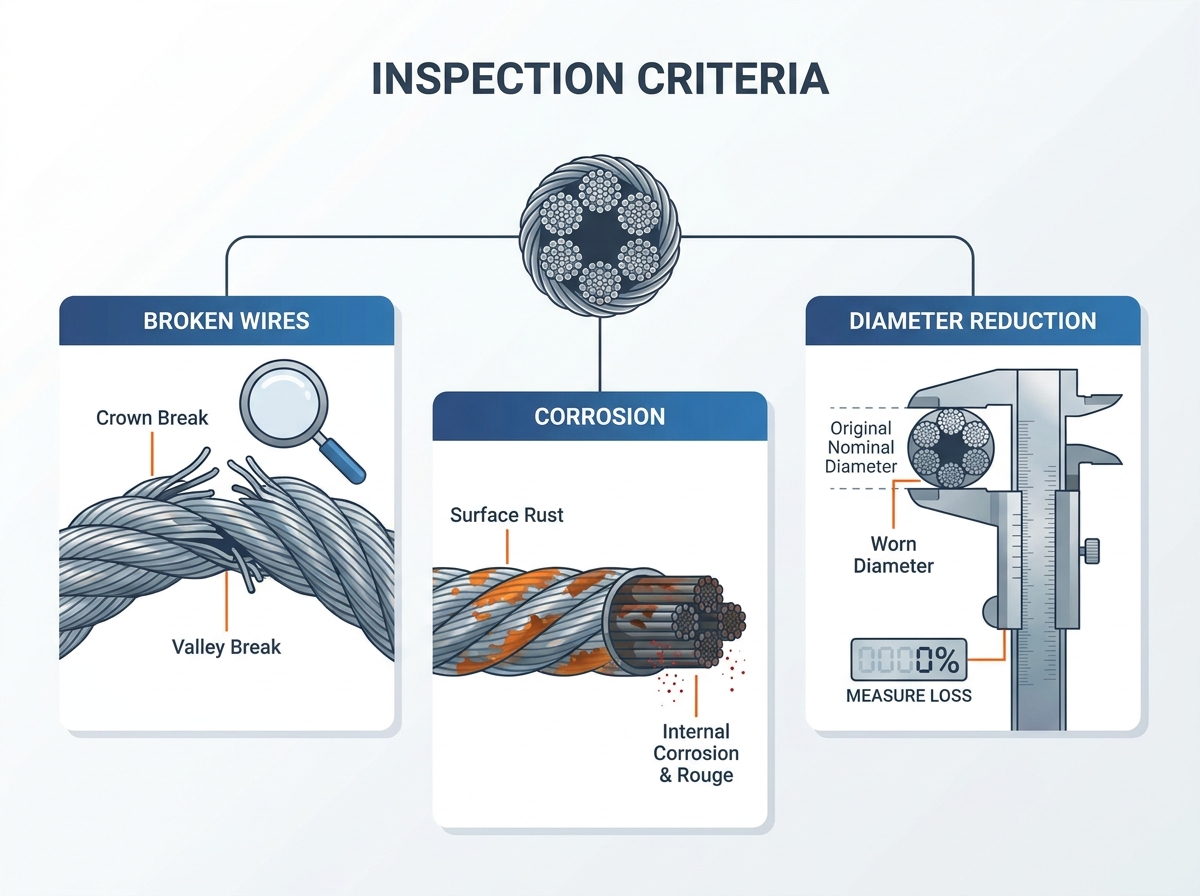
Inspectors must clearly distinguish between crown breaks and valley breaks. Crown breaks happen from normal bending fatigue. You see them on the outer surface of the strands. They occur as the rope repeatedly bends over sheaves and drums. Valley breaks represent a much more critical structural warning. They occur deep between the individual strands. A valley break usually indicates severe internal core degradation or collapse. Finding even a single valley break requires immediate attention. It often mandates instant retirement of the asset.
Counting protocol requires an objective, standardized method. You must count broken wires per lay length. A lay length is the longitudinal distance it takes one strand to make a complete revolution around the core. Inspectors absolutely must know the specific standard governing their specific equipment. For instance, crane rope inspection under ASME B30.5 uses completely different thresholds than overhead hoists evaluated under ASME B30.2. Mobile cranes generally allow fewer broken wires before retirement. You cannot apply a universal rule across all machinery types.
Evaluate the distribution patterns of any breaks you find. Isolated breaks happen naturally over time. Localized clustering signals extreme trouble. You must investigate clusters immediately. When multiple breaks occur within a highly concentrated area, it indicates severe localized stress. This often points to sheave misalignment, improper spooling, or a localized crushing event. Uniform distribution suggests standard end-of-life fatigue. Clusters suggest an active mechanical problem destroying the rope. Document the exact location of a broken wire rope to track spreading patterns.
Evaluating Wire Rope Wear: Measuring Diameter Reduction
Measuring diameter reduction requires a strict, objective methodology. Wire rope wear changes the physical dimension of the asset. You must measure correctly to track this change accurately. Use properly calibrated calipers. Always measure across the extreme outer crowns of the strands. Never measure across the valleys. Placing caliper jaws in the valleys yields a false, artificially smaller reading. We recommend taking three measurements at the same location. Rotate the calipers slightly each time. Record the largest reading as the true diameter.
You must differentiate between normal abrasive wear and peening. Abrasive wear actively removes metal. It happens naturally as the rope drags against sheaves, drums, and surrounding structures. Peening displaces metal without necessarily removing it. The outer wires flatten out from high-pressure contact or pounding. Peening often makes the rope look shiny and flat. It hardens the steel surface, which makes it brittle. Brittle steel eventually cracks, leading directly to premature fatigue breaks.
Establishing an accurate baseline is paramount for wear tracking. Nominal diameter only gives a general, catalog size. You must measure and record the actual diameter of the rope before placing it into service. A newly manufactured rope often measures slightly larger than its nominal designation. Always compare future wear readings against this true, actual baseline. If you use the nominal size as your baseline, you will miscalculate the percentage of diameter reduction entirely.
Comparison: Abrasive Wear vs. Peening
| Characteristic | Abrasive Wear | Peening |
| Mechanism | Metal is physically ground away via friction. | Metal is displaced and flattened by impact/pressure. |
| Visual Appearance | Smooth, worn down outer crowns. | Shiny, hammered, flattened outer wires. |
| Impact on Steel | Reduces cross-sectional area and strength. | Causes work-hardening, making wires highly brittle. |
| Common Causes | Normal operation over sheaves, dragging on surfaces. | Pounding on drums, improper fleet angles, crushing. |
Identifying Wire Rope Corrosion: Surface vs. Internal Degradation
Internal corrosion represents the ultimate hidden threat to lifting equipment. It often degrades the core rapidly without displaying obvious external signs. The outside might look perfectly fine. Meanwhile, the inside slowly rots away. Wire rope corrosion compromises the core's ability to support the outer strands. When the core collapses, the outer strands bear uneven loads. This leads to sudden, catastrophic failure during a lift. You must treat corrosion seriously. Environments near saltwater, chemical plants, or extreme humidity require heightened vigilance.
Distinguish carefully between surface rust and deep pitting. Benign surface oxidation often occurs on exposed steel. You can usually wipe it away with a rag or wire brush. Proper lubrication easily mitigates simple surface rust. Pitting acts entirely differently. It physically eats away at the steel. It creates microscopic craters on the wire surface. These craters concentrate stress. They significantly compromise structural wire strength. Once pitting begins, lubrication cannot reverse the structural damage. You must evaluate the depth of the pitting to determine safety.
Instruct all inspectors to look closely for rouge. Rouge appears as a distinct, red metallic dust. It emerges directly from the valleys between strands. Rouge serves as a primary, undeniable indicator of internal core deterioration. It forms when internal wires lose lubrication. They rub aggressively against one another. This internal fretting produces microscopic steel particles. These particles oxidize rapidly, creating the red dust. When you see rouge, you must assume severe internal damage exists.
Implementation: Setting Up Your Lifting Cable Inspection Routine
Structure your inspection routines logically. You must separate frequent checks from periodic inspections. Frequent inspections happen daily or at the start of every shift. A designated "competent person" usually performs them. They look primarily for obvious, glaring damage. They check for severe kinking, birdcaging, or sudden broken wires. Periodic inspections happen less frequently. They occur monthly, quarterly, or annually. A highly trained "qualified person" executes them. Periodic inspections involve deep, documented evaluation of diameter reduction, internal wear, and compliance thresholds.
Focus heavy scrutiny on targeted inspection zones. Certain areas suffer accelerated degradation. Highlight termination points. Examine wedge sockets, swaged fittings, and thimble eyes closely. These anchor points endure immense stress concentrations. Check the specific sections passing repeatedly over sheaves and drums. Bending fatigue peaks in these active zones. Finally, inspect any segments exposed to harsh environmental conditions. Look at areas resting in water, exposed to chemical fumes, or subjected to extreme weather. You must prioritize these high-risk areas.
Undocumented inspections create immense operational risk. A robust program requires accurate historical tracking. You cannot rely on memory. Record every measurement, break count, and rust observation in a standardized log. Historical tracking allows you to calculate the precise rate of degradation. Once you know the rate, you can accurately forecast replacement needs. This forecasting prevents unexpected downtime. It allows procurement teams to order specific OEM replacements ahead of time. Documentation proves your commitment to safety during regulatory audits.
Wire Rope Replacement: Making the Final Decision
Make the final call based on comprehensive evidence. Understand the cumulative effect of minor defects. A rope might technically pass individual thresholds. It might have acceptable breaks. It might show minimal wear. It might have slight rust. However, combining multiple marginal defects rapidly accelerates the failure timeline. The interaction between wear, rust, and fatigue creates a compounding hazard. When you observe a combination of these factors, the asset becomes fundamentally unsafe. This combination strictly mandates early retirement.
Shortlist your immediate next steps once you condemn a rope. First, transition from evaluation to action. Tag out the equipment immediately. Prevent any further use. Lock it out securely. Next, select the correct replacement. You must match OEM specifications exactly. Do not substitute core types, lay directions, or nominal diameters without engineering approval. Install the new rope using proper spooling techniques under tension. Finally, update the asset's inspection log. Mark the old rope as destroyed and record the new rope's installation date and baseline diameter.
Treat wire rope replacement as a critical investigative opportunity. Do not treat it as the final step. Encourage safety managers to address underlying root causes. Did misaligned sheaves cause excessive wear? Did improper drum spooling crush the rope? Did inadequate or incorrect lubrication lead to internal rust? Fix these root problems immediately. If you ignore the root cause, you will simply destroy the brand-new rope in the exact same manner. Proactive problem-solving extends the lifespan of your heavy equipment.
Conclusion
Wire rope inspection serves as a vital evidence-gathering process. It helps you balance operational longevity with uncompromising site safety. You cannot afford to rely on subjective guesses when evaluating heavy lifting assets. Objective measurement of wear, precise counting of broken wires, and early identification of internal corrosion will prevent catastrophic failures.
To secure your operations, follow these key steps immediately. First, audit your current inspection documentation to ensure it tracks historical degradation accurately. Second, train your frontline teams to distinguish between minor surface rust and critical internal rouge. Third, enforce strict use of calipers to measure actual diameter reduction. Finally, consult with certified rigging professionals if your in-house evaluation criteria lack objective thresholds. Actionable, standardized routines keep your personnel safe and your projects moving forward.
FAQ
Q: How often does crane wire rope need to be inspected?
A: A competent person must perform a visual inspection daily or before each shift. A qualified person must conduct a comprehensive, documented periodic inspection at least annually. Severe usage or harsh environments mandate more frequent periodic inspections, often monthly.
Q: Who is legally qualified to perform a wire rope inspection?
A: OSHA and ASME distinguish between personnel. A "competent person" handles daily visual checks. They possess enough knowledge to identify obvious hazards. A "qualified person" handles periodic inspections. They possess a recognized degree, certificate, or extensive professional standing to evaluate structural integrity and regulatory thresholds.
Q: Can you repair a broken wire rope?
A: No, you cannot repair individual broken wires or splice a damaged section. You can only cut out the damaged section if the remaining length meets operational requirements and complies with OEM specifications. Otherwise, you must replace the entire assembly.
Q: What is the maximum allowable diameter reduction for wire rope wear?
A: As a general rule, ropes should be retired when the diameter reduces by more than 5% from nominal. However, you must consult specific ASME/OSHA tables. The exact allowable reduction varies significantly based on nominal size and equipment type.

 English
 العربية
 Français
 Русский
 Español
 Português
 Deutsch
 italiano
 日本語
 한국어
 Nederlands
 Tiếng Việt
 ไทย
 Polski
 Türkçe
 አማርኛ
 ພາສາລາວ
 ភាសាខ្មែរ
 Bahasa Melayu
 ဗမာစာ
 தமிழ்
 Filipino
 Bahasa Indonesia
 magyar
 Română
 Čeština
 Монгол
 қазақ
 Српски
 हिन्दी
 Slovenčina
 Slovenščina
 Norsk
 Svenska
 українська
 Ελληνικά
 Suomi
 Հայերեն
 עברית
 Dansk
 اردو


