A rigging turnbuckle serves as a fundamental precision adjustment tool. Professionals rely on it daily to take up slack. You can apply exact tension across various rope, cable, and chain assemblies. We are discussing physical, heavy-duty load-bearing hardware here. Do not confuse this topic with skeletal 3D software animation terminology. Safety managers, marine technicians, and heavy-industry riggers all face the same critical responsibility on the job. Selecting the right components dictates overall worksite compliance. One wrong fitting can easily trigger a catastrophic structural failure. This guide breaks down essential applications, end-fitting selection protocols, material durability factors, and governing safety standards. By understanding these mechanical nuances, you will establish highly secure load management systems. You will learn how to maintain safety and keep your crews protected across every heavy-lifting project.
Key Takeaways
- Turnbuckles are essential tension hardware used to eliminate slack, balance loads, and fine-tune wire rope assemblies.
- Selection depends entirely on the application; overhead lifting requires specific end fittings (like jaws or eyes) rather than hooks.
- Material choice dictates lifespan: a galvanized turnbuckle offers cost-effective industrial strength, while stainless steel provides maximum marine-grade corrosion resistance.
- OSHA compliance dictates strict adherence to Working Load Limits (WLL) and mandatory pre-use visual inspections for thread deformation or fatigue.
Core Mechanics: The Role of a Cable Tensioner in Rigging
Achieving exact tension represents a major business problem across industrial environments. Static and dynamic systems require precise adjustments. Manual pulling simply cannot reach the high tension levels required for safety. Without a dedicated cable tensioner, operators struggle to secure structural supports. A loose cable compromises tower integrity. It causes unstable lifting operations.
Understanding the Mechanical Advantage
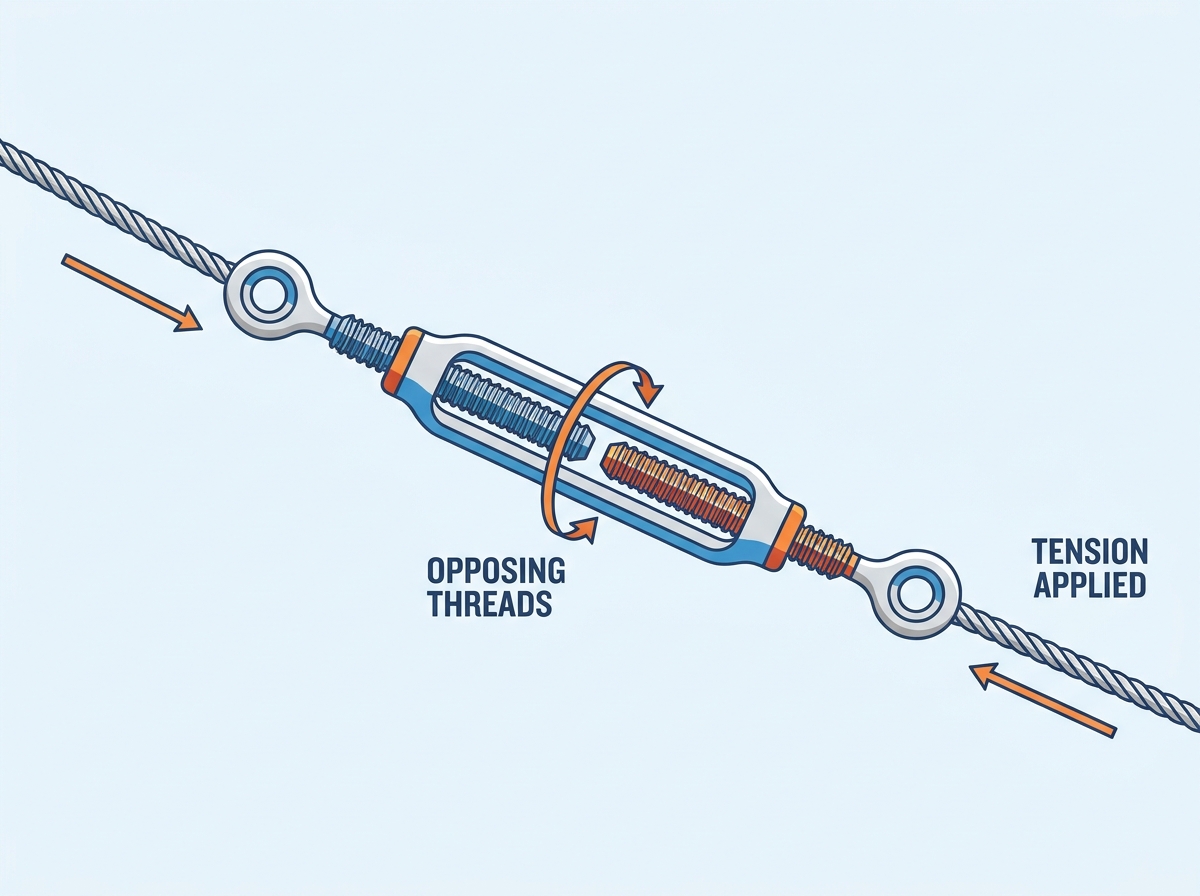
The genius of this specific tension hardware lies in its internal engineering. The central body features two threaded ends. One end uses a right-hand thread. The opposite end utilizes a left-hand thread. This opposing design creates a massive mechanical advantage.
When you rotate the central body, it simultaneously draws both end fittings inward. You push the ends outward by rotating the body in the opposite direction. This mechanism offers several distinct operational benefits:
- Zero Cable Twist: You can adjust tension without twisting the attached wire rope. Twisting compromises cable core strength.
- Micro-Adjustments: Operators can dial in millimeter-accurate lengths. This proves vital for precision engineering tasks.
- Controlled Force Application: The mechanical leverage allows a single user to apply hundreds of pounds of tension easily. You do not need secondary pulling machines.
The Necessity of Load Balancing
Load balancing is a critical requirement in multi-point suspension systems. Imagine a heavy steel plate suspended by four cables. If one cable is even slightly shorter, it carries disproportionate weight. This scenario creates a dangerous single-point failure risk. A turnbuckle placed inline on each cable solves this problem. Riggers rotate each unit individually. They carefully equalize the tension across all four suspension points. This micro-adjustment ensures proper load distribution. It prevents any single component from exceeding its rated capacity.
Primary Applications Across Rigging Sectors
Different industries utilize tensioning devices for highly specific purposes. The core mechanics remain identical. However, the operational demands vary wildly. You must select the proper rigging hardware based on your sector.
Industrial and Construction Sites
Heavy construction demands rugged, uncompromising equipment. Turnbuckles secure structural steel bracing during building erection. They hold temporary concrete forms in place. Tower construction heavily relies on them. Guy wires route from communication towers to ground anchors. Technicians use massive turnbuckles to tension these guy wires. This keeps towers perfectly plumb against high winds.
- Securing temporary scaffolding structures.
- Tensioning long-span conveyor belt support cables.
- Providing lateral stability for large-scale steel framework.
Marine and Sailing Environments
Sailors and marine technicians battle constant dynamic loads. They also fight severe saltwater corrosion. Turnbuckles tension the standing rigging on sailboats. This includes the shrouds and stays supporting the mast. Cargo ships use them to secure heavy deck cargo. Lashed equipment must survive violent ocean swells without shifting. Marine applications require specific materials to prevent rapid degradation.
Entertainment and Event Rigging
Live events demand absolute overhead safety. Production teams suspend heavy lighting trusses above crowds. They fly massive line-array speaker systems. In this sector, static load security heavily outweighs dynamic adjustment needs. Riggers set the exact trim height. They then lock the turnbuckles securely. Safety managers strictly prohibit temporary hooks here. They mandate enclosed hardware to guarantee nothing slips out during a live show.
Architectural and Consumer Projects
Modern architecture frequently incorporates exposed tension structures. You see them in sleek cable railings. They support pedestrian suspension bridges. Tensile fabric roof structures depend on precise tensioning. Here, load capacity remains critical. However, aesthetic profile also matters. Architects specify polished stainless steel units. These provide structural safety while looking intentionally designed.
Evaluating Turnbuckle End Fittings for Specific Loads
Hardware configuration dictates safety. You cannot use a universal approach when selecting end fittings. The connection points entirely guide your decision-making process. Choosing the wrong end fitting introduces immediate failure risks.
Hardware Configuration Guidelines
End Fitting Application Comparison
| Fitting Type | Primary Characteristic | Best Use Case | Overhead Lifting? |
| Jaw-to-Jaw | U-shaped opening, pin and cotter key | Fixed anchor points, thick steel plates | Yes (Enclosed) |
| Eye-to-Eye | Solid, fully enclosed loop | Use with shackles or rope thimbles | Yes (Highly Secure) |
| Hook-to-Hook | Open hook design | Temporary tensioning, quick release | No (Never permitted) |
| Hook-to-Eye | Hybrid open/closed | One fixed point, one temporary point | No (Never permitted) |
Jaw-to-Jaw Fittings
A jaw fitting features a U-shaped opening. It contains a removable pin secured by a cotter key. This design works best for connecting to fixed anchor points. You can easily slip the jaw over a thick steel mounting plate. You insert the pin. You lock it in place. It creates a highly secure, semi-permanent connection. Jaws articulate well under load. They prevent binding when angles shift slightly.
Eye-to-Eye Fittings
An eye fitting consists of a solid, fully enclosed loop. You pair them directly with shackles. You can also thread wire rope thimbles through them. The enclosed loop guarantees the connection cannot slip out. This physical enclosure makes the eye-to-eye configuration standard for any lifting turnbuckle. If tension momentarily drops, the shackle remains captured inside the eye.
Hook-to-Hook and Hook-to-Eye Fittings
Hooks provide rapid deployment. They slip easily over cables or rings. You use them for quick-release applications. They handle temporary tensioning tasks excellently. You might use them to tie down equipment in a truck bed. However, a critical caveat exists. You must never use hooks for overhead lifting operations. If a lifted load bounces, tension decreases for a split second. An open hook can easily dislodge. The load will drop instantly.
Material Selection: Galvanized Turnbuckle vs. Stainless Steel
Material choice dictates the lifespan of your hardware. Riggers must balance environmental demands against procurement budgets. You primarily choose between hot-dip galvanized steel and stainless steel.
Cost vs. Environment Matrix
Evaluate your job site conditions carefully. Will the hardware face saltwater? Will it encounter acidic industrial chemicals? Will it sit indoors in a climate-controlled warehouse? Answering these questions clarifies your material strategy.
Drop-Forged Galvanized Steel
A galvanized turnbuckle provides massive industrial strength. Manufacturers forge the body from high-carbon steel. They then dip the completed hardware into molten zinc. This zinc coating sacrifices itself to protect the underlying steel from rust. Galvanized units are highly cost-effective. They serve as the undisputed standard for heavy construction. They excel in non-corrosive outdoor environments. If you need maximum brute strength on a budget, galvanized hardware wins.
Stainless Steel (Type 316)
Type 316 stainless steel contains molybdenum. This alloy addition drastically improves resistance to chlorides. Stainless steel requires a higher upfront cost. It also carries a slightly lower Working Load Limit (WLL) compared to galvanized steel of the exact same diameter. However, stainless is completely essential for marine environments. It survives severe chemical exposure. Architects specify it for visual projects requiring permanent rust resistance. It never requires protective painting.
Decision Logic for Procurement
We recommend a simple decision logic tree. Choose galvanized steel for heavy industrial lifting. Use it where brute strength and budget rule. You should accept that the zinc coating may eventually weather. Choose stainless steel for harsh elements. Use it near the ocean. Deploy it when long-term maintenance access is difficult or impossible.
OSHA Compliance, Implementation Risks, and Inspection Standards
Safety regulations are written in blood. The operational risks of turnbuckle failure are severe. A broken body can drop catastrophic loads. It can collapse a multi-ton broadcast tower. OSHA compliance is a legal necessity. It protects human life.
Mitigating Operational Risks
You mitigate risk through strict adherence to Working Load Limits. You must calculate the exact tension required. You must account for dynamic shock loads. A gust of wind multiplies the force on a guy wire significantly. Your hardware must handle these sudden spikes without deforming.
Understanding Working Load Limit (WLL)
Every piece of structural hardware possesses a rated Working Load Limit. You must never load a turnbuckle beyond this specified limit. Furthermore, rigging assemblies operate as chains. The weakest link dictates the overall capacity. The WLL of your wire rope turnbuckle must match or exceed the lowest-rated component in the entire assembly. Do not pair a 10,000-pound turnbuckle with a 2,000-pound shackle and expect a 10,000-pound capacity.
Securing the Turnbuckle System
Dynamic loads create vibration. Constant vibration causes threaded components to unscrew over time. You must actively secure the turnbuckle body after setting the final tension. Many units feature lock nuts. You tighten these nuts against the main body to prevent rotation. Alternatively, riggers use safety mousing. They wrap heavy-duty safety wire through the end fittings and around the central body. This physical barrier stops the unit from unwinding.
Strict Inspection Criteria
OSHA standard 1926.251 dictates strict rules for material handling equipment. Competent personnel must conduct pre-use visual inspections. You must remove any compromised hardware from service immediately. Use this shortlist of mandatory rejection criteria:
- Cracked or Bent Bodies: Any visible deformation compromises structural integrity.
- Deformed Threads: Stripped or flattened threads cannot hold tension safely.
- Elongated Eyes: If an eye fitting stretches into an oval shape, it has exceeded its yield strength.
- Deep Gouges: Deep scratches create stress risers where future cracks will initiate.
- Missing Manufacturer Marks: Hardware lacking clear WLL and manufacturer identification is automatically non-compliant.
Conclusion
Selecting the right hardware goes far beyond simply grabbing the nearest threaded tool. You must balance the necessary load capacity against environmental demands. You must choose appropriate end-fittings based entirely on whether you are lifting loads or securing static lines.
Take actionable steps before your next project begins. Consult manufacturer load charts thoroughly. Verify all material certifications to ensure true marine-grade or drop-forged quality. We strongly advise contacting a certified rigging supplier. Have them audit your tension hardware requirements before procurement. Proper planning keeps your work site compliant. It protects your equipment. Most importantly, it keeps your crew safely out of harm's way.
FAQ
Q: Can you use a hook-end turnbuckle for overhead lifting?
A: No. You must never use open hooks for overhead lifting. If the load shifts or bounces, tension momentarily decreases. An open hook can easily dislodge from its connection point. This results in an immediate, catastrophic dropped load. You must specify enclosed eye or jaw fittings for any lifting operations.
Q: What is the difference between a wire rope turnbuckle and a come-along?
A: Turnbuckles serve static tensioning needs. They provide permanent micro-adjustments for stabilizing loads or guy wires. A come-along acts as a dynamic ratcheting puller. You use a come-along temporarily to drag heavy objects or hoist loads into position. You do not leave a come-along permanently installed in a structural system.
Q: How much of the turnbuckle thread must remain inside the body?
A: Industry standards dictate that all threaded portions must fully engage within the body to maintain the Working Load Limit. Over-extending the ends past the internal threads severely weakens the connection. You risk pulling the threads completely out under heavy tension.
Q: Why do turnbuckles have a left-hand and a right-hand thread?
A: Opposing threads provide a vital mechanical advantage. Rotating the central body draws both end fittings inward simultaneously. This allows you to tighten the assembly without twisting the attached wire rope. Twisting compromises cable strength and causes dangerous rotational torque.

 English
 العربية
 Français
 Русский
 Español
 Português
 Deutsch
 italiano
 日本語
 한국어
 Nederlands
 Tiếng Việt
 ไทย
 Polski
 Türkçe
 አማርኛ
 ພາສາລາວ
 ភាសាខ្មែរ
 Bahasa Melayu
 ဗမာစာ
 தமிழ்
 Filipino
 Bahasa Indonesia
 magyar
 Română
 Čeština
 Монгол
 қазақ
 Српски
 हिन्दी
 Slovenčina
 Slovenščina
 Norsk
 Svenska
 українська
 Ελληνικά
 Suomi
 Հայերեն
 עברית
 Dansk
 اردو


