Securing masts, lifelines, and structural components requires precise tensioning. A single point of failure can easily compromise your entire system. This hardware literally holds the boat together during rough seas. Buyers constantly navigate a saturated market filled with varying metal grades, structural designs, and load ratings. Marketing claims often obscure actual working load limits. Making the wrong choice risks catastrophic failure and severe safety hazards. We aim to provide a rigorous, evidence-based framework for your procurement process. You will learn how to evaluate, shortlist, and procure the exact equipment you need for specific aquatic environments. Let us dive into the technical realities of selecting a highly reliable marine turnbuckle.
Key Takeaways
- Material dictates lifespan: 316 stainless steel offers superior corrosion resistance, while hot-dipped galvanized steel provides higher impact strength and cost-efficiency for heavy-duty, non-aesthetic applications.
- Visibility vs. Protection: Open-frame designs allow for rapid visual inspection of thread engagement, whereas bottle-style (closed) bodies prevent snagging but obscure internal wear.
- Load ratings are non-negotiable: Procurement must be based on Working Load Limits (WLL) with appropriate safety factors, never on ultimate breaking strength alone.
- Maintenance is mandatory: Thread galling and metal fatigue are the primary causes of failure; proactive lubrication and strict "reuse vs. replace" inspection criteria are essential.
Framing the Procurement Problem: The Realities of Marine Rigging
Marine environments subject wire rope hardware to constant cyclical loading. Components endure vibration and shock loads from severe wind and wave action. These immense forces accelerate metal fatigue rapidly. Rigging components never sit static; they flex and vibrate constantly under tension. Buyers must understand how these physical stresses impact material choices. Ignoring dynamic loads usually leads to premature hardware failure.
Continuous exposure to chlorides creates an incredibly hostile environment. Saltwater aggressively attacks standard metals. This exposure leads to rapid pitting and severe crevice corrosion. Dissimilar metals suffer from galvanic corrosion if they are improperly paired. Moisture trapped in threads accelerates structural decay. You must select alloys boasting superior corrosion resistance for long-term safety.
A successful procurement decision balances several critical elements. You must achieve required tensile strength without sacrificing environmental survivability. Maintenance accessibility remains equally important for regular safety checks. Regulatory compliance ensures the vessel meets stringent safety standards. Relying solely on aesthetic appeal often leads to dangerous procurement mistakes.
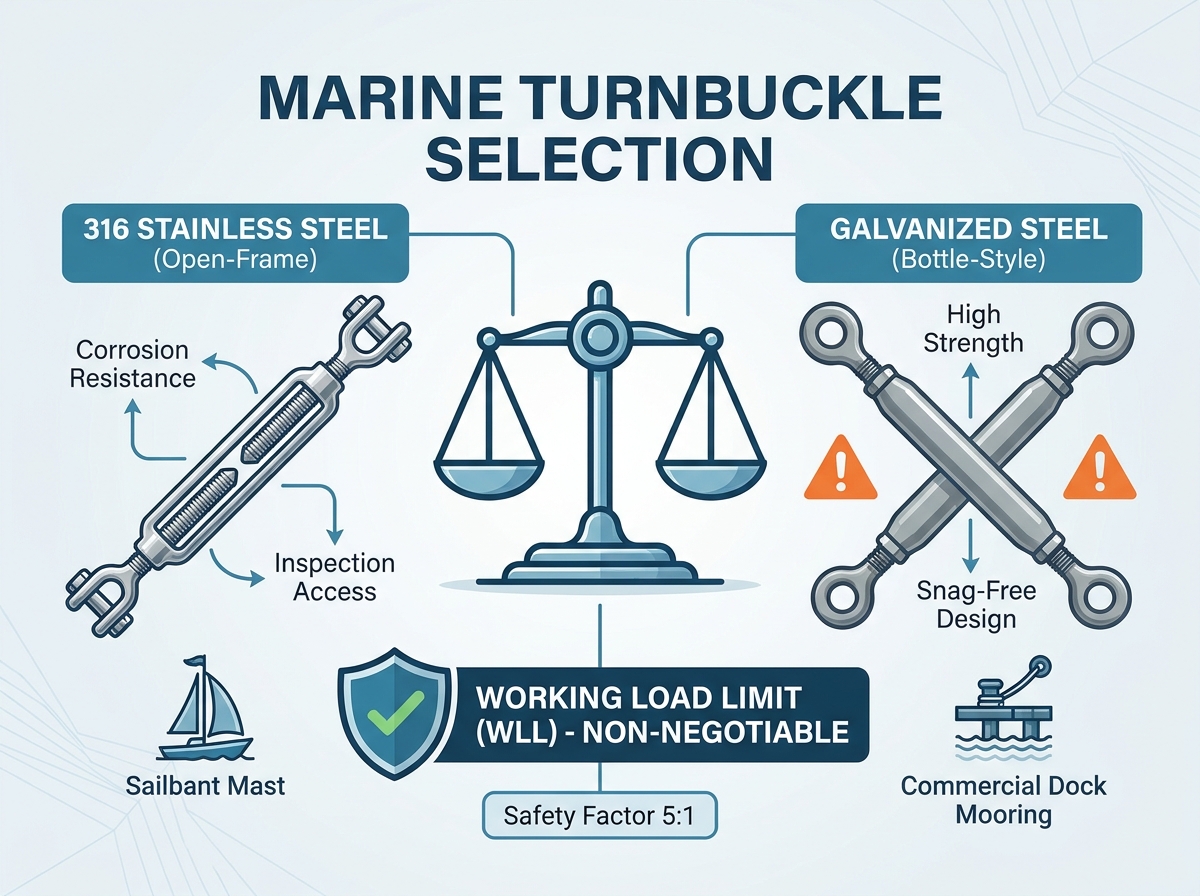
Solution Categories: Material and Structural Configurations
Stainless Turnbuckle vs. Galvanized Turnbuckle
Type 316 stainless steel remains the absolute industry standard for saltwater environments. It offers maximum protection against rust and chloride pitting. A stainless turnbuckle delivers excellent aesthetic appeal for highly visible topside rigging. Many sailboat owners prefer this pristine look. However, stainless steel carries specific trade-offs. The metal exhibits high susceptibility to thread galling under extreme tension. Heavy loads can literally weld the threads together permanently.
Hot-dipped galvanized steel serves entirely different applications perfectly. It dominates heavy commercial rigging, dock stabilization, and submerged moorings. A galvanized turnbuckle provides exceptional structural durability and impact resistance. The thick zinc coating sacrifices itself to protect the underlying steel. Eventually, this zinc coating wears away. Once depleted, the initial rust protection drops significantly. Yet, for massive structural tensioning, they remain incredibly reliable and highly practical.
Open-Frame vs. Bottle-Style (Closed Body)
Open-frame designs typically utilize a robust bronze or stainless body. They expose the internal threads completely to the elements. This advantage allows riggers to verify thread engagement instantly. You can easily inspect the metal for dangerous micro-cracks before they propagate. Premium versions often pair a chromed-bronze body alongside stainless steel terminals. Mixing these distinct metals effectively prevents destructive thread galling entirely.
Bottle-style designs encase the critical threads inside a tubular metal body. They create an aerodynamic, snag-free profile. This closed design works ideally for active running rigging or busy foot-traffic areas. Ropes and sails simply glide past the smooth exterior. The major risk involves trapped moisture. Saltwater sneaks inside the tube and silently degrades the hidden threads. You must disassemble them regularly for essential safety inspections.
Table 1: Comparison of Material and Body Configurations
| Configuration Type | Primary Advantage | Major Vulnerability | Best Use Case |
| 316 Stainless Steel | Maximum rust protection | Thread galling (cold welding) | Topside sailboat rigging |
| Hot-Dipped Galvanized | High impact strength | Zinc coating degradation | Commercial docks and moorings |
| Open-Frame Body | Instant visual inspection | Exposed threads catch debris | Permanent standing rigging |
| Bottle-Style Body | Snag-free, aerodynamic profile | Traps hidden moisture internally | High foot-traffic areas |
Core Evaluation Dimensions: Load Ratings and Hardware Compatibility
Working Load Limits (WLL) vs. Breaking Strength
Buyers must strictly avoid the dangerous metric trap during procurement. Unreliable vendors frequently advertise only the "Breaking Strength" to impress uninformed buyers. Breaking strength merely indicates the exact force causing catastrophic failure. You should never subject any hardware to loads approaching this ultimate limit. Procurement decisions must rely entirely on verified Working Load Limits (WLL).
Standard marine applications demand a rigorous safety factor for all tensioning hardware. Most regulatory bodies mandate a minimum 5:1 safety factor. This rule means the ultimate breaking strength equals five times the Working Load Limit. Choosing the proper cable tensioner requires understanding these ratios deeply. Critical overhead lifting operations often demand even higher safety margins. Verify the safety factor mathematics before finalizing any bulk hardware purchases.
End Fitting Selection for Wire Rope Hardware
Jaw/Jaw (often called fork) fittings securely attach hardware to fixed anchor points. These points include sturdy chainplates or deck pad eyes. They require a specific clevis pin secured firmly by a cotter ring. This setup offers incredible lateral strength for heavy side loads. Riggers favor this specific fitting for permanent standing rigging applications.
Eye/Eye fittings seamlessly connect to standard rigging shackles. They provide an exceptionally secure, closed-loop connection point. This design completely eliminates accidental detachment under shifting loads. However, they lack the fast-release functionality found in jaw fittings. Integrating them smoothly into existing wire rope hardware requires careful shackle sizing and pin alignment.
Hook/Hook fittings serve temporary tensioning needs exclusively. They work well for lashing cargo or temporarily securing loose gear. You should never use hooks for permanent vessel rigging. When lines go slack momentarily, hooks easily detach from their anchor points. This rapid detachment creates a severe safety hazard during turbulent weather conditions.
Implementation Risks and Lifecycle Management
Mitigating Thread Galling (Cold Welding)
Thread galling represents a massive risk for any stainless steel tensioning component. When riggers apply high tension, the immense friction generates sudden heat. The stainless steel threads actually fuse together molecularly. We call this destructive process cold welding. Once galled, the threads lock permanently. You must cut the destroyed hardware away using specialized metal saws.
Preventing this costly disaster requires strict installation protocols. You must mandate the application of marine-grade anti-seize lubricants. Products like Lanocote or Tef-Gel insulate the metal surfaces effectively. Riggers must apply these thick pastes generously during initial installation. They should reapply the lubricant during any seasonal rig adjustments. Proper lubrication guarantees smooth, safe adjustments for years.
Inspection Criteria: Reuse vs. Replace
Visual indicators clearly dictate immediate hardware replacement. Look closely for slightly bent threaded terminals. Check for visibly elongated eye fittings or splayed jaw components. Any physical deformation means the metal has surpassed its safe yield strength. Ignoring these obvious warnings invites catastrophic failure during the next heavy storm.
Thread integrity requires constant physical testing during maintenance routines. You should try turning the body smoothly by bare hand before applying final tension tools. If it sticks, catches, or binds up, the internal threads are compromised. Damaged threads cannot hold their rated loads safely. Throw away sticky hardware immediately.
Age and cyclical fatigue secretly destroy metal integrity over time. Stainless steel components suffer microscopic stress fractures under constant wave action. Even without visible rust, they weaken significantly. Industry experts recommend replacing heavily used marine rigging components every 10 to 15 years. Usage intensity ultimately dictates the exact replacement schedule.
Shortlisting Logic and Next Steps
Following a structured process guarantees safe, reliable equipment procurement. Jumping straight to aesthetic choices often ends poorly. You must analyze environmental demands and mechanical loads simultaneously. Implement these chronological steps carefully to narrow down your hardware options efficiently.
- Step 1: Define the Load. Calculate the maximum expected dynamic force precisely. Apply the mandatory 5:1 safety factor directly to this number. This mathematical calculation determines your required Working Load Limit accurately.
- Step 2: Match the Environment. Select 316 stainless alloys exclusively for topside sailboat rigging. Opt for heavy-duty galvanized components for submerged moorings. Commercial dock stabilization projects also demand galvanized steel for maximum impact resistance.
- Step 3: Verify Compatibility. Ensure the chosen clevis pin diameters perfectly match your existing chainplates. Measure the wire rope terminals meticulously. Even a tiny mismatch causes dangerous point-loading on the connecting pins.
Actionable Next Step: Never finalize bulk orders blindly. Request certified load testing documentation directly from the supplier. Demand official mill certificates for critical-application components. Reputable suppliers happily provide this documentation to verify their material grading claims.
Conclusion
Procuring safe tensioning hardware remains a serious exercise in strict risk management. You must prioritize verified Working Load Limits above all other factors. Matching the specific metal alloy to the exact environmental exposure guarantees longevity. Committing to a rigorous, scheduled maintenance routine ensures absolute structural integrity over time.
Smart buyers move completely past shallow aesthetic considerations. You should evaluate potential suppliers based entirely on their engineering transparency. Demand clear load testing data and honest material grading certificates. Following these evidence-based protocols protects your crew, your vessel, and your heavy marine investments securely.
FAQ
Q: What is the difference between a 304 and 316 stainless turnbuckle?
A: Type 316 contains added molybdenum. This specific element drastically increases resistance to chloride-induced pitting and severe rust in saltwater environments. Type 304 lacks this protection and is generally only suitable for freshwater lakes or sheltered inland applications.
Q: Can I use a galvanized turnbuckle with stainless steel wire rope?
A: Industry experts highly discourage this practice. Pairing dissimilar metals inside a wet, salty environment creates an active galvanic cell. This reaction leads to rapid, destructive galvanic corrosion of the less noble metal, rapidly stripping away the protective galvanized coating.
Q: How much thread engagement is required for safety?
A: Engineering standards dictate specific insertion depths. The threaded terminal must enter the central body by a distance at least equal to 1.5 times the actual thread diameter. Failing to achieve this depth severely reduces the rated load capacity.
Q: Why do some open-frame designs use a bronze body with stainless ends?
A: Bronze and stainless steel possess highly different metallurgical properties. Threading a stainless terminal directly into a chromed-bronze body virtually eliminates dangerous friction. This clever combination effectively stops thread galling and cold welding under extreme structural tension.

 English
 العربية
 Français
 Русский
 Español
 Português
 Deutsch
 italiano
 日本語
 한국어
 Nederlands
 Tiếng Việt
 ไทย
 Polski
 Türkçe
 አማርኛ
 ພາສາລາວ
 ភាសាខ្មែរ
 Bahasa Melayu
 ဗမာစာ
 தமிழ்
 Filipino
 Bahasa Indonesia
 magyar
 Română
 Čeština
 Монгол
 қазақ
 Српски
 हिन्दी
 Slovenčina
 Slovenščina
 Norsk
 Svenska
 українська
 Ελληνικά
 Suomi
 Հայերեն
 עברית
 Dansk
 اردو


