Sourcing the correct cable tensioner goes beyond simply matching thread sizes. It requires aligning metallurgical properties with harsh environmental realities. Rigging professionals face a constant balancing act on every project site. They must weigh raw tensile strength against long-term elemental survival. Selecting the wrong hardware material frequently leads to disaster. You risk accelerated structural fatigue, premature corrosion, or massive project overspends. A mismatched component can eventually compromise an entire suspended structure. We built this comprehensive guide to solve this exact engineering challenge. You need clear parameters to evaluate materials correctly before authorizing a purchase. This article provides an evidence-backed evaluation framework. We will help procurement teams and rigging professionals choose confidently between galvanized and stainless options. You will learn how to base your decisions on Working Load Limit (WLL), environmental exposure, and overall maintenance budgets.
Key Takeaways
- Hot-dipped **galvanized turnbuckles** generally offer higher Working Load Limits (WLL) for heavy-duty lifting at a fraction of the cost, but sacrifice long-term aesthetic and marine-grade corrosion resistance.
- **Stainless steel turnbuckles** (specifically Type 316) provide superior longevity in highly corrosive or marine environments but require careful installation to prevent thread galling.
- The final purchasing decision must prioritize safety factors (WLL) first, followed by environmental assessments (e.g., salt spray exposure) and maintenance budgets.
The Core Business Problem: Load Capacities vs. Environmental Realities
Every structural project demands reliable tensioning hardware. A successful deployment ensures your tensioner maintains the required load effectively. It must do this without structural degradation over the intended project duration. If hardware fails, entire mechanical systems or architectural spans collapse. You need components explicitly built for your specific application.
Many buyers fall for a dangerous misconception during procurement. They mistakenly assume stainless steel is universally stronger. They think premium pricing automatically equals maximum load capacity. In reality, this assumption is completely false. Standard drop-forged galvanized rigging hardware frequently boasts higher raw tensile strength. An equivalent stainless counterpart usually yields at much lower stress thresholds. You must understand this critical distinction to build safe overhead systems.
We break down the primary decision lenses for smart procurement. You should evaluate every hardware choice through three distinct filters. Balancing these lenses prevents catastrophic failures and wasted budgets.
- Load requirements: You must calculate both static and dynamic loads accurately. Static loads remain constant, like a hanging structural beam. Dynamic loads shift constantly from wind shear, moving crowds, or mechanical impact.
- Environmental exposure: You must assess the specific installation site deeply. Inland outdoor sites face typical rain and dust. Coastal sites face aggressive salt spray. Architectural sites require sterile, visually appealing finishes.
- Budget constraints: You must weigh initial procurement costs against replacement frequency. Cheap hardware often costs far more in long-term labor.
Selecting the right rigging turnbuckle requires balancing these exact factors. You cannot prioritize one engineering lens while ignoring the others.
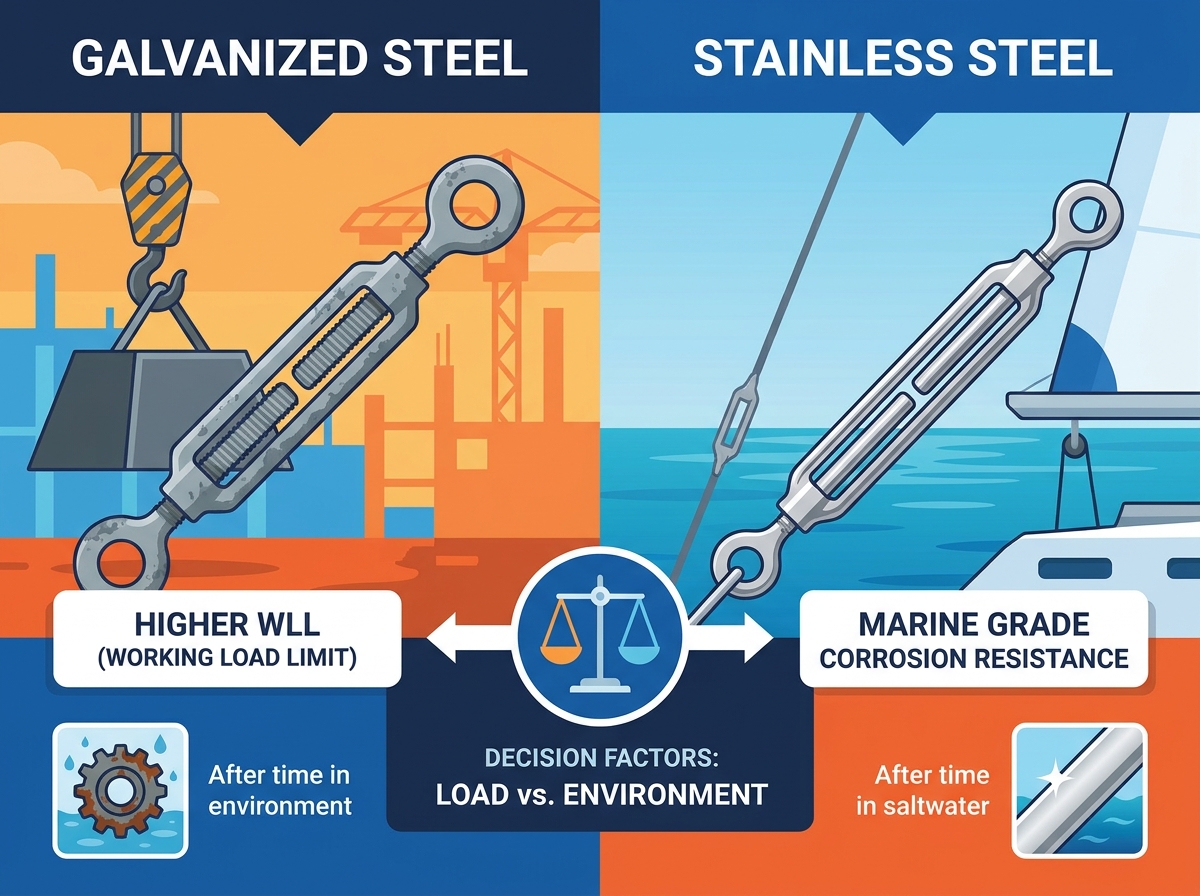
Galvanized Turnbuckles: Industrial Strength and Cost-Efficiency
Let us look closely at galvanized hardware. The material reality involves heavy-duty drop-forged carbon steel. The forging process aligns the metal grain structure perfectly. This creates immense internal strength. Manufacturers then coat this core steel in a protective layer of zinc. They usually apply this via hot-dip galvanization. The zinc creates a sacrificial barrier against rust. It protects the strong carbon steel underneath by corroding first.
This manufacturing process yields distinct primary advantages. First, you get a significantly higher Working Load Limit (WLL). Carbon steel dominates the heavy lifting industry. It serves as the preferred galvanized turnbuckle for towing operations and massive industrial tie-downs. You can safely tension enormous loads without fear of snapping. Second, these components remain highly cost-effective. They carry a significantly lower unit price. You can execute scalable procurement for large-scale structural projects easily. You will not drain your entire hardware budget on tensioners alone.
However, you must acknowledge the serious implementation risks. Galvanized hardware is definitely not invincible. The protective zinc coating can flake off over time. It wears down rapidly on the threads under heavy physical adjustment. Once the zinc depletes, it exposes the raw carbon steel directly to moisture. Severe rust will inevitably follow. Furthermore, it is not suitable as a long-term outdoor turnbuckle in highly acidic environments. Coastal environments will also destroy the zinc layer aggressively. Constant salt spray acts as a powerful catalyst for corrosion. You must inspect these components regularly. We strongly recommend logging visual checks into your monthly maintenance schedule.
Stainless Steel Turnbuckles: Maximum Corrosion Resistance
Stainless steel offers a completely different metallurgical profile. The material reality centers on robust steel alloys containing significant chromium. Manufacturers usually utilize Type 304 or Type 316 marine-grade alloys. The chromium creates a brilliant self-healing passive oxide layer. This invisible microscopic shield blocks rust at a molecular level. If you scratch the hardware, the layer reforms instantly upon oxygen exposure.
The primary advantages center entirely on environmental survival. You gain extreme environmental resilience. Type 316 serves as the definitive marine turnbuckle across the globe. It thrives during relentless saltwater exposure. Chemical processing plants and high-humidity tropical zones also rely heavily on it. Additionally, you secure incredible aesthetic and architectural value. Stainless steel will never bleed orange rust onto surrounding surfaces. This pristine trait makes it ideal for highly visible architectural rigging. Shade sails, sleek glass balustrades, and modern pedestrian bridges frequently employ stainless hardware for visual appeal.
Despite these amazing benefits, severe implementation risks exist. Thread galling presents the largest single threat to installers. Professionals often call this cold welding. Stainless steel threads under tension are highly susceptible to friction-induced fusing. The heat and pressure cause the metals to literally weld together during adjustment. You must use specific anti-seize lubricants during installation. If you ignore this step, the hardware will lock up permanently. You will have to cut the tensioner off the cable.
Another critical risk involves basic yield strength. As mentioned earlier, stainless alloys possess lower yield strength. They cannot match the raw pulling power of drop-forged carbon steel of the exact same diameter. You must carefully calculate the required stainless steel turnbuckle size. Never swap carbon steel for stainless without verifying the WLL first.
Head-to-Head Evaluation: Features to Outcomes
Rigging professionals need clear, objective comparisons. We built a direct head-to-head evaluation framework. You can use these exact parameters to guide your final procurement choice safely.
Consider long-term corrosion resistance first. Galvanized hardware relies entirely on a sacrificial zinc layer. This layer remains effective only until depleted by the elements. Once the zinc vanishes, rapid structural decay begins immediately. Stainless steel possesses inherent, elemental resistance. The alloy itself actively fights oxidation. This self-preserving characteristic makes it the superior corrosion resistant turnbuckle for extreme or coastal environments.
Next, strictly evaluate the Working Load Limit (WLL). Galvanized options deliver a much higher strength-to-diameter ratio. They remain ideal for heavy industrial tensioning, lifting, and securing. You get maximum physical strength in a highly compact profile. Stainless options suffer from noticeably lower WLL ratings. You must upsize the hardware diameter to compensate. A significantly larger stainless component is required to match standard galvanized load ratings.
Finally, analyze the cost-to-lifespan ratio carefully. Galvanized units offer a very low upfront cost. However, they carry high potential for regular maintenance in harsh weather. You might replace them more frequently over a ten-year span. Stainless units demand a very high initial investment. The upfront cost can shock some procurement teams. Yet, they require effectively zero maintenance in standard outdoor applications.
Hardware Evaluation Summary Matrix
| Evaluation Feature | Hot-Dipped Galvanized | Stainless Steel (Type 316) |
| Working Load Limit (WLL) | Exceptionally high. Ideal for industrial lifting. | Moderate. Requires upsizing for heavy loads. |
| Corrosion Resistance Mechanism | Sacrificial zinc coating (wears away). | Inherent passive oxide layer (self-healing). |
| Initial Procurement Cost | Low. Highly scalable for large projects. | High. Premium pricing for raw materials. |
| Aesthetic Quality | Dull, industrial gray. May bleed rust later. | Bright, polished, modern. Will not stain. |
| Primary Threat/Risk | Zinc flaking leading to structural rust. | Thread galling (cold welding) under tension. |
Implementation Considerations and Shortlisting Logic
Choosing the right hardware is only the very first step. You must implement it correctly in the field. Poor installation practices routinely ruin premium rigging hardware.
You must understand severe galvanic corrosion risks. Never mix dissimilar metals in the same rigging assembly. Pairing a galvanized steel cable with a premium stainless tensioner invites disaster. The dissimilar metals react aggressively when wet. This causes accelerated galvanic corrosion in the less noble metal. The zinc will strip away rapidly, destroying the galvanized parts. Always match your metals perfectly. Use stainless cable with stainless hardware. Use galvanized cable with galvanized hardware.
You should establish clear maintenance assumptions early. If you deploy galvanized hardware outdoors, plan for periodic inspections. You must monitor the zinc layer closely. Apply protective lubrication to the exposed threads regularly. If you deploy a stainless tensioner, prioritize the initial installation phase. Plan for strict anti-seize protocols. Apply specialized marine-grade lubricants to the threads before applying any physical load.
We recommend the following next-step actions for buyers. Use this logic to shortlist your hardware efficiently.
- Audit the environment: Determine the exact installation climate. Is the site within five miles of saltwater? Does it face harsh chemical exposure? If yes, always select Type 316 Stainless.
- Audit the load: Review the maximum dynamic forces required. Does the WLL requirement exceed the rating of standard stainless sizes? Can you afford to upsize the hardware diameter? If upsizing is impossible due to space, select Drop-Forged Galvanized.
- Audit the maintenance limits: Consider future access to the rigging. If maintenance access is dangerous or highly expensive, invest in stainless up front to avoid replacement costs.
Conclusion
You must base your rigging decisions on hard metallurgical data. Do not over-engineer with expensive stainless steel if the application is purely industrial and inland. You will waste your budget unnecessarily. Conversely, do not cut budgets with galvanized hardware if the rigging faces brutal marine elements. You will sacrifice long-term safety and architectural aesthetics.
The final verdict relies on balancing strength and survival. Prioritize the Working Load Limit above all else. Structural safety never compromises. Then, evaluate the environmental threats realistically.
We urge you to take immediate action today. Review technical specification sheets for exact WLL ratings before buying. Never guess load capacities based on visual size alone. Always consult a certified rigger before finalizing your hardware procurement.
- Match metallurgical properties to the exact installation environment.
- Never substitute stainless for galvanized without checking the WLL.
- Apply anti-seize lubricants to all stainless threads during installation.
- Avoid galvanic corrosion by matching wire rope metals to your hardware.
FAQ
Q: Can you use a galvanized turnbuckle with stainless steel wire rope?
A: We strongly advise against mixing these metals. Pairing galvanized hardware with stainless steel wire rope creates a destructive galvanic cell when exposed to moisture. The less noble metal, which is the galvanized zinc, will corrode rapidly. This aggressive galvanic corrosion weakens the assembly entirely. We recommend matching your metals completely to maintain long-term structural integrity.
Q: Is a stainless steel turnbuckle stronger than a galvanized one?
A: No, it is generally weaker. Buyers often confuse general tensile strength with the Working Load Limit (WLL). Drop-forged galvanized carbon steel boasts a higher WLL than stainless steel of the exact same diameter. If you require stainless hardware for specific corrosion resistance, you must typically upsize the diameter to match galvanized load ratings.
Q: How do you prevent stainless steel turnbuckle threads from seizing?
A: You must lubricate the threads before any installation. Stainless steel is highly susceptible to thread galling, also known as cold welding. The intense friction of tensioning causes the metals to fuse permanently. You can prevent this by generously applying a marine-grade anti-seize lubricant. This protective paste coats the threads and ensures smooth future adjustments.
Q: What is the difference between Type 304 and Type 316 stainless turnbuckles?
A: The primary difference involves molybdenum. Type 316 contains this vital element, which drastically increases resistance to chloride-induced corrosion. You should use Type 316 exclusively for true marine environments, coastal regions, and chemical plants. Type 304 lacks molybdenum but remains excellent for general outdoor use where severe salt spray is not a factor.

 English
 العربية
 Français
 Русский
 Español
 Português
 Deutsch
 italiano
 日本語
 한국어
 Nederlands
 Tiếng Việt
 ไทย
 Polski
 Türkçe
 አማርኛ
 ພາສາລາວ
 ភាសាខ្មែរ
 Bahasa Melayu
 ဗမာစာ
 தமிழ்
 Filipino
 Bahasa Indonesia
 magyar
 Română
 Čeština
 Монгол
 қазақ
 Српски
 हिन्दी
 Slovenčina
 Slovenščina
 Norsk
 Svenska
 українська
 Ελληνικά
 Suomi
 Հայերեն
 עברית
 Dansk
 اردو


