Adjusting tension and reducing slack define the core purpose of a turnbuckle in complex lifting systems. Many professionals focus heavily on the central body strength when buying hardware. However, systemic failures rarely occur in the middle of the frame. They usually happen at a mismatched end fitting.
Using the wrong end fitting severely compromises safety. For example, applying a hook where a secure jaw is mandatory lowers your Working Load Limit (WLL). This simple error directly violates rigorous safety compliance rules. It endangers the entire rigging operation and puts personnel at risk.
This guide provides a clear, engineering-based framework for evaluating jaw and eye configurations. You will learn the exact mechanical differences between various turnbuckles. Ultimately, you will gain the confidence to specify the correct tensioning hardware for any specific load requirement.
Key Takeaways
- Connection Compatibility: Jaw fittings require a removable pin to attach to solid eyes; eye fittings require a connectable piece (like a shackle) to attach to closed loops.
- Load Security: Eye-eye configurations offer the highest security for permanent installations, while jaw-jaw setups provide high security with easier disassembly.
- Compliance: Always select hardware rated for overhead lifting if applicable (avoiding hook ends for critical loads).
- WLL Matching: The turnbuckle’s WLL must meet or exceed the WLL of the wire rope and other connected cable hardware.
The Role of End Fittings in a Rigging Turnbuckle
To understand end fittings, you must first grasp the core mechanical principle. Every turnbuckle contains right-hand and left-hand internal threads. When you rotate the central body, these opposite threads engage simultaneously. They draw both end fittings inward to create tension. Conversely, rotating the body the other way pushes the fittings outward to release slack.
End fittings matter significantly because they dictate load distribution. A rigging turnbuckle is never an isolated tool. It must interface perfectly with anchor points and wire rope slings. The shape of the end fitting determines how well it connects to mating hardware. If the fit is poor, the load distribution becomes uneven. This causes premature wear and tear.
We must also emphasize the importance of inline tension. Structural integrity demands a straight, unbroken line of force. Any side-loading on jaws or eyes drastically reduces the WLL. Bending forces stress the threaded shanks. They can cause catastrophic failure well below the rated capacity. Always ensure your load pulls straight across the central axis.
Jaw Jaw Turnbuckle: Mechanics and Ideal Applications
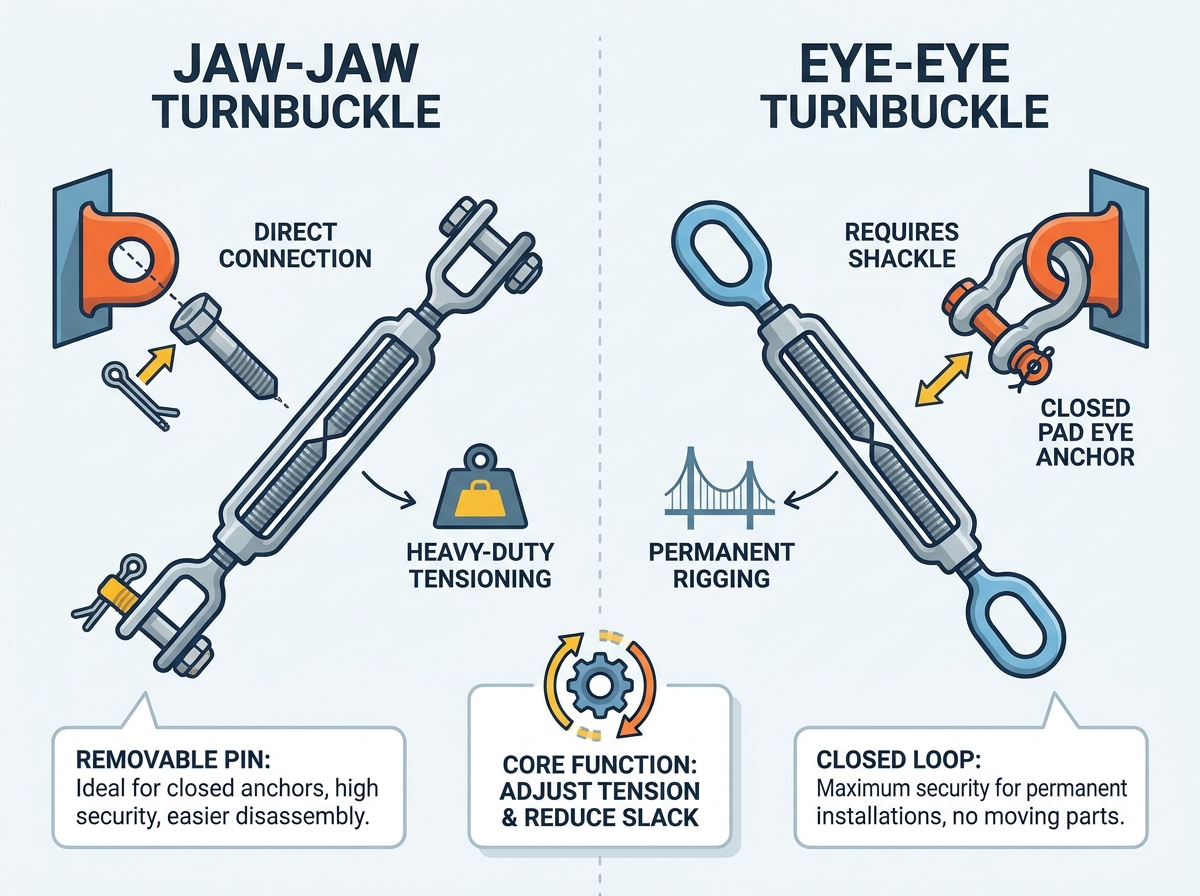
The jaw fitting often goes by the name "clevis". It features a distinct U-shaped yoke. A secured pin spans the open gap of this yoke. Manufacturers secure this pin using a nut, bolt, and cotter pin assembly. This robust design makes the jaw highly versatile for industrial lifting.
The core advantage of a jaw jaw turnbuckle lies in its direct connection capability. You can attach it straight to closed anchor points like pad eyes or drilled plates. You do not need an intermediate shackle. Eliminating extra connecting hardware saves weight. It also reduces the number of potential failure points in your assembly.
These models offer exceptional load capacity. They handle heavy-duty, straight-line tensioning effortlessly. You will often see them in marine architecture and heavy architectural installations. They excel wherever attachment points remain fixed and cannot open. Professionals frequently use them for temporary or permanent structural rigging.
However, implementation risks do exist. Subjecting the assembly to intense vibration can loosen the securing nut. If you lose the cotter pin, the main bolt might back out. To prevent this, riggers use a technique called mousing. They wrap safety wire around the pin to lock it firmly in place.
Eye Eye Turnbuckle: Mechanics and Ideal Applications
The eye fitting presents a simpler, closed-loop design. It consists of a solid, forged steel ring at the end of the threaded shank. This solid loop offers a continuous, unbroken circle of metal for load bearing.
The primary advantage here is the complete lack of moving parts. A eye eye turnbuckle carries zero risk of a pin backing out under vibration. You do not need to worry about missing nuts or broken cotter pins. This static design provides maximum security for long-term or permanent installations. Once installed, it requires very little maintenance.
These fittings shine in stationary, continuous-tension applications. Engineers specify them heavily for guy-wire tensioning. You will also find them supporting suspension bridge cables. They are the standard choice for semi-permanent structural tensioning where the hardware remains untouched for years.
There is a distinct evaluation friction to consider, though. You cannot attach a closed eye directly to another closed loop. You must introduce an additional connecting link. Typically, this means adding a load-rated shackle to the system. This requirement adds to your overall hardware count. It increases both the weight and the cost of the assembly.
Hook Eye Turnbuckle & Other Common Turnbuckle Types
While jaw and eye fittings dominate heavy lifting, other styles exist for specific tasks. The hook fitting is essentially an open loop. We must clearly contrast it against closed eyes and secure jaws.
A hook eye turnbuckle serves a very different purpose. Hooks allow for rapid engagement and quick release. They are ideal for temporary tensioning jobs. Workers frequently use them for lashing cargo down on flatbed trucks. The open hook speeds up the tie-down process significantly.
We must issue a strong safety warning regarding hooks. Hook ends possess a significantly lower WLL compared to jaws and eyes of the same diameter. A heavy load can bend the hook open. You should never use hook ends for overhead lifting. They are entirely unsuited for critical suspension tasks.
Beyond these three, the industry offers various turnbuckle types to solve unique problems. A Jaw-Eye combination blends the benefits of both ends. It works perfectly for asymmetrical setups involving one closed anchor and one open anchor. Stub ends feature unthreaded, blunt tips. Fabricators use stub ends when they need to custom-weld the hardware directly to a steel structure.
Decision Framework: How to Select the Right Tensioner
Choosing the correct tensioner requires a systematic approach. You cannot guess when dealing with heavy loads. Follow this four-step decision framework to ensure safety and efficiency.
- Anchor Point Analysis: Examine your mating hardware first. Is the anchor open or closed? If you have a closed pad eye, you require a jaw fitting. If your anchor is an open shackle, an eye fitting works best.
- Working Load Limit (WLL) & Safety Factors: Calculate the required capacity. You must account for dynamic loads, not just static weight. Wind, vibration, and movement multiply the force on your hardware. Always enforce a 5:1 safety factor. This is the gold standard for most industrial lifting applications.
- Permanence vs. Accessibility: Evaluate how often you will disassemble the system. Frequent tear-downs favor jaws or hooks. Permanent security heavily favors solid eyes.
- Material & Environment: Frame your choice around the operating environment. Hot-Dipped Galvanized steel is cost-effective and highly durable for standard outdoor use. However, if you work in marine or harsh chemical environments, you must select 316 Stainless Steel. It offers superior corrosion resistance.
Hardware Comparison Chart: End Fitting Capabilities
| Fitting Type | Anchor Compatibility | Permanence Level | Overhead Lifting Approved |
| Jaw-Jaw | Closed Anchors (Pad Eyes) | Semi-Permanent / Removable | Yes (if load-rated) |
| Eye-Eye | Open Anchors (Shackles) | Permanent | Yes (if load-rated) |
| Hook-Eye | Temporary Tie-Downs | Temporary | No |
By mapping your needs against these four steps, you will always select the proper cable hardware. Avoiding mismatches keeps your project compliant and safe.
Implementation Risks and Compliance (ASME B30.26)
Even the best hardware fails if installed incorrectly. Adhering to the ASME B30.26 standard ensures you avoid common implementation risks. This standard dictates strict rules for rigging hardware operation.
Thread engagement is a primary concern. You must never over-extend the turnbuckle body. The ASME standard states a clear safety requirement. The threaded ends must remain fully visible inside the turnbuckle body window. If you cannot see the threads penetrating the inside of the frame, the fitting is too loose. It could strip out under tension.
Locking the tension is equally critical. Wind and dynamic vibration can cause the body to spin. This slowly unwinds the assembly. You must prevent this movement. Install lock nuts tight against the frame. Alternatively, weave mousing wire through the frame and end fittings. This creates a physical barrier against unwinding.
Finally, implement strict inspection criteria. You must visually inspect hardware before every lift. Discard any unit exhibiting bent jaws or elongated eyes. Look closely for cracked threads. If the manufacturer's stamp indicating the WLL is missing or illegible, remove the tool from service immediately. You cannot guess the capacity of unmarked rigging gear.
Conclusion
Selecting the right hardware goes far beyond simply checking the load limit. The choice between jaw-jaw and eye-eye configurations comes down to your mating hardware. It also depends heavily on the permanence of your installation. Jaws offer direct connections, while eyes provide zero-maintenance security.
Do not leave safety to chance. Audit your anchor points today. Verify your required WLL against the expected dynamic loads. Always consult manufacturer spec sheets and adhere to ASME standards before placing bulk commercial orders. Proper planning ensures a flawless and secure rigging operation.
FAQ
Q: Can I use a jaw-jaw turnbuckle for overhead lifting?
A: Yes, provided it is forged, load-rated, and stamped with the WLL. It must also comply fully with ASME B30.26 standards for overhead lifting equipment.
Q: What is the difference between a turnbuckle and a rigging screw?
A: They serve the identical purpose of adjusting tension. However, a rigging screw typically features an enclosed tubular body. A standard turnbuckle uses an open frame, allowing you to see the internal thread engagement.
Q: How do I measure the size of a turnbuckle?
A: The standard measurement format is Thread Diameter x Take-Up length. For example, a 1/2" x 12" unit has a half-inch thread diameter and can adjust its length by 12 inches.
Q: Can I mix turnbuckle types (e.g., jaw on one end, eye on the other)?
A: Yes. Jaw-eye models are standard, widely available hardware. Manufacturers design them specifically for complex rigging systems that feature mismatched anchor points.

 English
 العربية
 Français
 Русский
 Español
 Português
 Deutsch
 italiano
 日本語
 한국어
 Nederlands
 Tiếng Việt
 ไทย
 Polski
 Türkçe
 አማርኛ
 ພາສາລາວ
 ភាសាខ្មែរ
 Bahasa Melayu
 ဗမာစာ
 தமிழ்
 Filipino
 Bahasa Indonesia
 magyar
 Română
 Čeština
 Монгол
 қазақ
 Српски
 हिन्दी
 Slovenčina
 Slovenščina
 Norsk
 Svenska
 українська
 Ελληνικά
 Suomi
 Հայերեն
 עברית
 Dansk
 اردو


