Operating in unpredictable marine environments subjects lifting and mooring equipment to constant dynamic loads, severe saltwater corrosion, and relentless abrasive friction. Selecting the wrong structural line does not simply reduce operational efficiency; it actively creates critical safety hazards and compliance risks. You must frame a marine wire rope not as a static tether, but as a complex machine. They feature internal moving parts demanding specific tolerances, precise manufacturing, and rigorous ongoing care. Neglecting these intricate mechanics accelerates degradation, risking sudden structural failures at sea. This guide provides marine operators, procurement managers, and riggers with an evidence-based evaluation framework. We will explore how to specify core constructions, evaluate protective coatings, and execute proactive upkeep routines. You will gain actionable strategies to maximize equipment lifespan and improve offshore reliability.
Key Takeaways
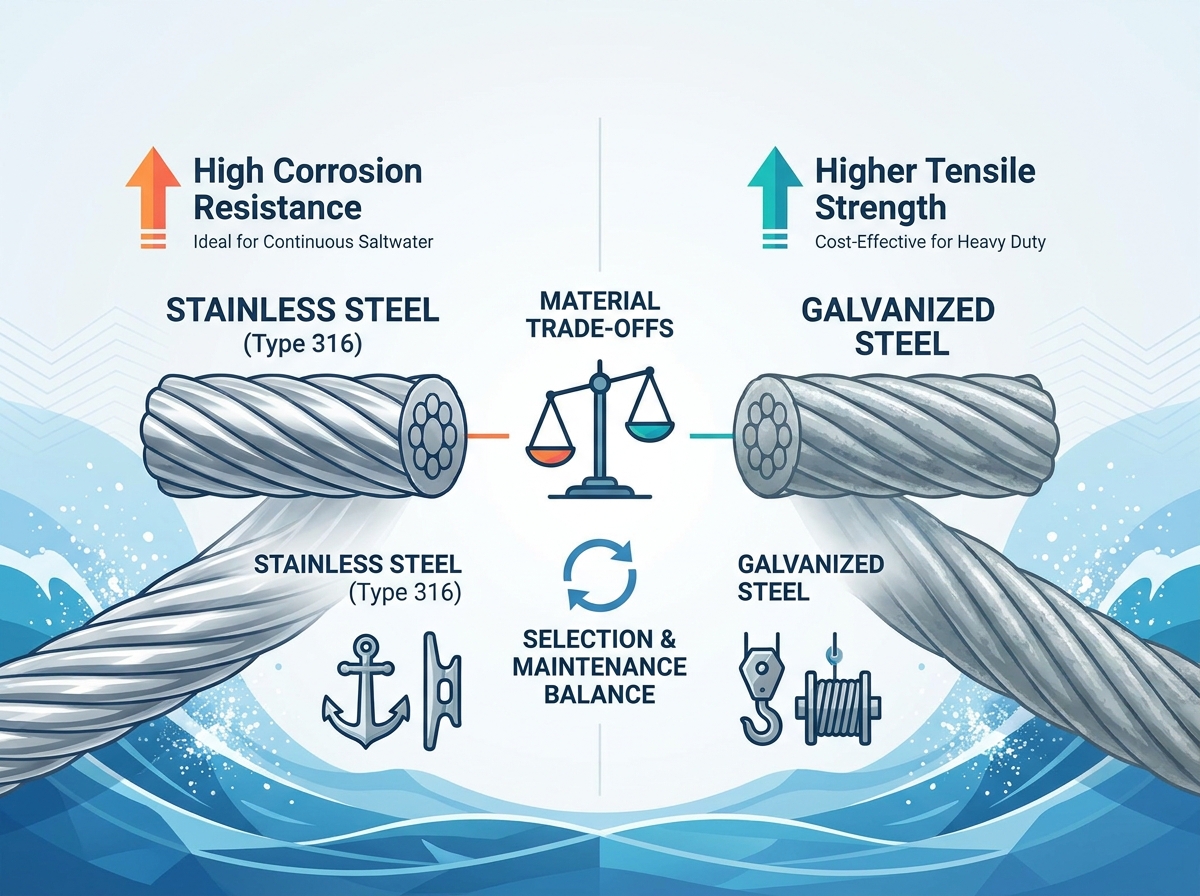
- Material Trade-offs: Stainless steel prioritizes ultimate corrosion resistance, while galvanized steel offers higher tensile strength and cost-efficiency.
- Application-Driven Selection: Running rigging, standing rigging, and mooring applications require entirely different core constructions and lay types.
- Proactive Maintenance is Mandatory: Effective wire rope maintenance relies on penetrating lubrication and routine desalination, not just surface treatments.
- Objective Retirement: Visual inspections must align with standardized discard criteria (e.g., ISO/ASME) regarding broken wires and dimensional wear.
The Business Impact of Marine Wire Rope Selection
Making arbitrary decisions regarding marine equipment leads directly to operational delays and catastrophic failures. You must evaluate the physical demands placed on your rigging components to prevent unforeseen downtime. Frequent component replacements drain labor resources and completely disrupt maritime schedules. Selecting an inadequate material guarantees accelerated structural breakdown in harsh coastal conditions.
The Harsh Realities of Saltwater
Saltwater acts as a relentless catalyst for equipment destruction. Galvanic corrosion occurs rapidly when dissimilar metals interact in a conductive saltwater environment. Chloride pitting attacks the microscopic surface structures of inferior alloys, creating localized weak points invisible to the naked eye. Structural fatigue compounded by continuous wave action degrades core strands over time. You cannot avoid these elements, but you can mitigate them through engineered material selection.
Compliance and Safety
Commercial maritime operations operate under strict regulatory oversight. Classification societies, including the American Bureau of Shipping (ABS), DNV, and Lloyd’s Register, dictate precise minimum breaking loads. They mandate rigorous material certifications for all overhead lifting and structural components. Failing to meet these compliance standards risks immediate vessel detention and invalidates insurance coverage. We advise operators to maintain complete documentation for every load-bearing assembly to ensure audit readiness.
Evaluating Materials: Stainless Steel vs. Galvanized Wire Rope
Specifying the correct alloy dictates how well your equipment survives atmospheric exposure and dynamic loading. The industry primarily relies on two main metallic solutions, supplemented by specialized synthetic alternatives.
Material Performance Comparison for Marine Applications
| Material Type | Corrosion Resistance | Tensile Strength | Best Use Case |
| Type 316 Stainless Steel | Excellent | Moderate | Continuous submersion, aesthetic applications |
| Galvanized Steel | Good (Self-healing) | High | Heavy commercial lifting, winches |
| Synthetic Coated (PVC/Nylon) | Superior | Varies by core | Guardrails, high-abrasion zones |
Stainless Steel Wire Rope (Type 316 / 304)
When ultimate rust resistance is the priority, a stainless steel wire rope provides unparalleled longevity against surface oxidation. Type 316 contains molybdenum, adding an extra layer of defense against harsh chloride environments.
- Pros: It offers exceptional rust resistance. This makes it ideal for continuous saltwater exposure, architectural rigging, and environments requiring strict hygiene standards.
- Cons: They generally exhibit a lower Minimum Breaking Load (MBL) compared to traditional carbon steel equivalents. Furthermore, stainless alloys remain highly susceptible to "crevice corrosion" in oxygen-deprived environments. If marine growth traps water against the metal, or if splices remain permanently wet, the protective chromium oxide layer breaks down quickly.
Galvanized Wire Rope
Commercial vessels heavily favor galvanized products for load-intensive operations. The manufacturing process coats high-carbon steel strands in zinc, creating a highly durable physical barrier.
- Pros: A galvanized wire rope delivers a superior strength-to-weight ratio. The zinc acts as a sacrificial anode. When scratched, the zinc oxidizes before the underlying steel, providing a self-healing effect. It serves as the standard for heavy-duty commercial lifting.
- Cons: The zinc coating eventually depletes over time. Once the sacrificial layer vanishes, the carbon steel core rusts aggressively. You must implement strict, ongoing lubrication protocols to prevent rapid degradation.
Specialty Corrosion Resistant Alternatives
Certain operations demand hybrid solutions. Manufacturers offer synthetic-coated ropes wrapped in extruded PVC or Nylon jackets. These jackets physically block saltwater from reaching the core strands. However, you must inspect the jacket meticulously; a single puncture traps water inside, rotting the core unseen. Compacted strand constructions represent another advanced option. By compressing the outer wires, manufacturers minimize the surface area exposed to the elements while increasing the overall metallic density.
Application-Specific Selection Criteria for Marine Operations
You cannot use a universal approach when specifying offshore equipment. The way a rigging wire rope functions dictates its necessary construction geometry. Flexibility and rigidity sit on opposite ends of the operational spectrum.
Rigging Configurations: Standing vs. Running
Different parts of a vessel demand entirely different mechanical properties.
Standing Rigging: These lines hold masts and fixed structures in place. They require extremely low stretch and high rigidity. Operators typically specify a 1x19 construction for standing applications. It contains few, thick wires, maximizing break strength and minimizing elongation.
Running Rigging: Winches, cranes, and hoists use running rigging. These lines constantly bend over sheaves and pulleys. They demand maximum flexibility and fatigue resistance to prevent internal wire snapping. A 7x19 or 6x36 construction distributes the bending stress across many finer wires, allowing the line to spool cleanly without structural distortion.
Mooring Lines and Towing
Mooring and towing subject equipment to violent shock loads. Waves and tides create unpredictable tension spikes. Lines used here must offer excellent shock absorption and immense abrasion resistance. Fairleads and chocks constantly rub against the outer wires. Multi-strand flexibility ensures the assembly absorbs kinetic energy rather than snapping under sudden tension.
Core Construction Evaluation
The core serves as the foundation for the entire assembly, supporting the outer strands under load.
- Independent Wire Rope Core (IWRC): This features a smaller secondary steel rope acting as the center. It offers superior crush resistance and higher overall tensile strength. Riggers prefer IWRC for heavy crane lifting and high-tension winch drums where flattening is a risk.
- Fiber Core (FC): This utilizes a synthetic or natural fiber center (like sisal or polypropylene). It offers greater flexibility and holds internal lubricants much better than steel cores. However, it possesses a lower breaking strength and will compress under extreme crushing loads.
Wire Rope Maintenance: Maximizing Operational Lifespan
Procuring premium materials represents only the first step. Aggressive, scheduled wire rope maintenance determines whether your investment lasts five years or five months.
Desalination and Cleaning
Salt crystals and wind-blown grit act like grinding paste inside the strands. You must wash off abrasive contaminants before they grind against the internal wires. Implement strict desalination protocols using fresh water rinses after heavy offshore deployment. Never use acidic cleaners or harsh solvents, as they strip the protective factory lubricants and accelerate rusting.
Lubrication Strategies
Many operators make a critical error by applying thick surface grease. Surface grease fails completely in marine settings because it traps salt, dirt, and moisture against the metal. It simply masks the corrosion happening beneath.
You need penetrating lubricants. These specialized fluids possess low viscosity during application, allowing them to seep deep into the core. Once inside, they displace moisture and reduce internal friction between the moving wires. As they cure, they thicken into a protective barrier. For heavy commercial setups, pressure lubrication systems are vastly superior to manual brushing. High-pressure collars force the lubricant entirely through the strands, flushing out old contaminants while completely saturating the core.
Storage and Handling
Improper handling ruins equipment before it even sees the water. You must unspool lines correctly from the reel to prevent permanent kinks. A kink permanently compromises the structural integrity of the line; you cannot simply bend it back into shape. During installation and off-season storage, ensure the equipment remains elevated off the ground, covered from direct rain, and thoroughly lubricated to prevent "bird-caging" (the explosive unraveling of outer strands).
Inspection Checklist and Discard Standards
Knowing exactly when to retire a marine cable separates safe operations from fatal accidents. Guesswork has no place in offshore rigging.
Routine vs. Periodic Inspections
Set realistic timelines based on operational frequency and environmental severity. Routine inspections should occur daily or prior to any major lift. They rely on quick visual checks for obvious deformation. Periodic inspections require a qualified inspector. These comprehensive evaluations happen monthly or annually, depending on class society regulations, and involve detailed measurements and documentation.
Key Wear Indicators
Inspectors must look for specific failure signs. Tracking these anomalies prevents catastrophic load drops.
- Broken Wires: Count the broken wires over a specific lay length. Randomly distributed breaks are normal wear and tear. Localized broken wires grouped closely together indicate severe internal failure and require immediate replacement.
- Diameter Reduction: Measure the line with calipers. A sudden reduction in diameter means the internal core has collapsed or degraded.
- Rouging: Look for fine red dust or rust bleeding from the inside of the strands. This indicates the internal core is rusting and grinding away, even if the exterior looks acceptable.
- Pitting and Heat Damage: Check for deep craters in the metal caused by chloride attacks or blue discoloration caused by extreme friction over stuck sheaves.
Objective Discard Criteria
Remove the guesswork by aligning internal policies with recognized marine safety standards. Frameworks like ISO 4309 and ASME B30.9 provide objective discard criteria. They specify the exact number of allowable broken wires per lay length and the maximum acceptable percentage of diameter loss. When a line reaches these quantifiable thresholds, you must retire it immediately. Delaying replacement invites disaster.
Shortlisting Suppliers and Procurement Next Steps
Sourcing components from unreliable vendors introduces massive blind spots into your safety protocols. Treat your procurement phase as a rigorous vetting process.
Traceability and Mill Certificates
Never procure uncertified rigging materials. You must demand full documentation of origin, alloy composition, and break-testing results. Mill certificates prove the material meets the specified Minimum Breaking Load. If a supplier cannot provide full traceability for their inventory, immediately remove them from your approved vendor list.
Customization Capabilities
A capable supplier does more than ship raw spools. Evaluate their ability to provide marine-grade terminations and custom hardware assemblies. Your vendor should possess the technical expertise to install heavy-duty thimbles, poured spelter sockets, and swaged fittings. Finding a corrosion resistant wire rope is only half the battle; the end terminations must withstand the exact same corrosive environment without failing.
Vendor Support
Shortlist partners who offer extensive post-sale support. Exceptional vendors provide ongoing material testing, maintenance guidance, and rapid replacement availability. Offshore operations cannot afford weeks of waiting for a replacement spool. Prioritize suppliers holding robust local inventory and dedicated technical support teams.
Conclusion
Navigating maritime challenges requires a careful balance between meticulous material selection and rigorous maintenance. You must align your material choice—whether high-strength galvanized alloys or extreme-durability stainless variants—with the precise demands of your operating environment. Reliable offshore operations depend on treating structural lines as actively managed assets. This proactive mindset heavily influences both crew safety and overall business continuity.
We encourage you to audit your current inventory immediately. Check your storage practices, review your lubrication schedules, and verify your mill certificates. Consult with certified rigging specialists to review your specific operational loads and ensure your equipment meets all modern compliance standards.
FAQ
Q: Which is stronger: galvanized or stainless steel wire rope?
A: Galvanized steel typically offers a higher breaking strength. It utilizes high-carbon steel, making it the preferred choice for heavy commercial lifting. Stainless steel sacrifices some overall tensile strength to accommodate the addition of chromium and nickel, which provide its superior, permanent corrosion resistance.
Q: How often should marine wire rope be lubricated?
A: Lubrication frequency depends heavily on operational usage and environmental severity. As a general rule, you must lubricate it the moment it feels dry to the touch or begins showing minor surface oxidation. High-use commercial lines often require weekly pressure lubrication.
Q: What is the best wire rope construction for boat winches?
A: Running applications like boat winches require flexible constructions to prevent metal fatigue. A 7x19 construction is ideal. It distributes bending stresses across many smaller wires, allowing the line to spool tightly and smoothly around small winch drums without distorting.
Q: Can I use a fiber core (FC) wire rope for marine applications?
A: Yes, but only in specific scenarios. Fiber cores offer excellent flexibility and retain penetrating lubricants extremely well. However, they lack structural density and are poorly suited for heavy crushing loads. If the line faces severe drum crushing, an Independent Wire Rope Core (IWRC) is mandatory.

 English
 العربية
 Français
 Русский
 Español
 Português
 Deutsch
 italiano
 日本語
 한국어
 Nederlands
 Tiếng Việt
 ไทย
 Polski
 Türkçe
 አማርኛ
 ພາສາລາວ
 ភាសាខ្មែរ
 Bahasa Melayu
 ဗမာစာ
 தமிழ்
 Filipino
 Bahasa Indonesia
 magyar
 Română
 Čeština
 Монгол
 қазақ
 Српски
 हिन्दी
 Slovenčina
 Slovenščina
 Norsk
 Svenska
 українська
 Ελληνικά
 Suomi
 Հայերեն
 עברית
 Dansk
 اردو


