Deciding when to retire a lifting cable is never a subjective maintenance choice. It is a critical, compliance-driven risk management decision. Facility managers face constant operational tension. Prematurely retiring a cable unnecessarily inflates maintenance budgets. However, delaying replacement risks catastrophic equipment failure, severe OSHA violations, and massive safety liabilities. You simply cannot afford to guess. The decision to retire a rope must rely on measurable discard criteria. Regular, documented inspections are non-negotiable in this industry. Strict adherence to lifting equipment regulations dictates exactly when retirement becomes mandatory.
In this comprehensive guide, we will explore the universal metrics for determining precise wear limits. You will learn application-specific safety standards for various cranes and hoists. We will also cover how to conduct defensible, traceable inspections. Ultimately, you will understand exactly when to schedule your next wire rope replacement to protect your crew and equipment.
Key Takeaways
- Replacement is metric-driven: The decision relies on specific thresholds of broken wires, measurable diameter reduction, and visible deformation.
- Standards dictate timelines: Guidelines from regulatory bodies (like OSHA, ASME B30.30, and ISO 4309) provide the absolute baseline for lifting rope safety.
- Inspection is mandatory: Routine, documented wire rope inspection by a "competent person" is required to track progressive wear and prevent unexpected failures.
- Application matters: Crane wire rope has different discard criteria and stress points compared to static guy wires or winches.
The Business and Safety Case for Timely Wire Rope Replacement
Operating heavy lifting equipment demands a strict zero-tolerance policy for failure. The stakes are extraordinarily high. Facility leaders must balance financial constraints against absolute safety requirements. Postponing maintenance might seem cost-effective initially, but it invites disastrous consequences down the line.
Consider the true cost of a dropped load. A snapped steel cable triggers immediate and catastrophic facility downtime. Consequent equipment damage often reaches millions of dollars. Furthermore, legal liabilities and severe worker injuries carry devastating long-term impacts. Compared to these catastrophic outcomes, the predictable cost of scheduled replacement is remarkably minimal. Smart managers view timely replacement as an essential insurance policy. It protects the company from existential financial threats.
Local and federal workplace safety laws provide strict operational guidelines. Operating compromised equipment automatically voids your compliance status. Organizations like OSHA show zero leniency for maintenance negligence. Ignoring obvious wear signals invites hefty regulatory fines. It also exposes corporate leadership to direct criminal liability if a fatal accident occurs.
You should always favor predictive maintenance over reactive responses. Reactive strategies guarantee unexpected operational downtime. By closely monitoring wire rope wear, procurement teams can order replacements early. This proactive approach prevents expensive expedited shipping costs. Predictive tracking keeps your facility running smoothly. You dictate the maintenance schedule, rather than letting sudden equipment failure dictate it for you.
Universal Discard Criteria: When to Retire the Rope
Industrial standards remove all guesswork from maintenance schedules. You must retire cables when they hit specific, measurable failure thresholds. Understanding these universal discard criteria ensures compliance and prevents catastrophic accidents.
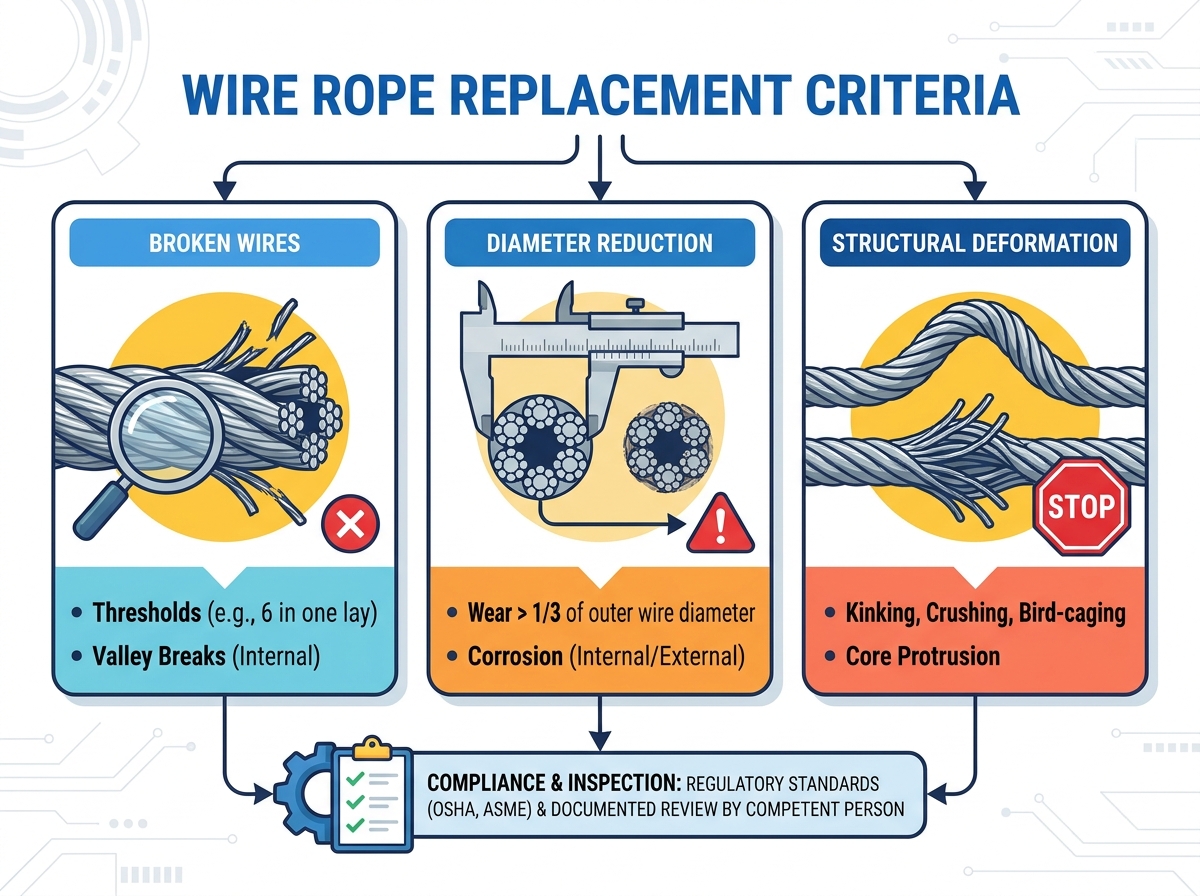
Counting broken wires provides a direct measurement of structural fatigue. Standard thresholds usually dictate discard if you find six randomly distributed breaks in one lay length. For running ropes, three breaks in a single strand within one lay length require immediate retirement. You must pay special attention to "valley breaks." These subtle breaks occur deep between the outer strands. Valley breaks often indicate severe internal core degradation. Even a single valley break usually mandates immediate cable removal.
Friction degrades outer wires consistently over time. Inspectors rely heavily on the one-third rule for diameter reduction. You must replace the assembly if wear exceeds one-third of the original outside wire diameter. Always watch closely for localized wear patterns. Flat spots frequently emerge from sheave alignment issues or improper spooling. A sudden, unexplained reduction in diameter often signals complete core failure.
Surface oxidation happens naturally in most industrial environments. Light surface rust is generally acceptable if it wipes away easily. However, severe pitting compromises structural integrity. It demands immediate replacement. Internal corrosion represents a much greater danger. It is often invisible to the naked eye but ultimately fatal to the cable. A sudden reduction in overall diameter often signals hidden internal rust. If you detect internal corrosion, remove the cable immediately.
Any significant physical deformation permanently destroys cable strength. Certain structural defects represent non-negotiable reasons for immediate discard:
- Kinking: Sharp bends permanently warp wire alignment and destroy load capacity.
- Crushing: Flattened sections reduce load-bearing ability and create severe weak points.
- Bird-caging: Strands untwist and flare outward dramatically from the inner core.
- Core Protrusion: The inner core literally pops through the outer steel strands.
Wire Rope Discard Thresholds Summary
| Defect Category | Critical Threshold for Discard | Immediate Action Required |
| Strand Breaks | 6 random breaks in one lay length | Remove from service |
| Valley Breaks | 1 or more between outer strands | Immediate discard |
| Diameter Wear | Exceeds 1/3 of outer wire diameter | Schedule replacement |
| Deformation | Any kinking, crushing, or bird-caging | Immediate discard |
Application-Specific Standards: Cranes, Hoists, and Rigging
One single standard does not fit every industrial application. Operating environments and equipment types dictate unique safety thresholds. You must evaluate your cables based on their specific operational duties.
A heavy-duty crane wire rope faces intense dynamic shock loads daily. Repeated lifting cycles cause rapid metal fatigue. Facilities must strictly adhere to ASME B30.5 or B30.2 standards for these machines. These stringent frameworks address the high-stress nature of continuous crane operations. Operators must carefully monitor drums and sheaves for accelerated wear patterns caused by continuous spooling.
Slings and rigging hardware demand much stricter discard criteria than multi-part hoist systems. They lack the built-in redundancy of complex crane configurations. A single broken wire near an end fitting or termination often condemns a sling completely. You cannot compromise on rigging hardware safety. The load drops immediately if a single-leg sling fails during a lift.
You must evaluate standing and running applications differently. Running ropes travel over sheaves and drums continuously. They suffer from constant bending fatigue and friction. Standing ropes remain entirely static. They act as permanent guy lines to hold masts or booms in place. Because standing cables experience less friction, they often last longer. However, they remain highly susceptible to environmental corrosion at their termination points. Inspectors use different break thresholds for each category based on these unique stress factors.
How to Conduct a Defensible Wire Rope Inspection
Identifying mechanical wear requires a highly systematic approach. A rigorous, documented wire rope inspection protocol keeps your facility compliant and safe. Proper evaluation routines prevent small defects from becoming fatal accidents.
Operators must perform quick operational checks before every single shift. This visual check is your first line of defense. Operators should look for obvious kinks, severe wear, or sudden strand breaks. They must also check for proper spooling on the drum. Any visible anomaly warrants immediate shutdown and further expert review.
Safety standards require monthly and annual comprehensive evaluations. A designated "competent person" must conduct these detailed teardowns. They evaluate the entire length of the cable meticulously. The inspector takes precise caliper measurements to track diameter reduction. They thoroughly examine high-stress areas near fittings, sockets, and sheaves.
Visual checks cannot uncover hidden internal flaws. Magnetic rope testing (MRT) offers an advanced technological solution. MRT detects internal strand breaks and hidden corrosion accurately. It evaluates the inner core without dismantling the equipment. Many heavy industries now mandate non-destructive testing (NDT) for critical lifting applications.
An inspection holds absolutely no legal value unless it is recorded. You must maintain detailed logbooks. These records track the exact degradation rate over time. Defensible documentation justifies your eventual replacement date. It also provides vital proof of compliance if an OSHA auditor visits your facility.
- Clean the test area: Remove heavy grease to expose the outer strands clearly.
- Measure the diameter: Use calibrated calipers strictly across the crowns of the strands.
- Count the breaks: Carefully document the exact number of breaks per lay length.
- Check terminations: Inspect all end fittings for slippage or localized wire failure.
- Log the results: Sign and date the official maintenance record immediately.
Sourcing Your Replacement Steel Cable: Evaluation Criteria
Identifying a failed cable solves only half the problem. You must procure the exact right replacement to ensure long-term reliability. Sourcing high-quality materials is crucial for maintaining workplace safety.
Buying direct from the Original Equipment Manufacturer (OEM) guarantees an exact match. It simplifies the purchasing process significantly. However, OEM cables often carry a steep premium markup. Purchasing from a specialized rigging supplier frequently provides better overall value. A specialized vendor can offer aftermarket equivalents that meet or exceed original OEM specifications.
Replacement offers an excellent opportunity to upgrade your equipment. If your facility struggles with recurrent wear, consider a different construction. Moving from a standard 6x19 class to a compacted cable increases strength and abrasion resistance. Rotation-resistant designs prevent loads from spinning dangerously during free-fall lifts. Upgrading can significantly improve overall lifting rope safety and longevity.
Never purchase lifting cables from unverified or unknown sources. You must rigorously evaluate your vendors. Look for suppliers who provide complete mill test reports with every purchase. They should supply comprehensive proof-testing certificates. Traceability is critical for compliance audits. Your vendor must guarantee the origin and testing history of every single spool they sell.
Do not wait for a complete failure to evaluate your equipment. Proactive managers schedule professional site assessments early. Reach out to a certified rigger to verify your current specifications. Request a quote for replacement materials well before your current cables reach their absolute discard threshold.
Conclusion
Retiring heavy lifting equipment requires a disciplined, data-driven approach. You cannot rely on guesswork or visual estimates alone. Making the right replacement decision protects your crew, your equipment, and your company's bottom line.
- Rely strictly on precise caliper measurements and documented visual defect counts.
- Follow the stringent regulatory standards set forth by OSHA and ASME.
- Build a proactive safety culture where every operator feels fully empowered to stop work.
- Never compromise on the sourcing quality of your replacement cables.
If lifting equipment safety is ever in question, ground the machinery immediately. It is always better to replace a worn cable early than to face the devastating aftermath of a dropped load. Contact a certified rigging inspector today. Submit your equipment specifications to secure a reliable replacement quote and proactively protect your operations.
FAQ
Q: Can wire rope be repaired instead of replaced?
A: Generally, no. While a damaged end fitting can sometimes be cut off and re-terminated if sufficient length remains, a damaged rope body cannot be spliced or repaired. Any internal core damage, significant wear, or broken wires mandate that the entire assembly must be replaced immediately.
Q: What is the average lifespan of a steel cable?
A: There is no fixed chronological lifespan. It depends entirely on the duty cycle, load weight, environmental conditions, and maintenance routines. A cable used continuously in harsh, corrosive environments may last only months, while an occasionally used, well-lubricated cable can last for years.
Q: Why is my wire rope wearing out so quickly?
A: Premature wear is typically caused by poor spooling, misaligned sheaves, undersized drums, or a lack of proper lubrication. Selecting the wrong rope construction for a specific application, such as using a standard rope where a rotation-resistant one is required, also drastically accelerates wear.
Q: Who is legally allowed to inspect and condemn a wire rope?
A: OSHA requires a "competent person" to conduct formal inspections. This is someone with the specialized training, field experience, and organizational authority to identify mechanical hazards accurately and immediately authorize corrective action or equipment replacement.

 English
 العربية
 Français
 Русский
 Español
 Português
 Deutsch
 italiano
 日本語
 한국어
 Nederlands
 Tiếng Việt
 ไทย
 Polski
 Türkçe
 አማርኛ
 ພາສາລາວ
 ភាសាខ្មែរ
 Bahasa Melayu
 ဗမာစာ
 தமிழ்
 Filipino
 Bahasa Indonesia
 magyar
 Română
 Čeština
 Монгол
 қазақ
 Српски
 हिन्दी
 Slovenčina
 Slovenščina
 Norsk
 Svenska
 українська
 Ελληνικά
 Suomi
 Հայերեն
 עברית
 Dansk
 اردو


