Turnbuckles play a critical role in load-bearing and tensioning applications across multiple industries. A single failure can lead to catastrophic damage. You face severe safety liabilities and costly project downtime if these devices break. You rely on these components to hold immense forces securely every single day.
While these components are foundational to structural integrity, they remain highly prone to specific mechanical and environmental failures. Improper specification or neglected upkeep often triggers severe turnbuckle problems. You must understand these vulnerabilities to prevent accidents and protect your investments.
This guide provides a transparent, engineering-focused look at common issues, diagnostic signs, and procurement criteria. We will explore practical strategies to ensure long-term rigging stability. You will learn exactly how to specify, inspect, and maintain your hardware effectively for maximum safety.
Key Takeaways
- Vibration and environmental exposure are the primary catalysts for turnbuckle failure, requiring specific locking mechanisms and material choices.
- Thread galling is a frequently overlooked issue that compromises cable tension and destroys hardware during installation.
- Proper turnbuckle inspection protocols can identify micro-deformations before they escalate to catastrophic load drops.
- Selecting the right rigging hardware involves matching Working Load Limits (WLL) and material grades (e.g., stainless vs. galvanized turnbuckle) to the exact use case.
Identifying the Most Common Turnbuckle Problems
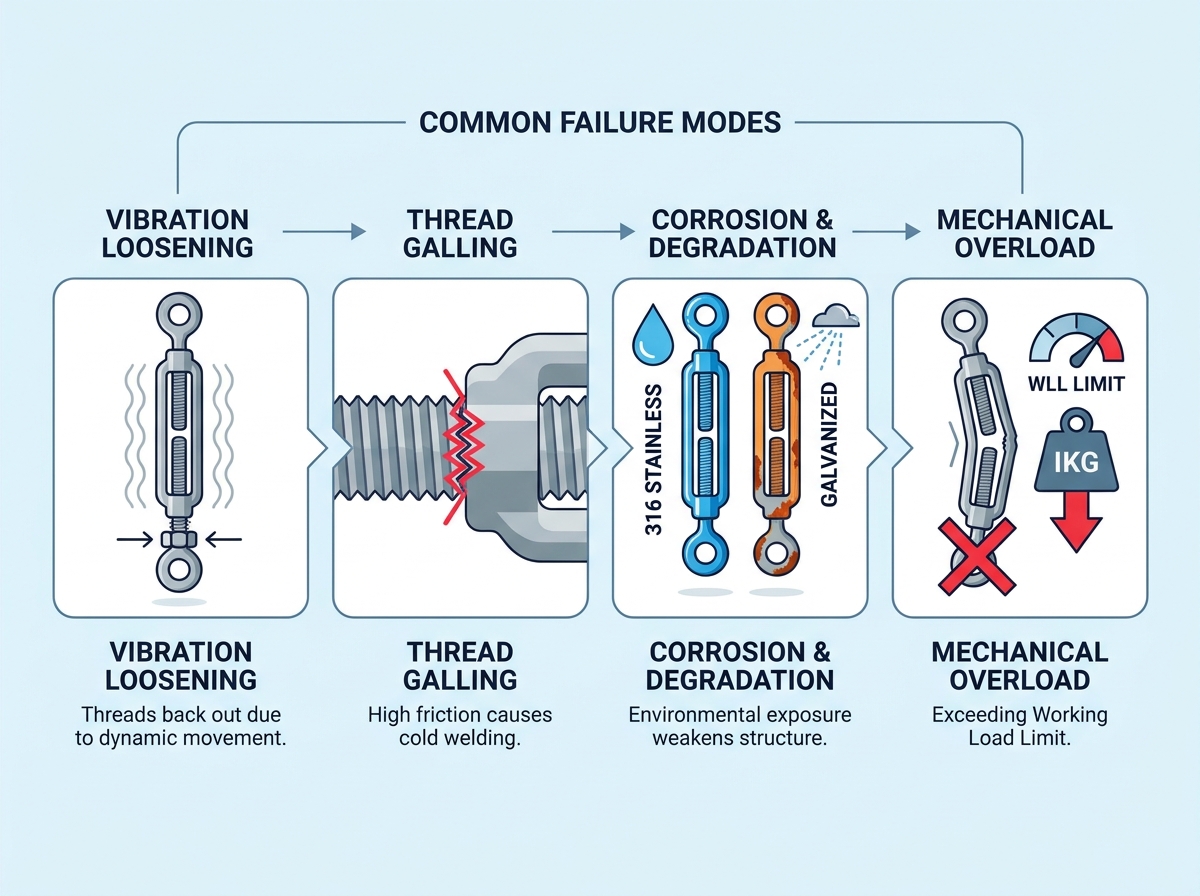
Understanding the root causes of hardware degradation helps you anticipate issues before they escalate. We commonly see four major threat categories affecting rigging systems in the field. You must actively monitor for these specific conditions.
Vibration-Induced Loosening
Constant dynamic movement causes threads to slowly back out over time. You will encounter this frequently in transport, marine rigging, or wind-loaded signage. Resonant frequencies travel through wire ropes directly into the hardware body. The central body spins loose gradually.
This leads to a sudden loss of cable tension. Shifting loads follow immediately. Structural instability then threatens the entire assembly. A loose cable transfers shock loads to other anchor points. This domino effect often destroys secondary rigging components.
Thread Galling (Cold Welding)
High friction during installation under load generates intense localized heat. This problem is especially common in stainless steel hardware. The protective oxide layer strips away. The raw metals then fuse together at the microscopic level. We call this phenomenon cold welding.
Threads seize up entirely. Adjustments become completely impossible. You often have to cut the hardware away to remove it. You lose both time and expensive equipment. Galling happens suddenly, often giving you no warning during the tensioning process.
Corrosion and Environmental Degradation
Exposure to saltwater, industrial chemicals, or prolonged moisture destroys metal integrity. Rust attacks the thread roots first. This hides the most severe damage from casual observation. Structural weakening accelerates rapidly in harsh industrial environments.
Different materials handle these threats differently. A galvanized turnbuckle uses a sacrificial zinc coating to delay rust. The zinc corrodes so the steel beneath survives. Meanwhile, 316 stainless steel offers true structural corrosion resistance through its chromium and molybdenum content. You must choose based on your specific climate.
Mechanical Deformation and Overloading
Exceeding the Working Load Limit (WLL) causes permanent physical damage. Applying side-loads instead of straight, in-line tension forces the metal to bend. These devices are engineered purely for linear tension. They cannot survive lateral stress.
Impacts show up as bent frames, elongated eyes, or cracked jaws. These deformations lead to inevitable turnbuckle failure. Even a slight bend in the threaded rod compromises the entire load capacity. You must discard any deformed equipment immediately.
Standardizing Your Turnbuckle Inspection Protocol
You need a strict visual and tactile routine to catch early warning signs. We recommend establishing a non-negotiable checklist for your crew. Routine checks prevent minor wear from turning into fatal drops.
A rigorous turnbuckle inspection requires checking several key evaluation dimensions:
- Examine stress points: Look for hairline fractures at the base of threads. Check the neck areas of all eyes, jaws, and hooks.
- Measure thread wear: Ensure the central body rotates smoothly. It should never catch or grind during adjustment.
- Verify end fittings: Confirm jaw, eye, and hook shapes remain true. They must not be elongated or warped out of their original forged shape.
- Inspect for pitting: Look deep into the threaded body to spot hidden rust pockets.
Always reference industry standards like ASME B30.26 for compliance and safety. This standard explicitly dictates removing damaged equipment from service immediately. Never attempt to weld, heat, or bend deformed components back into shape. Doing so destroys the metallurgical tempering completely.
Strategies to Prevent Turnbuckle Failure
Proactive strategies ensure your assemblies remain secure under dynamic loads. You must implement physical safeguards, correct tensioning logic, and smart material choices to maximize safety.
Utilizing Secondary Locking Mechanisms
You cannot rely on thread friction alone to secure dynamic loads. Constant vibration demands secondary locking methods. Two primary solutions exist to prevent vibration back-off.
Locking Mechanism Comparison Chart
| Mechanism Type | How It Works | Best Use Case | Drawbacks |
| Lock Nuts (Jam Nuts) | Tightened against the main body to freeze the threads. | Static outdoor loads, heavy industrial lifting. | Can vibrate loose if not torqued correctly. |
| Safety Wire (Mousing) | Wire wrapped through the body and end fittings. | Marine environments, aerospace, high-vibration zones. | Requires more time and skill to install properly. |
Mousing provides superior visual confirmation. You can instantly see if the safety wire remains intact. Jam nuts offer a faster installation. However, you must wrench-tighten them firmly to guarantee effectiveness.
Proper Sizing and Tensioning Practices
You must calculate the required Working Load Limit (WLL) accurately. Always apply an adequate safety factor. A 5:1 safety factor represents the industry standard for general rigging. If your load weighs 1,000 pounds, your hardware needs a WLL of at least 5,000 pounds.
We see one common mistake repeatedly. Operators use the threaded body to *pull* a heavy load into place. This is highly dangerous. You should only use the central body to adjust existing slack. Always use a winch or come-along to pull the load. Then, tighten the threads merely to secure the final position.
Material Selection for Scalability and Longevity
Your environment dictates your material choice. Selecting the wrong metal guarantees premature decay. You generally choose between hot-dipped galvanized steel and stainless steel.
Specify hot-dipped galvanized models for cost-effective durability. They handle static outdoor loads exceptionally well. The thick zinc coating takes the brunt of atmospheric corrosion. Specify 316 stainless steel for hygienic facilities or marine environments. Stainless costs more upfront. However, it requires a significantly lower replacement frequency in saltwater zones.
Implementing a Turnbuckle Maintenance Schedule
A proactive maintenance calendar drastically extends equipment lifespan. You must move from reactive fixes to scheduled care. Regular upkeep prevents seizing and maintains accurate load capacities.
Lubrication Protocols: Specify the use of high-quality anti-seize compounds prior to tensioning. We highly recommend molybdenum disulfide or copper-based greases. Apply these lubricants directly to the threads. This simple step virtually eliminates the risk of thread galling. Never assemble stainless steel components dry under any circumstances.
Routine Adjustments: Wire rope stretches over its lifecycle. We call this constructional stretch. It happens rapidly during the first few weeks of load application. You must follow strict guidelines for checking and resetting tension. Schedule an initial re-tensioning after 24 hours of use. Follow up with monthly checks thereafter.
Documentation: Tracking turnbuckle maintenance dates mitigates liability. You must record replacement cycles carefully. Assign unique serial numbers or RFID tags to critical lifting components. Keep a digital logbook. This documentation ensures continuous operational safety and satisfies OSHA compliance audits.
When to Replace vs. Repair Rigging Hardware
Knowing when to discard compromised equipment saves lives. You must eliminate any guesswork from this decision process. Give your team clear, black-and-white rules for discarding damaged items.
Evaluating Replacement Triggers: Implement a clear decision framework. Repair is rarely a safe option. Replace the item immediately if you observe any of the following:
- Threads appear stripped or flattened.
- The central frame shows signs of twisting.
- Rust has pitted deeply into the load-bearing metal.
- End fittings show more than a 10% wear in any dimension.
- The jaw pins sit loosely in their designated holes.
Cost of Failure vs. Cost of Replacement: rigging hardware remains relatively inexpensive. Contrast this low cost against the extreme liability of property damage. A dropped load destroys expensive machinery. Severe injuries result in massive lawsuits. Throwing away a questionable twenty-dollar part is always the smartest financial decision you can make.
Next-Step Actions: Audit your current rigging setups today. Walk the floor and inspect active tensioners. Shortlist reliable suppliers who provide certified mill test reports. Always demand drop-forged hardware. Avoid cast metal components entirely. Cast metals contain hidden air pockets and shatter unpredictably under sudden shock loads.
Conclusion
Reliable load management relies entirely on specifying the correct hardware. You must install it accurately and inspect it relentlessly. Overlooking minor wear inevitably invites major disasters.
Consider these actionable next steps to secure your operations:
- Implement a mandatory safety mousing policy for all dynamic loads.
- Audit your existing inventory and discard any cast metal tensioners immediately.
- Stock high-quality anti-seize grease at all installation stations.
- Train your crew to identify thread wear and hairline fractures using tactile checks.
Do not compromise on hardware quality. Moving from reactive fixes to proactive maintenance guarantees safety. Protect your crew, secure your loads, and ensure your project's longevity by treating these small components with the engineering respect they deserve.
FAQ
Q: What is the main cause of turnbuckle failure?
A: Overloading (exceeding WLL), side-loading, and extreme corrosion are the primary culprits. Side-loading forces the metal to bend unnaturally, breaking its structural integrity. Corrosion eats away thread roots, causing sudden stripping under heavy loads.
Q: How often should turnbuckle inspection be performed?
A: It depends strictly on the application. Critical lifting requires pre-use inspection every single time. Static outdoor rigging requires thorough quarterly or bi-annual checks. High-vibration environments demand weekly visual audits.
Q: How do you keep a turnbuckle from loosening?
A: Utilize locking nuts tight against the main body to freeze the threads in place. Alternatively, run safety mousing wire through the central body and through the end fittings to prevent any rotational movement.
Q: Can a galvanized turnbuckle be used in marine environments?
A: While it offers some rust resistance, hot-dipped galvanized hardware will eventually corrode rapidly in saltwater. The zinc layer simply sacrifices itself too quickly. 316 Stainless steel remains the strict standard for all reliable marine applications.

 English
 العربية
 Français
 Русский
 Español
 Português
 Deutsch
 italiano
 日本語
 한국어
 Nederlands
 Tiếng Việt
 ไทย
 Polski
 Türkçe
 አማርኛ
 ພາສາລາວ
 ភាសាខ្មែរ
 Bahasa Melayu
 ဗမာစာ
 தமிழ்
 Filipino
 Bahasa Indonesia
 magyar
 Română
 Čeština
 Монгол
 қазақ
 Српски
 हिन्दी
 Slovenčina
 Slovenščina
 Norsk
 Svenska
 українська
 Ελληνικά
 Suomi
 Հայերեն
 עברית
 Dansk
 اردو


