Sourcing bulk rigging hardware carries immense stakes for any industrial operation. A single hardware failure can trigger catastrophic accidents. It often results in severe safety liabilities, extended operational downtime, and massive regulatory fines. Procurement professionals face a complex landscape today. You cannot afford to treat this vital purchase purely as a pricing exercise. Finding reliable partners requires rigorous vetting. You must prioritize supply chain resilience and strict risk management.
This article provides an evidence-based framework for evaluating vendors. We will explore how to assess suppliers systemically. You will learn the crucial technical differences between manufacturing methods. We highlight non-negotiable compliance standards you must demand. We also outline clear red flags to watch for during factory audits. This comprehensive guide empowers engineers and purchasing managers. You can confidently secure large-scale hardware orders while minimizing operational hazards.
Key Takeaways
- Material Integrity is Non-Negotiable: Prioritize drop-forged alloy steel over inferior casting methods to ensure impact resistance and fatigue life.
- Traceability Mitigates Risk: Authentic suppliers provide heat numbers, mill test reports (MTRs), and batch-level proof load certifications.
- VET the QC Pipeline: A reliable manufacturer must have in-house testing equipment (tensile, spectrometer, magnetic particle inspection).
- Look Beyond the Broker: Partnering directly with a verified lifting hook manufacturer rather than an intermediary ensures tighter quality control and better lead times for wholesale orders.
1. Beyond Unit Cost: The True Business Impact of Rigging Hardware
Procuring industrial lifting components demands a focus on long-term project stability. Upfront unit prices often distract buyers from hidden backend liabilities. Poor quality wholesale lifting hooks introduce severe vulnerabilities into your operations. Premature wear necessitates frequent replacements. This constantly disrupts production schedules. Inconsistent hardware quality also leads to high batch rejection rates. These rejections paralyze assembly lines and delay critical construction phases.
Liability and compliance represent your biggest operational exposures. Deploying non-compliant hardware creates immense financial risks. Industrial environments operate under strict safety mandates. Regulatory bodies like OSHA rigorously inspect rigging setups. A failed hook leading to an accident invites devastating legal consequences. Fines easily exceed initial procurement savings. Corporate reputations suffer irreparable damage following safety incidents. You must ensure every component meets documented industry standards.
Supply chain reliability is equally critical for enterprise buyers. Sudden drop-offs in quality from unverified vendors cripple projects. Many buyers face unexpected delays when dealing with unreliable partners. Inconsistent lead times force you to carry excessive safety stock. Working directly with a vetted lifting hook supplier stabilizes your inventory flow. Transparent vendors communicate realistic production timelines. They prevent the operational shocks caused by delayed or defective shipments.
Common Mistake: Relying solely on visual inspections upon delivery. Surface appearances rarely reveal internal micro-cracks or poor metallurgical properties. Always demand comprehensive testing data before deploying new hardware.
2. Technical Evaluation: Forging, Metallurgy, and Hook Design
Metallurgy dictates the safety limits of your rigging hardware. You must understand how your components are manufactured. The production method directly influences failure modes.
Forged vs. Cast Manufacturing
Any industrial rigging hardware must utilize drop-forging. A forged hook offers a superior strength-to-weight ratio. The forging process compresses heated steel. This action aligns the internal grain flow to follow the component's contour. Continuous grain alignment drastically improves impact resistance. It also maximizes fatigue life under heavy repetitive loads.
Avoid cast alternatives for overhead lifting applications entirely. Casting involves pouring molten metal into molds. This process often traps air bubbles. It creates microscopic internal voids. Cast metal lacks aligned grain structures. These components frequently fail catastrophically without visible warning signs. Forging provides ductile yielding. A properly manufactured unit will stretch visibly before breaking. This elongation serves as a critical visual warning for operators.
Evaluating Grade Standards (G80/G100)
Alloy steel grading defines performance capabilities. When auditing a G80 hook supplier, demand specific metallurgical data. Grade 80 steel requires precise heat treatment. The quenching and tempering processes are vital. Quenching hardens the steel rapidly. Tempering restores necessary ductility. If a vendor rushes these steps, the steel becomes dangerously brittle.
The industry is steadily shifting toward Grade 100 components. G100 provides approximately 25% higher capacity-to-weight demands than G80. This allows operators to use lighter rigging assemblies. Lighter setups reduce worker fatigue. Ensure your prospective vendor possesses the advanced furnaces required for G100 production.
Application-Specific Variations
Matching the hardware design to the operational environment prevents premature failure. Different environments impose unique stresses on rigging components. Consider these common variations:
- Self-Locking: Features a mechanism closing automatically under load. Ideal for dynamic lifts where loads might shift.
- Clevis Grab: Designed specifically for chain adjustments. It prevents chain links from slipping during transport.
- Swivel: Allows load rotation before lifting. It prevents dangerous twisting forces on wire ropes or chains.
- Foundry: Features a wide throat opening. Designed for high-heat environments and oversized connection points.
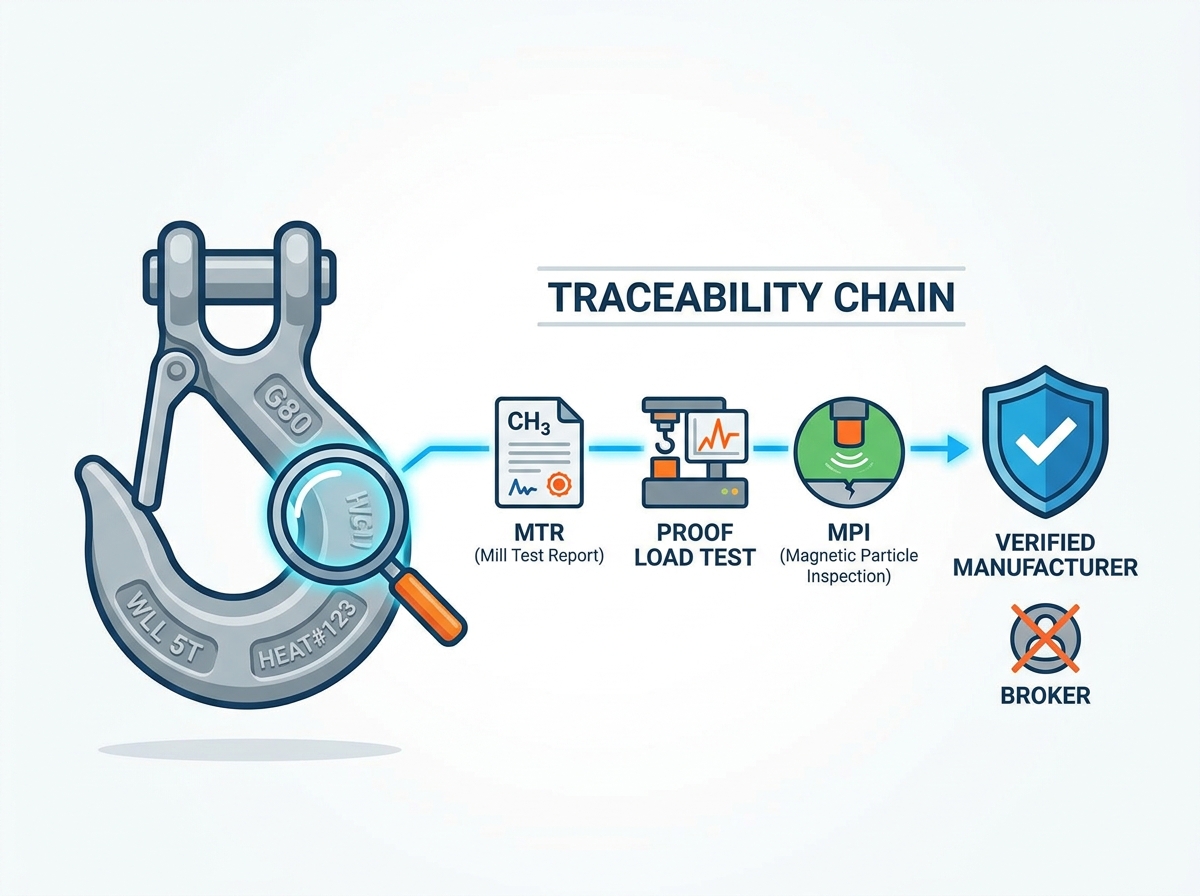
3. Non-Negotiable Compliance and Traceability Standards
Traceability forms the backbone of hardware safety. You cannot verify product integrity without documented historical data. Reputable vendors embed traceability into every production phase.
Strict Batch Traceability
Every authentic industrial component requires permanent raised markings. These forged-in markings survive harsh operational conditions. You must look for the manufacturer ID. The Working Load Limit (WLL) must be clearly visible. Grade indicators ensure operators use correct capacities. The heat trace code is arguably the most important marking. This alphanumeric code links the finished product back to its original steel batch. If a component fails, the heat code allows you to recall the entire affected batch safely.
Essential Testing Certifications
A legitimate lifting hardware supplier willingly provides comprehensive documentation. Never accept verbal assurances regarding safety margins.
Essential Documentation Checklist:
Mandatory Rigging Certification Documents | Document Type | Purpose and Standard Metric | Why It Matters |
| Mill Test Reports (MTRs) | Verifies raw chemical composition of the steel. | Ensures the alloy meets exact metallurgical requirements before forging begins. |
| Proof Load Certificates | Confirms testing at 2x to 2.5x the Working Load Limit. | Validates the component can handle stated capacities without permanent deformation. |
| Destruction Test Data | Proves the minimum 4x WLL design safety factor. | Guarantees a safe margin of error against sudden dynamic shock loads. |
Global Regulatory Alignment
Check vendor familiarity regarding global safety standards. Ignorance of regional regulations signals a lack of professional maturity. North American buyers should demand compliance with ASME B30.10. OSHA regulations heavily reference these ASME standards. European markets require strict adherence to EN 1677 specifications. Always verify documentation aligns exactly with your local regulatory frameworks.
4. Vetting the Lifting Hook Supplier: Factory Floor and QA Realities
Many online profiles project false industrial capabilities. You must distinguish between genuine factories and trading intermediaries. Partnering with the actual manufacturer ensures accountability.
Manufacturer vs. Intermediary
Brokers frequently mark up prices while hiding true production origins. You lose direct control over quality assurance when using intermediaries. To verify a lifting hook manufacturer, request live virtual machinery audits. Ask for continuous videos of the factory footprint. Legitimate factories easily demonstrate active drop hammers and heat treatment furnaces. Brokers typically offer only highly polished marketing photos. Look for worker safety equipment and organized production flows. True manufacturers welcome detailed technical questioning.
In-House Quality Control (QC) Infrastructure
A vendor is only as reliable as their testing equipment. Outsourced quality control often leads to dangerous oversight. The factory must possess specific diagnostic machinery on-site.
- Spectrometers: These analyze raw material chemical composition. They ensure inbound steel billets match required alloy specifications perfectly.
- Tensile Testing Machines: Operators use these to conduct proof load and destruction tests. They measure yield strength and ultimate tensile strength.
- Magnetic Particle Inspection (MPI): This non-destructive test detects subsurface micro-cracks. Post-forging cooling sometimes creates invisible flaws. MPI reveals these dangers before shipment.
Best Practice: Ask the vendor for the calibration certificates of their testing machinery. Uncalibrated equipment produces useless safety data.
Evaluating Capacity and Scalability
Assess their ability to handle sudden bulk volume increases. Reliable partners manage growth without compromising quality. Some factories accept massive orders they cannot fulfill internally. They silently outsource overflow production to unvetted sub-tier workshops. This practice introduces dangerous inconsistencies into your supply chain. Demand explicit contract clauses forbidding unapproved subcontracting. Review their maximum monthly tonnage capabilities during the initial audit.
5. Shortlisting Logic and Implementation Risks
Transitioning to a new vendor requires methodical execution. Rushing the onboarding process invites severe operational disruptions. You must validate claims through physical testing.
The Prototype and Sample Phase
Never place a bulk order based solely on digital communications. Order a representative prototype batch first. Inspect dimensional tolerances meticulously upon arrival. A high-quality rigging hook exhibits precise latch spring tension. Sloppy latches indicate poor assembly oversight. Check the finish and coating adhesion. Flaking paint or uneven galvanization signals rushed processing. Most importantly, send random samples to an independent third-party metallurgical lab. Compare these independent results against the vendor's provided MTRs.
Red Flags During Evaluation
Remain vigilant for subtle warning signs during negotiations. Walk away if you encounter these critical red flags:
- Vague Material Sourcing: The vendor cannot name their steel mill partners or provide raw material origin certificates.
- Audit Refusal: They actively discourage or refuse to accommodate third-party factory audits from reputable firms like SGS or TUV.
- Lack of Defect Guaranteases: They show unwillingness to guarantee a specific defect rate in the Service Level Agreement (SLA).
Implementing a Phased Rollout
Transitioning your supply chain requires a structured approach. Avoid swapping your entire inventory overnight. Recommend a pilot order strategy.
- Initial Pilot Order: Procure a small batch representing 10% of your typical monthly volume. Deploy this hardware in controlled, low-risk environments.
- Field Performance Review: Monitor the pilot batch for three months. Gather operator feedback regarding latch usability and wear patterns.
- Volume Scaling: If field data proves satisfactory, increase volume to 50%. Continue auditing testing certificates for every new batch.
- Full Integration: Transition entirely only after consecutive successful deliveries. Maintain routine quarterly quality audits indefinitely.
Conclusion
Sourcing lifting equipment in bulk demands rigorous attention to detail. It represents a delicate balance of metallurgical science, documented safety compliance, and deep vendor transparency. You must look beyond simple unit pricing. Prioritize forged manufacturing, strict batch traceability, and proven in-house testing capabilities. Avoiding intermediaries protects your project timelines and legal standing.
Your next steps should focus on verifiable evidence. Do not rely on promises. Encourage your purchasing team to request an initial technical consultation today. Demand an MTR sample from recent production runs. Schedule a virtual factory audit to verify machinery claims. Taking these proactive steps ensures your supply chain remains resilient, safe, and highly efficient.
FAQ
Q: What is the standard lead time for wholesale lifting hooks?
A: Off-the-shelf standard grade hooks typically ship within 2 to 4 weeks. Custom OEM runs require 8 to 12 weeks. This extended timeline accommodates custom die forging, specialized heat treating, and mandatory batch testing. Ocean freight adds another 3 to 6 weeks depending on destination. Always pad schedules for initial custom orders.
Q: Can a supplier provide OEM customization for specific rigging hooks?
A: Yes, reputable manufacturers offer OEM customization. You will encounter upfront tooling costs for custom forging dies. Minimum order quantities (MOQs) are generally higher to offset setup times. Custom shapes significantly impact load testing requirements. The supplier must create new destruction test benchmarks to guarantee the modified design factor.
Q: How do I verify a G80 hook supplier’s test certificates are authentic?
A: Start by cross-referencing the heat trace numbers forged onto the hardware with the provided MTRs. The alphanumeric codes must match exactly. Furthermore, mandate independent third-party lab testing for your first bulk shipment. Compare the independent yield and tensile results against the vendor's documentation to confirm data integrity.

 English
 العربية
 Français
 Русский
 Español
 Português
 Deutsch
 italiano
 日本語
 한국어
 Nederlands
 Tiếng Việt
 ไทย
 Polski
 Türkçe
 አማርኛ
 ພາສາລາວ
 ភាសាខ្មែរ
 Bahasa Melayu
 ဗမာစာ
 தமிழ்
 Filipino
 Bahasa Indonesia
 magyar
 Română
 Čeština
 Монгол
 қазақ
 Српски
 हिन्दी
 Slovenčina
 Slovenščina
 Norsk
 Svenska
 українська
 Ελληνικά
 Suomi
 Հայերեն
 עברית
 Dansk
 اردو


