Combining mismatched chains and hooks represents a primary cause of rigging failures. It also triggers serious compliance violations across industrial job sites. Operators often assume physical fit equals safety. This assumption creates dangerous working environments. Sizing a hook involves much more than physical clearance. You must ensure precise alignment of metallurgy. We refer to this as the material Grade. Working Load Limits (WLL) and attachment mechanics also demand careful coordination. We aim to provide a technical, objective framework here. You will learn how to select and match the correct hook to your existing or planned assemblies. This guide focuses strictly on verifiable safety standards rather than guesswork. Relying on engineered metrics ensures every lift meets strict regulatory requirements.
Key Takeaways
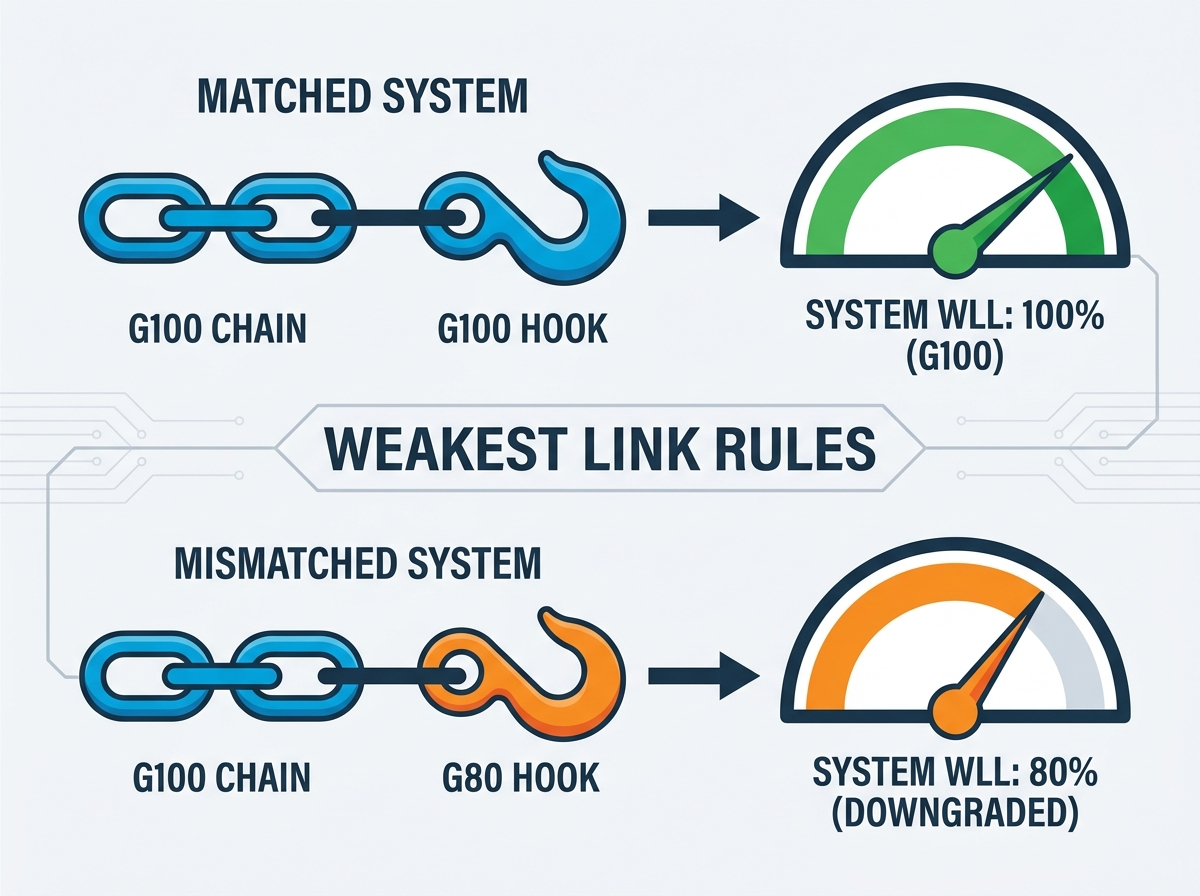
- The Working Load Limit (WLL) of the entire lifting assembly is dictated by its weakest component; chain and hook grades must match.
- Direct-connect (clevis) hooks eliminate the need for intermediate coupling links, simplifying inspection.
- Hook profile selection (sling, grab, or foundry) must be driven by the load's geometry and the hitch type.
- ASME B30.10 and OSHA compliance require documented alignment of rigging hardware components.
The Golden Rule of Matching: Grade and Working Load Limit (WLL)
Many riggers misunderstand the concept of component downgrading. A Grade 100 chain paired with a G80 hook immediately reduces the overall assembly capacity. The entire system drops to Grade 80 standards. The weakest component always dictates the ultimate Working Load Limit. Rigging engineers design lifting systems based on this weakest link principle. You cannot lift Grade 100 capacities just because the chain supports it.
Material compatibility matters deeply in heavy lifting environments. You must match the hook metallurgy directly to the lifting chain. Cross-matching different materials introduces extreme risks during dynamic lifts. Different grades possess distinct elasticity and elongation properties. They stretch at vastly different rates under heavy stress. Unpredictable stretching causes sudden load shifts. It can also lead to premature metal fatigue in the stronger component.
Manufacturer traceability serves as your primary defense against mismatched hardware. Always verify standard stamped markings before finalizing compatibility. You must look for three specific indicators on every piece of hardware. First, locate the size stamp. Second, find the Grade marking. Third, identify the specific manufacturer code. Never use unmarked hardware for overhead lifting. If these marks fade beyond recognition, you must remove the component from service immediately.
Best Practices for Verifying Markings
- Clean the hardware surface thoroughly before inspection.
- Use a flashlight to check for faint stamps in the metal.
- Cross-reference the manufacturer code against your approved vendor list.
- Document the Grade and WLL in your daily rigging log.
Clevis Hook vs. Eye Hook: Evaluating Attachment Methods
Understanding attachment mechanics prevents catastrophic mechanical failures. A clevis hook offers a distinct primary operational advantage. It attaches directly to the chain link. You secure it using a specialized load pin and a cotter pin. This direct connection drastically minimizes the component count. It simplifies the overall design of your chain sling. Fewer moving parts mean fewer points of potential failure. It also speeds up your mandatory pre-lift inspections.
Eye hooks serve an entirely different structural purpose. You need them when incorporating intermediate coupling links. They also accommodate swivel mechanisms perfectly. Swivels become mandatory for loads requiring rotational freedom during the lift. The eye provides a closed loop for mechanical couplers to grab. You cannot attach an eye hook directly to a standard chain link.
We must evaluate both options carefully based on specific field conditions. Consider the ease of field replacement first. Clevis pins allow quick swapping if the hook suffers damage. Eye hooks usually require cutting links or replacing mechanical couplings entirely. Next, evaluate inspection complexity. The direct clevis connection presents a highly visible inspection point. Eye hook assemblies obscure wear points inside the coupling linkages.
Attachment Method Comparison Chart
| Feature | Clevis Style | Eye Style |
| Attachment Mechanism | Direct via load pin and cotter pin | Requires mechanical coupling link |
| Component Count | Low (Direct connection) | High (Requires extra hardware) |
| Rotational Freedom | Rigid inline positioning | High (When paired with a swivel) |
| Field Replacement | Fast and straightforward | Time-consuming and complex |
| Inspection Difficulty | Simple visible wear points | Hidden wear inside coupling links |
Selecting the Correct Lifting Chain Hook Profile for the Load
Load geometry strictly dictates your optimal hook profile choice. Standard sling hooks remain the default option for general lifting tasks. They feature a wide throat opening. They also require functional safety latches. Operators rely on them for straightforward overhead rigging. The latch keeps the load line seated securely inside the bowl. You must never modify or grind down a sling hook to force a fit.
Grab hooks serve a highly specific operational function. You use them exclusively to shorten a chain leg. They also excel at creating secure loop structures. Standard grab hooks pinch the chain link directly. This severe point-loading creates a dangerous stress riser. It typically reduces the overall Working Load Limit by 20%. Cradle-style grab hooks avoid this penalty. They feature integrated side supports. These supports cradle the link and maintain full assembly strength.
Foundry hooks accommodate massive, bulky load connections. You find them in specialized environments demanding oversized throat openings. Traditional safety latches prove entirely impractical in these extreme heat settings. Strict compliance conditions govern their use heavily. OSHA requires specific administrative controls when operating latchless foundry hooks. Riggers must ensure continuous tension on the line at all times.
Self-locking hooks provide maximum security for high-risk lifts. They represent a premium lifting chain hook solution. The primary latch mechanism locks automatically under load tension. This design prevents accidental rollout during dynamic or unpredictable lifts. Operators favor them in construction zones. They remain securely locked until the operator manually releases the trigger.
Common Mistakes in Profile Selection
- Using a standard grab hook without calculating the 20% capacity reduction.
- Deploying foundry hooks outside of approved, specialized industrial zones.
- Forcing a large synthetic sling into a narrow grab hook throat.
- Failing to clean the locking mechanism on self-locking hooks, causing them to jam.
Lifting Eye vs. Chain Hook: Making the Right Engineering Choice
Field operators often debate rigid lifting eyes versus flexible assemblies. Framing the application correctly solves this engineering debate. Load geometry should drive your final equipment choice. You should use rigid lifting eyes for fixed anchor points. Machined machinery components often feature engineered holes for these eyes. They provide a highly stable, predictable connection for straight vertical lifts.
Use a flexible chain hook for choking or basket-hitching techniques. They excel when you must attach to non-standard geometric shapes. Flexible assemblies adapt to rough or uneven load contours. They allow the rigging system to find its natural center of gravity. Rigid eyes cannot adapt to shifting loads dynamically. You must match the connection method to the load's physical reality.
Side-loading introduces critical mechanical risks to your assembly. Standard hooks cannot handle angular tension safely. Side-loading forces stress the hook body improperly. It pushes tension against the latch or the hook tip. This creates an extreme risk of catastrophic deformation. Swivel hoist rings offer a vastly superior alternative for angular tension. They rotate freely to align perfectly with the load path. You should always substitute them for rigid eyes during complex angular lifts.
Implementation Risks and Field Inspection Standards
Field implementation presents numerous unpredictable mechanical hazards. Dimensional mismatches occur frequently on fast-paced job sites. Riggers sometimes try to force oversized links into restrictive clevis channels. This severe error causes mechanical binding. It prevents natural articulation during the lifting process. The assembly must move freely under tension to distribute weight evenly. Binding forces all the stress onto the connecting pin. This causes premature shear failure.
Wear and deformation demand strict, measurable rejection criteria. You must measure the throat opening regularly using calipers. Reject the hardware immediately if you find 5% elongation. Elongation indicates extreme overloading events. Check the inner saddle area closely as well. A 10% wear reduction in the saddle requires immediate replacement. Metal loss weakens the bowl structure significantly. It compromises the core integrity of the equipment.
Safety latch integrity also fails frequently in harsh field conditions. Operators sometimes illegally bypass or completely remove these protective latches. They do this to speed up attachment times. Compliant rigging hardware must always feature functioning latches. ASME B30.10 strictly governs these requirements. The engineered lift plan must specifically exempt latches if they are absent. Never operate compromised hardware based on convenience. Document every inspection to maintain a clear chain of safety compliance.
Conclusion
Matching a hook requires solving a multi-variable engineering equation. You must carefully calculate Grade, physical size, attachment style, and load profile. Ignoring even one variable jeopardizes the entire lifting operation. Safe rigging relies entirely on predictable equipment behavior. Mismatched components destroy that vital predictability. We recommend conducting a full hardware audit of all existing slings immediately.
Take actionable steps to standardize your hardware procurement. Standardizing entirely on Grade 100 prevents dangerous cross-contamination on the job site. It removes the guesswork for your riggers entirely. Separate incompatible hardware into locked storage bins. Finally, consult a certified rigging engineer for any custom assembly designs. They provide the necessary calculations for complex lifts. Prioritize verifiable safety over temporary operational convenience.
FAQ
Q: Can I use a Grade 80 chain hook on a Grade 100 chain?
A: Yes, but it legally downgrades the lifting capacity of the entire assembly to Grade 80 limits. It is not recommended due to the risk of operator confusion.
Q: Do I need a coupling link if I use a clevis hook?
A: No. Clevis hooks are designed to connect directly to the chain link, eliminating the need for a mechanical coupling link.
Q: Why does my grab hook reduce the Working Load Limit?
A: Standard non-cradle grab hooks point-load the chain link, creating a stress riser that typically requires a 20% WLL reduction under standard ASME guidelines.

 English
 العربية
 Français
 Русский
 Español
 Português
 Deutsch
 italiano
 日本語
 한국어
 Nederlands
 Tiếng Việt
 ไทย
 Polski
 Türkçe
 አማርኛ
 ພາສາລາວ
 ភាសាខ្មែរ
 Bahasa Melayu
 ဗမာစာ
 தமிழ்
 Filipino
 Bahasa Indonesia
 magyar
 Română
 Čeština
 Монгол
 қазақ
 Српски
 हिन्दी
 Slovenčina
 Slovenščina
 Norsk
 Svenska
 українська
 Ελληνικά
 Suomi
 Հայերեն
 עברית
 Dansk
 اردو


