A compromised lifting hook represents a critical single point of failure on any job site. It completely bypasses all other safety redundancies built into your overhead rigging systems. We often see facilities relying heavily on basic assumptions rather than standardized visual checks. This dangerous oversight leads directly to catastrophic load drops. It also triggers severe OSHA citations and causes massive unplanned operational downtime.
We must shift our focus away from reactive maintenance. Waiting for an annual review invites disaster onto the shop floor. Our objective is to provide a standardized, ASME-aligned framework for evaluating your lifting hardware properly. We will detail the exact deformation limits and compliance rules you must follow daily. By applying this methodology, you ensure uncompromised lifting safety before every single shift begins.
Key Takeaways
- Regulatory Baseline: ASME B30.10 dictates exact criteria for frequent (pre-shift) and periodic (documented) inspections.
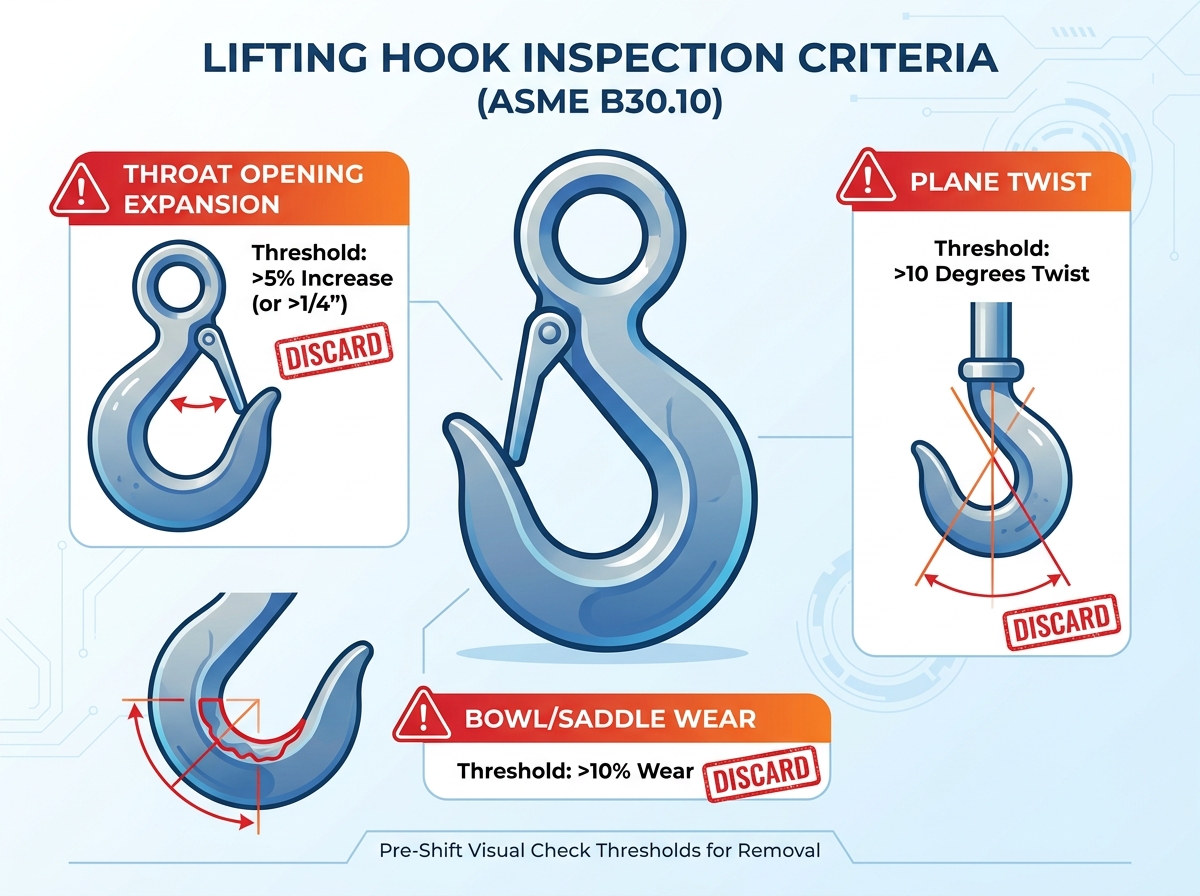
- Deformation Thresholds: A hook must be removed from service if throat opening increases by >5% (or 1/4"), wear exceeds 10%, or twisting exceeds 10 degrees.
- Zero-Tolerance Repair: Heating, welding, or reshaping a damaged hook structurally compromises the alloy and is strictly prohibited.
- Process Scalability: Standardizing daily checks through mobile checklists or software prevents minor hook wear from escalating into critical failures.
The Business Case for a Rigorous Rigging Inspection Standard
Many organizations write excellent theoretical safety policies for their operations. However, actual shop-floor execution often falls incredibly short. We must address this dangerous gap immediately. Visual pre-shift checks prevent the vast majority of hardware failures. Operators serve as the first line of defense against accidents. When they skip these daily visual evaluations, risk multiplies exponentially.
Ignoring hardware degradation metrics leads to severe operational consequences. The costs extend far beyond just replacing a broken part. We routinely see immense financial damage stemming from poor maintenance habits. Consider the following immediate risks:
- Massive liability claims arising from severe workplace injuries.
- Expensive structural facility damage caused by uncontrolled load drops.
- Severe operational delays while awaiting specialized replacement equipment.
- Steep regulatory fines levied during surprise OSHA site audits.
A successful protocol looks remarkably simple in practice. It requires standardized daily execution across all departments. Documentation must remain completely uncompromised and easily accessible. Most importantly, teams need zero ambiguity regarding removal criteria. When workers know exactly when to scrap a component, workplace accidents plummet. Clear rules empower operators to make safe, confident decisions daily.
ASME B30.10 Framework: What Compliance Actually Requires
ASME B30.10 serves as the absolute industry benchmark globally. It dictates strict criteria for proper crane hook inspection and daily maintenance. OSHA auditors rely heavily on this precise framework during their investigations. You must adopt it as your primary operational baseline. Understanding these rules protects your personnel and your company simultaneously.
The standard divides evaluations into two distinct categories. Facilities must execute both types flawlessly to maintain full compliance. The chart below outlines the key differences between these two critical processes.
Inspection Frequency Comparison Chart
| Criteria | Frequent Inspection | Periodic Inspection |
| Executor | Crane Operator or Rigger | Designated Qualified Professional |
| Frequency | Pre-shift or Daily | Annually (or more based on severity) |
| Documentation | No formal records required | Written or digital records mandatory |
| Method | Visual checks, operational tests | Comprehensive assessment, possible NDT |
Competency requirements remain incredibly strict under these guidelines. Not just anyone can sign off on a load-bearing evaluation. A "qualified person" must hold specific industry certifications. Alternatively, they must possess extensive verifiable field experience. They carry the legal and technical authority to authorize continued equipment use. Never assign periodic evaluations to untrained personnel.
Step-by-Step Lifting Hook Inspection SOP (Pre-Shift)
Verifying Identification and Load Ratings
You must confirm the manufacturer identification remains entirely legible. Check the Safe Working Load (SWL) markings immediately before lifting anything. Missing or unreadable tags require immediate removal from active service. Operators cannot guess equipment capacity safely under any circumstances. Replace missing tags only through the original equipment manufacturer. Ensure all identification data aligns perfectly with your rigging plan.
Visual Hardware and Surface Assessment
Inspect the entire steel body carefully from top to bottom. Look closely for deep nicks, gouges, or hairline cracks. Severe corrosion compromises structural integrity rapidly in harsh environments. Pay special attention when evaluating a sling hook before your shift begins. Check its attachment eye thoroughly for uneven friction patterns. Overhead crane blocks require a slightly different approach. You must inspect the entire block housing interface closely. Dirt and heavy grease often hide dangerous microscopic cracks.
Follow this numbered sequence for a reliable visual assessment:
- Wipe away all grease and dirt using a clean rag.
- Scan the attachment eye or clevis pin for signs of stretching.
- Examine the outer bowl for impact gouges or blunt force damage.
- Inspect the inner saddle for deep rope grooves or pitting.
Testing the Safety Latch Mechanism
Ensure the safety latch bridges the throat opening completely. It must rest flush against the inner tip. Test the internal spring mechanism manually by hand. Watch closely for binding, stiffness, or a complete lack of tension. A missing or inoperable latch mandates an immediate lockdown of that asset. Never tape or wire a broken latch shut. This makeshift fix introduces massive operational hazards.
Checking Articulation and Bearings
Swivel models demand extra attention during your morning routine. Verify smooth rotation across a full 360-degree range. You should feel no excessive vertical clearance or wobbling. Grinding sounds indicate severe bearing degradation inside the upper housing. If the swivel binds under no load, it will certainly fail under pressure. Remove sticky or grinding units from service immediately for further maintenance.
Deformation Limits: When to Discard a Damaged Hook
Throat Opening Expansion Limits
Define this strict threshold clearly for all your rigging operators. Discard the unit immediately if the throat opening increases significantly. ASME sets the limit at more than 5% of its original manufacturer dimension. Furthermore, this total expansion must never exceed 1/4 inch overall. Throat stretching proves severe overloading occurred during a previous lift. Once the metal yields, it loses its engineered strength permanently.
Plane Twist and Bending Parameters
Specify the lateral bending limits strictly to your floor teams. Any visible twist exceeding 10 degrees from the unbent plane demands immediate scrapping. A twisted body loses its original load distribution geometry completely. Forces no longer travel down the engineered center line. This offset stress creates massive shear forces on the shank. We recommend using a digital angle gauge for precise verification when in doubt.
Assessing Hook Wear in the Bowl/Saddle
Establish the saddle wear limit clearly across your facility. You must remove the hardware if hook wear in the load-bearing saddle exceeds 10 percent. Compare this current measurement against the original cross-sectional dimension. The saddle bears the entire weight during every lift you make. Wire ropes and chain links grind against this steel bowl constantly. Grab a precise caliper to measure this critical zone accurately. Never guess the wear percentage using just your eyes.
The "No-Repair" Rule
Clarify the underlying metallurgical reality immediately to your maintenance staff. Field repairs destroy the internal grain structure of forged steel. Heating or welding a damaged hook alters its factory heat treatment permanently. This reckless action voids all manufacturer load ratings instantly. The alloy becomes dangerously brittle and unpredictable under stress. The industry enforces a strict zero-tolerance policy regarding such repairs. Never attempt to reshape bent hardware using a torch or press. Discard it immediately and buy a compliant replacement unit.
Implementing a Standardized Rigging Inspection Program
Transitioning from Paper to Digital
Evaluate paper checklist limitations honestly to improve your workflows. Paper forms get lost easily in busy industrial environments. They also succumb to grease, dirt, and daily wear quickly. Digital asset management software tracks hardware degradation over time perfectly. It allows facility managers to spot dangerous wear trends early. Digital systems also force operators to complete every field before submitting their daily report.
Standardizing the Checklist
Recommend integrating specific ASME B30.10 data points deeply into your systems. Build these precise metrics into daily maintenance checklists directly. This action eliminates operator guesswork entirely on the shop floor. We need clear yes-or-no decisions regarding hardware safety. List the 5% stretch and 10% wear rules boldly on every form. Standardized questions yield standardized, highly reliable safety outcomes.
Shortlisting Third-Party Experts
Establish strict criteria for selecting your external safety vendors. You need highly reliable third-party rigging inspection services for peace of mind. They handle your annual periodic reviews with professional accuracy. Look for technicians holding recognized national certifications in material handling. Ensure they understand your specific heavy lifting applications fully. They should also perform Non-Destructive Testing (NDT) competently when required. Ask for sample audit reports before signing any long-term service contracts.
Next-Step Actions
Guide your facility managers clearly toward immediate corrective actions. Conduct a comprehensive audit of your current hardware inventory today. Identify and retire all non-compliant or damaged assets immediately. Quarantine these items in a locked bin to prevent accidental reuse. Schedule bulk replacement orders quickly to maintain normal workflow speeds. Finally, schedule a mandatory safety briefing to review these ASME standards with your entire operational crew.
Conclusion
An effective lifting hook inspection acts as a non-negotiable operational standard. It is never just a simple compliance checkbox for auditors. Reiterate these crucial rules to your team frequently. Utilizing strict, quantifiable thresholds removes dangerous subjective guessing entirely. Stick firmly to the 5% stretch rule. Enforce the 10% wear limit strictly. Never ignore a 10-degree plane twist under any circumstances.
Take immediate, decisive action today to secure your operations. Download a standardized facility maintenance checklist for your operators. Alternatively, schedule a comprehensive evaluation using a certified rigging expert immediately. Protect your personnel and secure your valuable facility assets against catastrophic failures.
FAQ
Q: Can a damaged lifting hook be repaired by welding?
A: No. Welding introduces localized heat that destroys the original metallurgical heat treatment, drastically reducing the safe working load limit.
Q: How often should a crane hook undergo Non-Destructive Testing (NDT)?
A: NDT (like magnetic particle or dye penetrant testing) is not strictly mandated by ASME B30.10 for daily use but is highly recommended during annual periodic inspections or after severe overloading incidents.
Q: What is the difference between a frequent and periodic inspection?
A: Frequent inspections are visual checks done pre-shift or daily by the operator. Periodic inspections are documented, highly detailed evaluations performed by a designated, qualified professional (annually, or more frequently based on use severity).
Q: Are safety latches legally required on all lifting hooks?
A: In most material handling applications (under OSHA and ASME guidelines), latches are required to retain slings or loads unless a specific, evaluated lifting plan dictates that a latch introduces a greater hazard.

 English
 العربية
 Français
 Русский
 Español
 Português
 Deutsch
 italiano
 日本語
 한국어
 Nederlands
 Tiếng Việt
 ไทย
 Polski
 Türkçe
 አማርኛ
 ພາສາລາວ
 ភាសាខ្មែរ
 Bahasa Melayu
 ဗမာစာ
 தமிழ்
 Filipino
 Bahasa Indonesia
 magyar
 Română
 Čeština
 Монгол
 қазақ
 Српски
 हिन्दी
 Slovenčina
 Slovenščina
 Norsk
 Svenska
 українська
 Ελληνικά
 Suomi
 Հայերեն
 עברית
 Dansk
 اردو


