Heavy lifting operations demand absolute precision. The biggest threat to job site safety often stems from unpredictable load rotation. Wire ropes can twist violently under immense strain. Without proper hardware, rotational forces rapidly degrade expensive rigging equipment. They can also cause suspended loads to spin dangerously out of control. Riggers and crane operators face a constant battle against this torque buildup during complex lifts. You must neutralize these forces to ensure site safety and protect your hardware.
We will explore how a specialized swivel hook mitigates these dangerous rotational forces. You will learn the mechanical differences between bearing and non-bearing designs. We will also outline crucial OSHA compliance requirements governing their use. Finally, we provide a practical framework for selecting the exact hardware your lift demands. Choosing the right components ultimately protects your crew and your bottom line.
Key Takeaways
- Swivel hooks utilize a rotating eye to allow for easier load alignment and to prevent lifting lines from twisting.
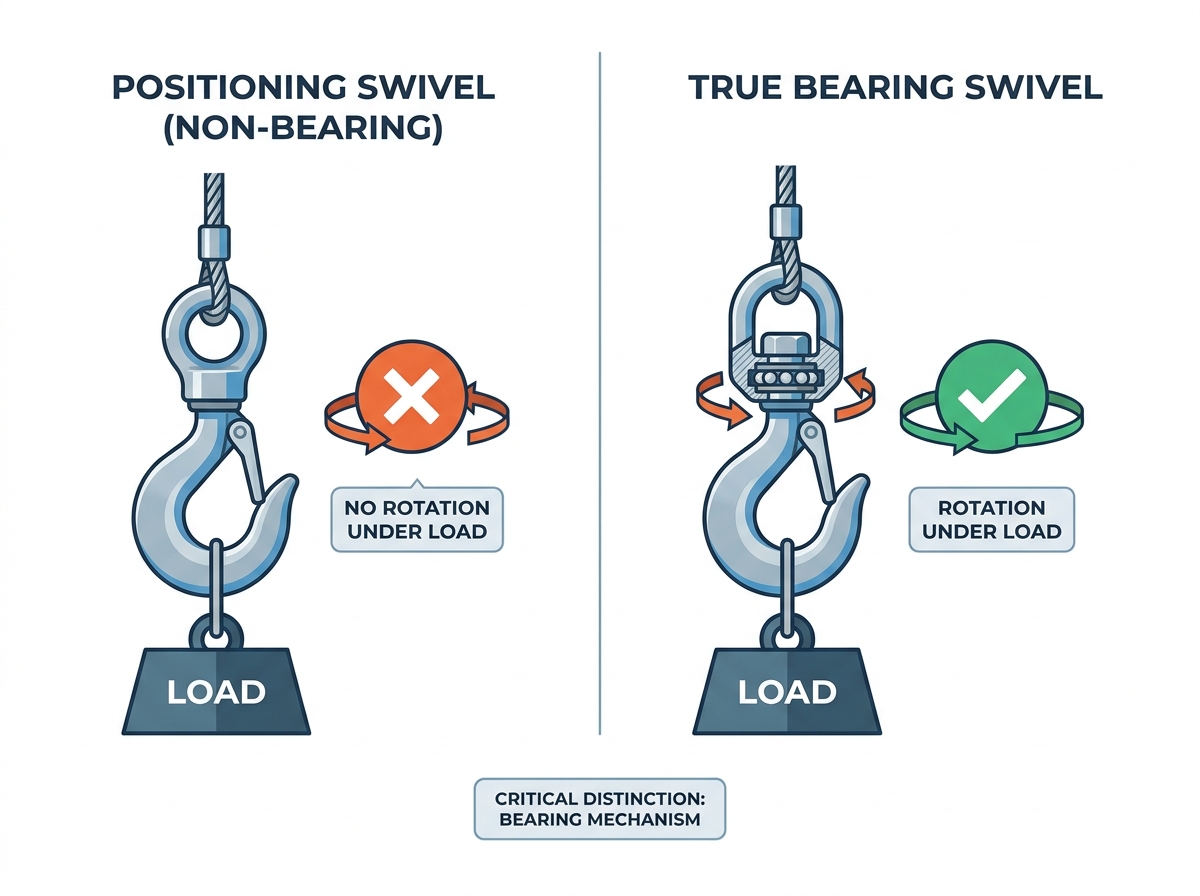
- There is a critical operational difference between positioning swivels (not designed to rotate under tension) and bearing swivels (designed to rotate under full load).
- Selecting a crane swivel hook requires evaluating Working Load Limits (WLL), bearing types, and mandatory safety features like integrated latches.
- Upgrading from standard fixed hooks to swivel designs increases initial procurement costs but significantly extends the lifespan of wire ropes and rigging gear.
The Mechanics of a Swivel Hook
To understand how this hardware functions, you must first examine its structural anatomy. The defining feature is the pivoting joint. Industry professionals often call this the swivel bail or the eye. This joint connects the main body of the hook to the rest of your rigging assembly. It allows the lower bowl to spin independently from the upper connection point. This mechanical separation isolates rotational forces.
Manufacturers rely heavily on specialized metallurgy to produce these components. An alloy steel hook provides maximum tensile strength. It also delivers exceptional durability in harsh industrial environments. Alloy steel undergoes quenching and tempering processes. This heat treatment grants the metal a superior strength-to-weight ratio. As a result, the hardware can support massive loads without becoming too bulky for practical daily use.
You can clearly see the advantages when contrasting these tools with standard fixed hardware. Rigid eye hooks and clevis hooks lock your rigging assembly into a single orientation. If a suspended load shifts or spins, a fixed connection forces the entire lifting line to rotate. This rigid constraint places immense stress on the crane block. It also makes manual load alignment incredibly difficult for ground crews. A pivoting joint eliminates these operational friction points.
Bearing vs. Non-Bearing: The Most Critical Distinction
The rigging industry categorizes pivoting hardware into two distinct functional groups. You must never confuse them. Swapping one for the other creates severe safety hazards on the job site. The primary distinction lies in how the internal mechanism handles tension. Let us examine the specific engineering behind each category.
Positioning Swivels (Non-Bearing)
Engineers design positioning swivels strictly for pre-lift alignment. You use them to align the hardware with the load before applying any upward tension. They lack internal bearings. When you lift the load, metal-on-metal friction locks the shank securely against the bail. The assembly becomes completely rigid.
This design introduces a massive risk factor. You must never attempt to rotate a non-bearing swivel under a heavy load. The sheer frictional force binds the internal components. Forcing the load to spin can easily shear the internal pin or strip the retaining nut. This mechanical failure leads directly to dropped loads and catastrophic accidents. If you need continuous rotation, a positioning model will fail.
True Bearing Swivels
True bearing swivels contain specialized internal components. Manufacturers typically equip them with enclosed thrust bearings or tapered roller bearings. These internal rollers separate the load-bearing surfaces. They drastically reduce friction within the joint assembly.
A true crane swivel hook is engineered to rotate freely. It maintains this rotation while supporting its absolute maximum Working Load Limit (WLL). You deploy these components for specific, demanding use cases. They excel in operations where continuous load rotation is required. They also protect your gear when uncontrollable rotation is simply unavoidable during the lift.
Comparison Chart: Bearing vs. Non-Bearing Swivels
| Feature | Positioning Swivel (Non-Bearing) | True Bearing Swivel |
| Internal Mechanism | Simple pin and shank assembly | Tapered roller or thrust bearings |
| Rotation Under Load | Strictly prohibited | Fully rated for maximum WLL |
| Primary Application | Pre-lift alignment only | Continuous rotation during lifts |
| Failure Risk | High if forced to spin under tension | Low, engineered for dynamic spinning |
| Maintenance Needs | Low (visual inspection) | High (regular lubrication required) |
When to Specify a Swivel Hook in Your Lift Plan
Drafting a comprehensive lift plan requires foresight. You must anticipate how dynamic forces will act upon the suspended load. Choosing the right hardware at the planning stage prevents costly delays. Here are the primary scenarios where these pivoting components become indispensable.
Preventing Wire Rope Damage
Wire ropes possess a natural tendency to unlay or unwind. Manufacturers construct them by winding steel strands in a helical pattern. When you apply massive downward tension, the rope naturally attempts to straighten itself. This physical reaction generates intense rotational torque. If this torque travels down to a fixed connection point, it damages the rope's structural integrity.
Utilizing a pivoting rigging hook safely absorbs this torque. The internal bearing allows the block to spin freely in response to the wire rope's unlaying force. This prevents structural core damage. It also stops the rope from bird-caging, a fatal defect where outer strands permanently separate from the core.
Precise Load Positioning
Many construction tasks demand millimeter-perfect alignment. Setting structural steel beams requires extreme precision. Positioning heavy industrial machinery inside tight manufacturing facilities leaves no margin for error. Ground crews must physically guide these loads into their final resting places.
A pivoting connection makes this manual guidance possible. Riggers can freely rotate the suspended load by hand or via taglines. They can achieve this without torqueing the crane block above. This isolation keeps the main lifting line perfectly stable while the load rotates underneath it. It ensures a safer, faster, and more controlled installation process.
Complex Rigging Assemblies
Modern lifting operations frequently rely on multi-leg sling setups. Bridle slings use three or four legs to distribute weight evenly across a large payload. Connecting these complex assemblies to a single point creates geometric challenges.
You can use a pivoting component as the primary connection point between the crane block and the sling legs. The rotating eye adjusts naturally as tension shifts between the different legs. This movement reduces dangerous binding. It also minimizes premature wear on the expensive shackles and master links within the assembly.
Evaluation Dimensions and Compliance Standards
Hardware selection goes beyond simple mechanics. You must navigate strict regulatory environments. Safety organizations establish rigorous guidelines to prevent workplace fatalities. Meeting these standards requires thorough evaluation of your equipment before every shift.
Safety and Compliance (OSHA/ASME)
Federal regulations mandate strict adherence to safety protocols. OSHA and the American Society of Mechanical Engineers (ASME) provide the guiding frameworks. Specifically, you must consult the ASME B30.10 standard for hardware compliance. This standard dictates the structural requirements for all lifting connections.
You must prioritize using a hook with latch to meet these safety mandates. The spring-loaded latch crosses the throat opening. It serves a singular, life-saving purpose: preventing accidental sling disengagement. If the load momentarily snags or the crane line goes slack, the latch traps the sling inside the bowl. Operating without a functional latch violates ASME standards unless a highly specialized, pre-approved lift plan dictates otherwise.
Working Load Limit (WLL) and Design Factor
You must accurately match the hardware's rating to the specific demands of your hoist. The Working Load Limit (WLL) represents the absolute maximum weight the component can safely suspend. You will find this number permanently forged into the metal body.
However, static weight calculations rarely tell the whole story. You must account for dynamic loading. Wind gusts, jerky crane movements, and sudden stops multiply the actual force exerted on the hardware. Manufacturers apply a design factor to account for these dynamic stresses. You must ensure the chosen crane hook offers a sufficient safety margin to absorb sudden shock loads without deforming.
Inspection and Maintenance Scalability
Upgrading your hardware introduces new maintenance responsibilities. You must evaluate this overhead before purchasing. Bearing swivels demand regular upkeep. You must establish strict lubrication schedules to keep the internal thrust bearings functioning smoothly. Neglecting grease fittings leads to rapid internal corrosion.
Your safety managers must also execute rigorous inspection criteria. Follow this standard five-step checklist before authorizing a lift:
- Check the throat opening for visible spreading or deformation. A widened throat indicates extreme overloading.
- Inspect the internal bearing mechanism for smooth, silent rotation. Grinding noises indicate shattered rollers.
- Examine the swivel nut and retaining pin for thread wear or backing out.
- Test the latch spring integrity. The latch must snap shut forcefully against the tip.
- Review the metal body for gouges, cracks, or unauthorized welding repairs.
Shortlisting Logic: Swivel Hook vs. Standard Lifting Hook
Procurement teams often struggle to justify equipment upgrades. You need a reliable framework to evaluate costs against operational benefits. Understanding the long-term return on investment simplifies the purchasing process.
Cost vs. Outcome
We must acknowledge the higher initial procurement cost of bearing swivels. A precision-engineered thrust bearing assembly naturally costs more than a solid piece of forged steel. However, focusing solely on the upfront price tag obscures the real financial impact.
You justify this ROI through massive reductions in wire rope replacement costs. Wire ropes fail prematurely when subjected to constant torque and unlaying forces. A pivoting lifting hook neutralizes these forces. This hardware extension significantly prolongs the life of your most expensive rigging assets. Furthermore, faster load handling times reduce expensive crane rental hours.
Decision Framework
Use this straightforward decision logic to shortlist your equipment:
- Is load rotation required during the lift? You must choose a bearing swivel. It safely handles continuous spinning under maximum tension.
- Is rotation only needed for initial attachment? You should choose a positioning swivel. It allows ground crews to align the connection before applying tension.
- Is load rotation strictly prohibited? You must choose a fixed connection and utilize multiple taglines to restrict all movement.
Vendor Selection
Never compromise on manufacturer quality. The market contains dangerous, counterfeit rigging hardware. You must source exclusively from reputable vendors. Demand clear traceability codes forged directly into the metal. These codes track the exact batch of alloy steel used during production. Furthermore, insist on proof testing certificates. Reliable manufacturers physically test their products beyond the stated WLL to guarantee structural integrity.
Conclusion
Swivel hooks remain essential risk-mitigation tools for specific rotational challenges. They protect both your personnel and your expensive lifting equipment. Mastering the distinction between positioning and bearing models represents the most critical step in hardware selection.
Specifying the wrong type of swivel introduces severe, immediate safety risks to your job site. You must never force a non-bearing model to rotate under load. Always ensure your chosen hardware features an operational safety latch to maintain strict ASME compliance.
Moving forward, audit your current rigging inventory. Identify any operations where wire rope unlaying causes premature wear. We strongly encourage you to consult with a certified rigger or structural engineer. They will review your complex load calculations and ensure total hardware compatibility before you finalize any new procurement.
FAQ
Q: Can all swivel hooks rotate under load?
A: No. Only swivel hooks equipped with internal thrust bearings are rated to rotate under load. Non-bearing swivels are for pre-lift positioning only. Forcing a non-bearing model to spin under tension can cause catastrophic failure.
Q: Is a safety latch legally required on a rigging hook?
A: Under OSHA and ASME B30.10 standards, hooks must be equipped with a functional latch. You can only omit a latch if the specific application makes its use impractical or more dangerous. This exception requires a highly specialized, pre-approved lift plan.
Q: How often should a crane swivel hook be inspected?
A: Visual inspections should occur before every shift. Riggers must check for throat deformation and latch integrity daily. Documented, comprehensive periodic inspections by a qualified person should occur at least annually. Severe usage environments dictate more frequent comprehensive checks.
Q: Why are these hooks typically made of alloy steel?
A: Alloy steel undergoes specialized heat treatment, including quenching and tempering. This metallurgy provides the necessary toughness to resist sudden deformation. It offers the required strength to handle massive Working Load Limits without adding excessive bulk to the hardware.

 English
 العربية
 Français
 Русский
 Español
 Português
 Deutsch
 italiano
 日本語
 한국어
 Nederlands
 Tiếng Việt
 ไทย
 Polski
 Türkçe
 አማርኛ
 ພາສາລາວ
 ភាសាខ្មែរ
 Bahasa Melayu
 ဗမာစာ
 தமிழ்
 Filipino
 Bahasa Indonesia
 magyar
 Română
 Čeština
 Монгол
 қазақ
 Српски
 हिन्दी
 Slovenčina
 Slovenščina
 Norsk
 Svenska
 українська
 Ελληνικά
 Suomi
 Հայերեն
 עברית
 Dansk
 اردو


