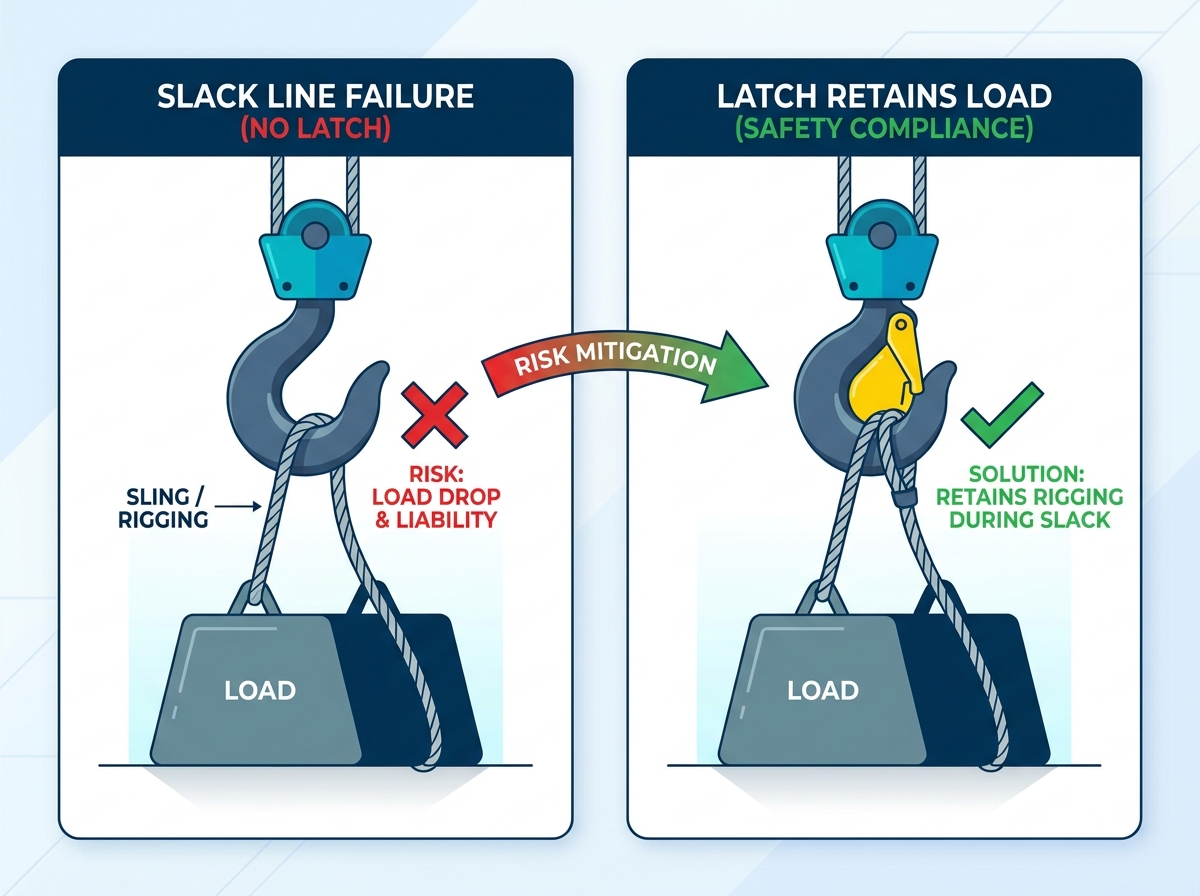
A lifting hook latch is often viewed by field operators as a daily inconvenience. However, from a strict risk management perspective, it represents the absolute frontline defense against catastrophic load drops and severe legal liability. Slack line conditions and dynamic load shifts account for a remarkably high percentage of industrial rigging accidents. During these brief moments, tension drops instantly. The latch is exactly what keeps your hardware contained when tension is temporarily lost. If the load slips out, the consequences are disastrous. This guide bypasses general safety platitudes entirely. We break down the exact compliance standards, mechanical failure points, and evaluation criteria for managing latches on your equipment. You will learn how to inspect your gear properly and ensure maximum operational safety.
Key Takeaways
- Compliance Reality: While OSHA does not have a standalone rule mandating latches on all hooks, ASME B30.10 and OSHA interpretation letters require them if the hook was originally manufactured with one.
- Primary Function: A safety latch hook is not designed to bear loads; its sole purpose is retaining loose slings or rigging hardware during slack conditions.
- Operator Friction: The biggest implementation risk is operators deliberately bypassing latches. Upgrading to self-locking designs can solve this without slowing down workflows.
- Inspection Thresholds: A bent, missing, or spring-compromised latch means the entire hook should be removed from service until repaired by a qualified person.
The Business Problem: Load Drop Risks and Slack Line Failures
Cranes do not operate in a perfect vacuum. A load shifts unexpectedly. It touches the ground a fraction of a second too early. It catches a hidden obstruction during a lift. This creates a highly dangerous "slack line" condition. Tension drops instantly across the rigging system. A strong latch proves its immense value precisely here. It spans the throat opening securely. Gravity and momentum constantly work against you. Slings loosen immediately when tension vanishes. The mechanism prevents these slings from escaping.
What fails first during these momentary losses of tension? The main connection point fails first. Wire rope slings, synthetic webs, or heavy chain links easily slip out of the throat opening. Without a physical barrier, the hardware disengages completely. The moment the crane operator reapplies tension, the unbalanced load crashes down. We see this happen constantly in heavy manufacturing and construction environments. A simple mechanical barrier prevents this disconnection from occurring.
Missing latches cause direct, severe financial outcomes. You face damaged loads and destroyed property. You face immediate OSHA citations under the General Duty Clause. Lifting safety metrics plummet rapidly. Severe operational downtime costs thousands of dollars per hour. Emotional appeals do not fix job sites. Verifiable safety metrics do. If you ignore this small hardware piece, you expose your entire operation to massive legal liability. Risk managers track these incidents closely to prevent insurance premiums from skyrocketing.
OSHA and ASME Standards: Are Latches Legally Mandatory?
People frequently debate regulatory requirements on busy job sites. The OSHA 1976 interpretation clarifies the historical and current regulatory stance. OSHA does not strictly state "all hooks must have latches" across every single application. Instead, they defer directly to manufacturer intent. If a manufacturer builds a hook containing a latch, operating without it constitutes a clear violation. You cannot simply remove a broken component. Removing it alters the approved design specification. Inspectors look for these unauthorized modifications immediately.
The American Society of Mechanical Engineers provides the definitive industry standard. ASME B30.10 dictates specific hardware inspection protocols. If you hoist personnel, you must use a positive locking latch. There are no exceptions. General applications require operational latches if the equipment was originally equipped. For example, a heavy-duty crane hook must retain its original safety hardware to pass annual compliance audits. Inspectors check the spring tension. They check the alignment. They verify the unit operates as originally intended.
Many companies fall into the "hazard recognition" trap. They wrongly assume older hardware without original latches remains inherently compliant today. This is completely false. A safety inspector might deem a specific lift hazardous without a latch. If they do, they can still cite you under general safety provisions. Always default to maximum retention capability. You must protect your workers above minimum baseline rules. Relying on outdated hardware exposes you to unnecessary scrutiny.
Evaluating Latch Mechanisms Across Different Hook Types
You must select the right mechanism based on specific hardware applications. A universal approach fails in complex environments. We need a clear framework for selecting the correct components for varying tasks.
- Crane Hook Integrations: Overhead dynamic lifts require heavy-duty flapper designs. Some operations mandate positive-locking mechanisms. These prevent accidental release during aggressive load swings. Heavy forging processes rely heavily on these robust designs to protect floor workers.
- Swivel Hook Considerations: Mechanisms interact uniquely during rotation. A swivel hook spins under load to release internal torque. This prevents severe line twist. The mechanism must withstand lateral pressure if twisted lines press against it. Standard springs often bend under this severe rotational stress.
- Sling Hook vs. Rigging Hook Latches: Standard spring-loaded models work well for general applications. However, harsh environments crush them rapidly. We contrast these standard options against self-locking designs. A grip-latch secures a sling hook firmly under tension. An industrial rigging hook often requires a forged barrier to survive daily abuse in steel mills or active foundries.
Always verify manufacturer markings before attempting installation. A replacement kit must match the exact grade and working load limit profile of the base hardware. Mismatched grades compromise the entire assembly. You cannot put a low-grade component on an alloy steel body. It will fail instantly during a critical slack event.
Comparison Chart: Latch Mechanism Applications
| Hardware Type | Recommended Mechanism | Primary Environmental Use | Key Vulnerability |
| Overhead Crane | Positive-Locking Flapper | Manufacturing Floors | Lateral impact from swinging loads |
| Swivel Block | Heavy-Duty Spring Loaded | Mobile Crane Operations | Twisting forces pushing outward |
| Sling Attachment | Grip-Latch / Self-Closing | Harsh Construction Sites | Crushing from dropped rigging |
Decision Framework: When to Replace vs. Repair a Latch
Buyers need a strict evaluation matrix for field inspections. You must know exactly when to discard a part completely.
Let us define unacceptable wear during visual inspections. Look for bent flappers first. If the flapper does not bridge the throat perfectly, it fails inspection. Missing springs render the unit completely useless. Severe corrosion weakens the hinge pin over time. We train field inspectors to look for these exact defects daily. A compromised safety latch hook offers zero actual protection. It provides only a dangerous false sense of security for the rigging team.
The throat opening test serves as the most critical diagnostic step.
- Locate the original throat measurement in the manufacturer specifications.
- Measure the current distance between the tip and the bowl using calipers.
- Compare the two numbers. If the body is stretched beyond allowable limits, discard it entirely.
Replacing the mechanism will not fix underlying structural failure. A stretched body indicates catastrophic prior overload. It is a ticking time bomb.
When does it make financial sense to buy a repair kit? High-capacity units warrant repair kits. Smaller, lower-grade hardware is usually cheaper to replace entirely. Do not waste expensive labor hours repairing a twenty-dollar component. Field technicians should carry spare kits for high-value items only.
Decision Matrix: Repair vs. Replace Guidelines
| Condition Observed | Diagnostic Action | Required Outcome |
| Bent Flapper | Check throat alignment | Replace Kit |
| Missing Spring | Inspect hinge pin for damage | Replace Kit |
| Stretched Throat | Measure against OEM specs | Replace Entire Hook |
| Deep Gouges in Body | Assess depth of structural wear | Replace Entire Hook |
Implementation Risks and Overcoming Operator Resistance
We must acknowledge a harsh field reality regarding daily operations. Operators frequently tape back or remove retention mechanisms completely. They do this because standard springs make one-handed rigging exceptionally difficult. Cumbersome hardware slows down fast-paced cycle times significantly. Workers prioritize speed over strict compliance. This widespread "tape-back" phenomenon creates massive undocumented risk across job sites. Managers often ignore it until an accident occurs.
You must address the actual root cause of this behavior. Do not just punish the operator blindly. If workers constantly bypass the system, you are likely using the wrong hardware style. You are forcing them to fight their equipment all day long. Traditional spring-loaded designs pinch thick gloved hands. They require awkward angles to open properly. Frustration leads directly to unsafe workarounds.
We recommend upgrading to self-closing models immediately. Modern triggers are ergonomically designed for heavy work gloves. They lock automatically under applied tension. They release easily when pressed intentionally by the user. This eliminates the common excuse of operational friction. You maintain strict safety compliance. You also keep your workflow moving efficiently. Give your team the right tools, and they will use them correctly.
Conclusion
Lifting hardware latches serve as critical engineering controls for risk mitigation. They are never optional accessories for convenience.
- Conduct an immediate visual audit of all active hardware on your job site today.
- Tag out any item displaying a missing, bent, or sprung retention mechanism.
- Establish a clear reporting process so operators can request replacements without penalty or delay.
- Upgrade high-use setups to self-locking ergonomic designs to reduce worker fatigue and lower bypass rates.
Contact your rigging specialists immediately to procure certified replacement kits. Alternatively, request a comprehensive site inspection to ensure your operations meet all current ASME standards. Secure your loads today to prevent disasters tomorrow.
FAQ
Q: Can you lift with a hook that has a broken latch?
A: No. It must be tagged out of service immediately. You cannot use it until a replacement kit is installed by a competent person. Operating with broken retention hardware violates industry safety standards.
Q: Do all lifting hooks require a safety latch?
A: Most standard operations require them. There are narrow exceptions for specific dragline operations or custom sorting applications where a latch creates greater hazards. However, standard industrial applications always require them if originally equipped.
Q: Can I install a makeshift latch on an older hook?
A: No. Only manufacturer-approved replacement kits are legally defensible. DIY fixes are severe compliance violations. Modifying hardware invalidates the original load rating and transfers all legal liability directly to your company.
Q: How often should a lifting hook latch be inspected?
A: Operators must perform pre-use visual checks daily. Qualified personnel must conduct documented inspections annually. You should increase this frequency to monthly or quarterly based on usage severity in harsh environments.

 English
 العربية
 Français
 Русский
 Español
 Português
 Deutsch
 italiano
 日本語
 한국어
 Nederlands
 Tiếng Việt
 ไทย
 Polski
 Türkçe
 አማርኛ
 ພາສາລາວ
 ភាសាខ្មែរ
 Bahasa Melayu
 ဗမာစာ
 தமிழ்
 Filipino
 Bahasa Indonesia
 magyar
 Română
 Čeština
 Монгол
 қазақ
 Српски
 हिन्दी
 Slovenčina
 Slovenščina
 Norsk
 Svenska
 українська
 Ελληνικά
 Suomi
 Հայերեն
 עברית
 Dansk
 اردو


