| Availability: | |
|---|---|
| Quantity: | |
Product Advantage
The lifting hook, also known as forged lifting hook/alloy steel lifting hook/high load-bearing hook, is made of high-quality alloy steel forging, with a tensile strength of over 600MPa. After heat treatment, the hardness reaches HRC40-50, and the wear resistance is improved by 30%. Certified according to the ISO4309 standard, it can withstand a 5-fold safety factor test, ensuring stable operation in environments ranging from -20 ℃ to 150 ℃ and eliminating the risk of fracture.
a
covering various types such as single hook, double hook, rotating hook, etc., with rated loads ranging from 500kg to 200 tons and full coverage. Equipped with innovative designs such as anti detachment claws and quick connection devices, it is suitable for complex scenarios such as port loading and unloading, mining, and bridge construction, meeting the diverse needs of different customers.

The surface adopts galvanized/Dacromet anti-corrosion technology, and there is no rust after 500 hours of salt spray testing. The hook tongue is precision machined by CNC, reducing friction loss by 40% and achieving a service life of over 10 years. Combined with regular lubrication, maintenance costs are reduced by 60%. Professional port machinery uses lifting hooks and high-strength anti slip safety lifting devices, suitable for long-term heavy load conditions.
flexible adaptation: supports non-standard customization, and can complete scheme design within 72 hours according to customers' special working conditions requirements. We provide value-added services such as load testing and fatigue life testing, and have provided exclusive solutions for over 3000 enterprises, with customer satisfaction reaching over 98%.
Product Parameters
Parameter | Technical Specifications | Product Advantages |
Material | High-quality alloy steel (35CrMo/42CrMo) | High strength, wear-resistant, certified by GB/T10051.1-2010 |
Rated Load | 1T/2T/3T/5T/10T/20T/50T (customizable) | Safety factor ≥4, ensuring operational safety |
Operating Temperature | -40℃ ~ +200℃ | Special coating withstands up to 300℃ |
Anti-corrosion Treatment | Galvanized/Dacromet/Stainless steel (optional) | Salt spray test ≥600 hours, suitable for humid/corrosive environments |
| Rotation Angle | Fixed / 180° / 360° rotation | Low-torque design for smooth operation |
| Throat Opening | 30mm–300mm (matched to load capacity) | Precision machining, tolerance ≤±1% |
Weight | 2.5kg (1T) – 85kg (50T) | Lightweight design, 15% lighter than conventional hooks |
Safety Latch | Standard anti-release device (auto/manual optional) | Complies with EN1677, 100% anti-release guarantee |
Surface Finish | Polished/Sandblasted/Coated (optional) | Reduces friction, extends service life |
Product Applications
Crane hooks are widely used in tower cranes, truck cranes, and other equipment for safe lifting of building materials such as steel bars and precast concrete components. Its high-strength alloy steel material (35CrMo) can withstand loads of 5-50 tons, and its 360 ° rotating design enhances flexibility, making it particularly suitable for high-rise building construction and bridge erection operations.
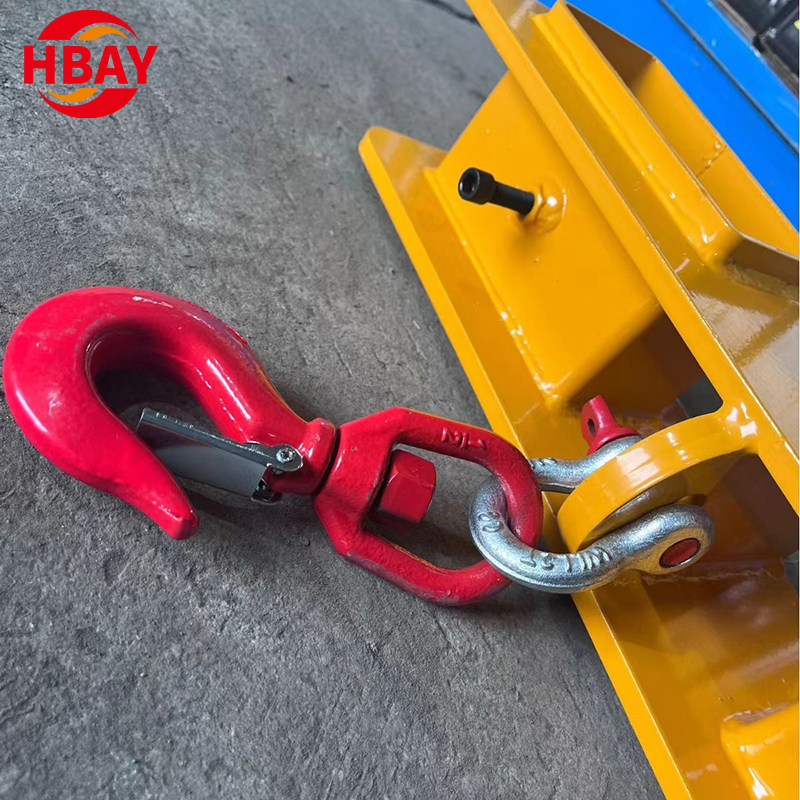
In dock gantry cranes and quay crane equipment, lifting hooks are used for efficient handling of containers and bulk cargo. Galvanized/Dacromet anti-corrosion treatment can resist marine salt spray corrosion, and comes with a standard anti stripping lock design (EN1677 certification) to ensure safe maritime operations and reduce the risk of cargo falling.
When installing wind turbine blades, the -40 ℃ low-temperature toughness and high-temperature resistant coating (200 ℃) of the lifting hook are suitable for extreme environments. The special rotating structure achieves precise positioning in the air, and 20000 fatigue tests ensure long-term reliability.
Used for connecting mine hoists and mining cars, made of ultra resistant running in steel material to resist friction loss of ores. The 50 ton heavy-duty hook is equipped with dual safety locks to ensure the safety of continuous underground operations and reduce equipment replacement frequency.
1.Pre use inspection: Carefully inspect the surface of the lifting hook for cracks and deformation, check whether the anti detachment pawl is flexible, and whether the wear of the hook mouth exceeds the standard. Confirm the absence of internal damage through non-destructive testing to ensure safety and reliability.
2.Correctly hang the load: Hang the hook steadily on the center of gravity of the heavy object, ensure that the hook opening is completely closed, and prevent the pawl from getting stuck and locking. Avoid unbalanced loading and diagonal pulling, and overloading is strictly prohibited.
3.Lifting operation: Slowly lift the hook and observe that the heavy object is stable before moving. Maintain a constant speed during the lifting process, avoid sudden stops and turns, and keep a safe distance between personnel and heavy objects.
4.Post job maintenance: Clean the oil and debris on the surface of the hook, check the wear and tear, and record it. Apply rust proof grease, store in a dry environment, and undergo regular professional testing and maintenance.
FAQ
Lifting Hook is a key component of lifting equipment used for hanging, connecting, and lifting loads. It is usually made of high-strength alloy steel or stainless steel and is widely used in equipment such as cranes, hoists, chain hoists, and electric hoists.
Alloy steel (such as 20Mn2, 35CrMo): high strength and good toughness, used for forging hooks (such as forging hooks in the national standard GB/T 10051).
Low carbon steel (such as Q235B): Low cost, used for small hooks or non critical scenarios, but with limited load-bearing capacity.
Stainless steel (such as 304, 316): Strong corrosion resistance, suitable for food, chemical, and humid environments.
Special steel: such as high-temperature alloys (resistant to over 300 ℃) or explosion-proof materials (used in flammable and explosive environments)
Clevis Hook: equipped with bolt locking device to prevent detachment, suitable for frequent swinging occasions (such as construction cranes).
Eye Hook: With a circular ring at the top, it is used to secure ropes or shackles and is commonly used in lifting belt systems.
Swivel Hook: It can rotate 360 ° to prevent chains or ropes from twisting, and is suitable for multi-directional force applications.
Safety Latch Hook: equipped with a spring lock to prevent accidental slippage of the sling (such as port lifting and high-altitude operations).
It depends on the frequency of use and environment, but regular inspections are key. It is recommended to conduct professional testing every 6 months for high-intensity work environments
Use a safety hook with a safety buckle. If there is no buckle, it can be fixed with a wire rope buckle or a release buckle..