In heavy-duty material handling, a chain sling is only as reliable as its connection points. Industrial operators face tremendous risks daily on busy job sites. Selecting the wrong lifting hook directly compromises safety. Poor selections violate strict compliance standards and lead to costly operational downtime. We must move beyond basic dimensions to build safer lifting systems. You need to evaluate hooks based on load behaviors, connection mechanics, and system-wide compatibility.
What can you expect from this guide? We provide a detailed technical breakdown of hook types and attachment styles. You will learn the principles of grade matching and essential compliance criteria. This knowledge ensures your rigging assembly remains secure and fully standard-compliant. Let us explore the fundamental engineering behind these critical connections. You can apply these principles directly to your next procurement cycle. By understanding metallurgical properties and lifting geometry, you protect both your personnel and your most valuable cargo.
Key Takeaways
- System Limitation: The Working Load Limit (WLL) of a chain sling assembly is dictated by its weakest component; a hook must always match or exceed the chain’s grade.
- Application Specificity: Standard sling hooks suit general overhead lifts, while grab hooks are strictly designed for shortening chain legs.
- Compliance is Mandatory: OSHA and ASME B30.10 standards dictate strict requirements for safety latches, wear tolerances, and verifiable manufacturer markings.
Assessing Load Requirements and Operational Environments
Before selecting any rigging hook, you must evaluate the specific physical and environmental demands of your lifting application. A standard overhead lift introduces dynamic forces far beyond the static weight of the payload.
- Calculating Working Load Limit (WLL): Define the maximum load weight first. You must account for the tension multipliers introduced by sling angles. A 60-degree angle significantly increases the stress placed on the hook compared to a standard vertical hitch. Riggers must calculate this angular tension to prevent accidental overloading.
- Evaluating Environmental Degradation: Assess the lifting environment carefully. Temperatures exceeding 400°F (204°C) cause permanent WLL reductions in standard alloys. Exposure to corrosive chemicals mandates specific alloy treatments or protective coatings. Extreme cold can make certain metals brittle, requiring specialized metallurgical compositions.
- Analyzing Clearance and Geometry: Determine your local headroom restrictions. You must identify the load’s center of gravity to ensure stability. The hook’s throat opening and bowl size must align seamlessly into the engineered lifting point. Forcing a mismatched hook into a tight lifting lug causes side-loading, which severely compromises structural integrity.
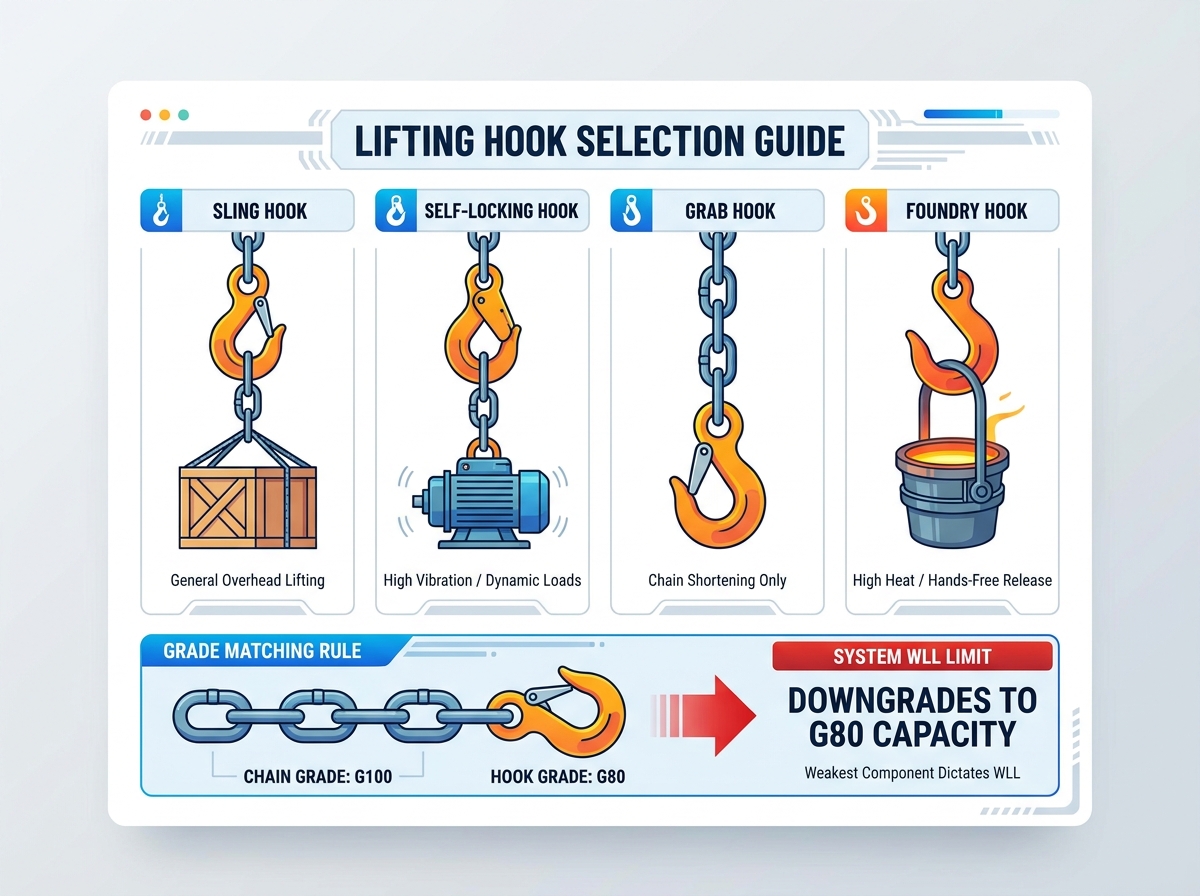
Evaluating Core Lifting Hook Types by Application
Every chain sling hook serves a distinct mechanical purpose. Selecting the wrong profile creates hazardous mismatches between the load and the rigging hardware.
Sling Hooks serve as the baseline for general-purpose overhead lifting. They feature a wide throat and a spring-loaded safety latch. This design works best for rapid attachment to engineered lift points. Operators use them frequently in construction and manufacturing settings due to their versatile geometry.
Self-Locking Hooks automatically close and lock when tension is applied to the sling. They remain closed until manually released by the operator. These are essential for high-vibration or dynamic load environments. Standard spring latches might fail or disengage under heavy bouncing, but self-locking mechanisms maintain absolute load security.
Grab Hooks feature a narrow, specialized throat. Engineers designed this throat exclusively to cradle a single link of a chain securely. Crucial Distinction: Riggers use a grab hook primarily for shortening chain legs or forming a tight choke around a load. You must not use them for direct connection to an engineered load point unless explicitly rated for that geometry.
Foundry Hooks are characterized by a deep, exceptionally wide throat and the intentional absence of a safety latch. Industry standards strictly reserve these for specialized, high-heat applications like metal casting. In these extreme environments, operators require hands-free load release to protect personnel from radiant heat.
Core Hook Types Comparison
| Hook Type | Defining Feature | Primary Application | Latch Included? |
| Sling | Wide throat profile | General overhead lifts | Yes (Spring-loaded) |
| Self-Locking | Tension-activated lock | High-vibration / Dynamic loads | Yes (Integrated mechanism) |
| Grab | Narrow throat slot | Shortening chain legs | Typically No (Depends on style) |
| Foundry | Deep throat, wide opening | High-heat metal casting | No |
Connection Mechanics: Clevis Hook vs. Eye Hook
The method you use to attach the hook to the chain sling dictates its field serviceability and its overall articulation. Operators generally choose between clevis and eye connections based on maintenance protocols and multi-leg configuration needs.
Clevis Hook Integration: A clevis hook features a distinct U-shaped attachment point. It connects directly to the chain links using a structural load pin and a securing cotter pin.
Advantage: This design allows for immediate, tool-light field replacement. If a hook sustains damage mid-shift, riggers can swap it out rapidly. You do not require specialized welding tools or additional mechanical coupling links to perform the repair.
Eye Hook Integration: This design features a completely closed circular loop at the top of the body. It requires a mechanical coupling link—often called a hammerlock—or a factory-welded connection to attach properly to the chain sling.
Advantage: The eye configuration offers far greater articulation and flexibility. It handles side-loading stresses better in certain configurations. This makes it ideal for multi-leg bridles and complex, custom rigging hardware assemblies where the angle of pull shifts during the lift.
Matching Chain Grades and Material Specifications
You cannot ignore metallurgical compatibility when building a lifting assembly. The strength of your system depends entirely on precise material matching across all components.
The Rule of Parity: To maintain the certified rated capacity of a chain sling assembly, the metallurgical grade of the hook must match or exceed the chain it attaches to. You compromise the entire system if you ignore this fundamental engineering rule.
Grade 80 (G80) Hook: The G80 hook remains the standard alloy workhorse for overhead lifting across the globe. It provides a highly reliable balance of raw strength, material ductility, and cost-effectiveness. Most general industrial applications rely heavily on G80 configurations for daily operations.
Grade 100 & 120 Options: These premium alloys offer approximately 25% and 50% higher strength-to-weight ratios than standard G80 hardware. They are ideal for heavy lifting jobs where minimizing the physical weight and bulk of the rigging hardware reduces operator fatigue. Lighter equipment leads to safer, faster rigging in the field.
Downgrade Risks: Mismatching grades carries severe consequences. Assembling a high-capacity Grade 100 chain using a standard G80 hook instantly reduces the entire sling's certified WLL down to Grade 80 standards. This oversight wastes your premium investment in the Grade 100 chain and introduces confusion regarding the assembly's true capacity on the job site.
ASME Standards, Safety Latches, and Inspection Criteria
Regulatory compliance is not optional. Following established industrial standards ensures your equipment behaves predictably under maximum stress conditions.
- Traceability Markers: Compliant hooks must feature raised, highly visible, and permanent markings. These markings indicate the manufacturer’s insignia, the alloy grade, and the batch trace code. You must remove any hardware missing these identifying marks from active service immediately.
- Safety Latch Mandates: OSHA dictates strict rules for overhead environments. Hooks used in standard overhead lifting must possess functional, spring-loaded safety latches. These latches retain slings and loads securely during slack conditions, preventing accidental unhooking before tension is fully applied.
- Removal from Service (ASME B30.10): Establish rigorous pre-shift visual inspection protocols. Supervisors must permanently retire hooks if they exhibit specific damage tolerances. You must discard any hook showing a throat opening expansion of 5% (not to exceed 1/4 inch). You must also discard hooks displaying any visible twisting exceeding 10 degrees from the unbent plane, or showing gouges and wear exceeding 10% of the original cross-sectional dimension.
Shortlisting Rigging Hardware and Next Steps
Procurement requires more than just browsing catalogs for matching capacities. You must evaluate the operational philosophy of the manufacturer and your own internal safety goals.
Evaluating Manufacturer Reputations: Limit your shortlist strictly to vendors who provide clear proof-load testing certificates. They must offer full metallurgical traceability for every piece of lifting hardware they sell. Trustworthy manufacturers subject their products to rigorous fatigue testing and publish these results transparently.
Weighing Initial Price Against Long-Term Durability: Always weigh the initial purchase price of a standard sling hook against the long-term durability and enhanced safety profile of a premium self-locking hook. Advanced locking mechanisms cost more upfront but prevent dropped loads and reduce hardware replacement frequencies in harsh environments.
Facility Standardization: Consider unifying all chain sling hooks in your facility to a single, high-capacity grade. For example, moving exclusively to Grade 100 hardware across the board physically eliminates the risk of operators mismatching hardware capacities. Standardization streamlines your inspection process and dramatically reduces inventory complexity.
Conclusion
Summary: Selecting the correct chain sling hook is a calculated engineering decision. You must balance strict WLL requirements, geometric load fit, and harsh environmental realities. Every lift depends entirely on the metallurgical strength and structural integrity of these terminal connections. A casual approach to selection invites catastrophic failure.
Next Action: Audit your current chain slings immediately for mismatched grades or deformed hooks. Implement a stringent daily inspection routine based on ASME B30.10 tolerances. Finally, consult a certified rigging specialist before finalizing procurement for complex or custom lifting applications to ensure total compliance and maximum safety.
FAQ
Q: Can I use a grab hook for direct overhead lifting?
A: Grab hooks are designed to engage chain links to shorten a leg. While part of an overhead lifting system, they should not be used as the terminal connection to a load point unless specifically engineered and rated by the manufacturer for that exact geometry.
Q: What happens if I put a G80 hook on a Grade 100 chain?
A: The entire assembly is bottlenecked by its weakest component. You instantly downgrade the system's capacity. The sling must be formally tagged and used strictly according to the lower Grade 80 Working Load Limit to maintain safety.
Q: When is it legal to use a lifting hook without a safety latch?
A: Under strict OSHA and ASME exceptions, latch-free hooks (like foundry or specific sorting hooks) are only permitted when the use of a latch creates a greater hazard to the rigger. This typically applies to extreme heat environments and must be approved by a qualified safety plan.
Q: How often should chain sling hooks be inspected?
A: A basic visual inspection by the operator is required before every single shift. Additionally, a documented, comprehensive inspection by a qualified rigging professional must occur at least annually. You must inspect them more frequently depending on usage severity and environmental conditions.

 English
 العربية
 Français
 Русский
 Español
 Português
 Deutsch
 italiano
 日本語
 한국어
 Nederlands
 Tiếng Việt
 ไทย
 Polski
 Türkçe
 አማርኛ
 ພາສາລາວ
 ភាសាខ្មែរ
 Bahasa Melayu
 ဗမာစာ
 தமிழ்
 Filipino
 Bahasa Indonesia
 magyar
 Română
 Čeština
 Монгол
 қазақ
 Српски
 हिन्दी
 Slovenčina
 Slovenščina
 Norsk
 Svenska
 українська
 Ελληνικά
 Suomi
 Հայերեն
 עברית
 Dansk
 اردو


