Every day, heavy industries rely on seemingly simple components to hoist massive loads safely. Selecting the wrong lifting hook jeopardizes site safety, risks serious OSHA and ASME compliance violations, and leads to costly operational downtime. Many teams mistakenly base their hardware choices solely on basic weight capacities. This approach ignores critical variables present in real-world lifting scenarios.
Choosing the right industrial lifting hooks requires moving beyond basic limits. You must evaluate dynamic loads, environmental stressors, and specific rigging configurations. A hook performing perfectly in a dry warehouse might fail catastrophically on a freezing offshore platform. Rigging geometry also dictates how forces interact across your connection points.
This guide will explore how to match hook architecture to demanding operational environments. We provide procurement teams, safety officers, and site managers an evidence-based framework. You will learn to evaluate, specify, and source high-reliability lifting solutions efficiently.
Key Takeaways
- Application Dictates Design: A standard construction hook will rapidly degrade in corrosive offshore environments; material grade and coating must match the use case.
- Latch Mechanisms Matter: Self-locking hooks provide superior security against accidental load release compared to standard spring-latch designs, especially under dynamic loads.
- Compliance is Non-Negotiable: All selected hooks must adhere to ASME B30.10 standards and display clear Working Load Limit (WLL) and manufacturer traceability markings.
- System Compatibility: A hook is only as strong as its connection point; evaluate swivel vs. fixed eye designs based on the specific wire rope or chain sling behavior.
Defining Success Criteria for Load and Environmental Variables
Safety begins long before rigging equipment reaches the job site. You must establish clear success criteria based on precise load calculations and environmental forecasts.
Working Load Limit (WLL) vs. Breaking Strength
Understanding the difference between Working Load Limit and breaking strength is paramount. Working Load Limit denotes the maximum safe force you can apply to a hook during normal operations. Manufacturers determine this number by incorporating a specific design factor, typically 4:1 or 5:1 for standard rigging hardware.
A 4:1 design factor means the hook should theoretically break at four times its stated WLL. You must never select hooks based on breaking strength. Selecting equipment based on breaking strength eliminates your safety margin. Always specify components using the WLL stamped on the body.
Dynamic Load Considerations
A static load resting on the ground behaves differently once suspended. Active operations introduce dynamic forces. Sudden stops, load swinging, and heavy wind gusts multiply the force applied to your rigging hardware temporarily.
If a crane operator stops a rapid descent abruptly, the kinetic energy transfers directly into the hook bowl. This shock load can easily exceed the component's WLL. You must account for these dynamic multipliers during the planning phase. Selecting hardware slightly above your minimum static weight requirements provides an essential buffer against unpredictable operational forces.
Environmental Stressors
The operational climate directly alters metallurgical properties over time. You must assess two primary environmental threats:
- Temperature extremes: Freezing environments cause steel brittleness. Standard alloys undergo a ductile-to-brittle transition in extreme cold. This transition makes them prone to sudden cracking under impact loads. High-heat environments, conversely, can weaken standard steel tempers.
- Corrosion: Chemical exposure in manufacturing facilities degrades unprotected metal rapidly. Maritime applications introduce saltwater exposure. Saltwater acts as a highly aggressive electrolyte, accelerating rust and pitting on standard steel surfaces.
Matching Hook Architecture to Operational Environments
Different industries demand highly specialized engineering solutions. A universally perfect lifting component does not exist. You must match the hardware design to your daily operational reality.
Construction and Heavy Infrastructure
Construction sites require ultimate durability. Teams lift diverse materials across uneven, unpredictable terrain. A standard crane hook manages most routine tasks effectively, offering a wide throat for large slings.
Riggers also heavily utilize grab hooks. Grab hooks feature a narrow throat designed specifically to seat chain links. This allows operators to shorten chain slings safely when dealing with uneven center-of-gravity loads. A high-quality construction hook must endure constant physical impacts, dragging, and abrasive dust exposure daily.
Marine and Offshore Operations
Offshore environments destroy standard steel quickly. You must specify corrosion-resistant alloys. Galvanized finishes provide excellent baseline protection. Stainless steel offers superior longevity in constant saltwater spray.
Specialized designs dominate this sector. A dedicated marine lifting hook addresses specific maritime hazards. Pelican hooks allow personnel to release lines quickly under high tension. Remotely Operated Vehicle (ROV) hooks let underwater submersibles manipulate heavy loads safely without human divers.
Warehousing and Manufacturing
Indoor facilities prioritize operational speed and ergonomic efficiency. Teams perform high-frequency, repetitive lifts. Sling hooks facilitate fast daily pallet and machinery movements. Their streamlined design allows quick attachments.
Foundries present unique challenges. Extreme heat and rapid processes make standard latches hazardous. Foundry hooks feature wide throats and deliberately omit spring latches. Latches impede the rapid disengagement necessary around molten metals. You must use foundry hooks strictly in these controlled, high-heat applications.
Table 1: Operational Environment and Hook Selection Guide
| Environment | Primary Challenge | Recommended Hook Type | Material / Coating Focus |
| Construction | Uneven loads, abrasive dust, impact | Standard Crane Hook, Grab Hook | Alloy steel, painted or powder-coated |
| Marine / Offshore | Saltwater corrosion, underwater manipulation | Pelican Hook, ROV Hook | Galvanized steel, Stainless steel |
| Warehousing | High-frequency repetitive lifting | Standard Sling Hook, Self-Locking Hook | High-grade alloy (Grade 100) for weight reduction |
| Foundry / High Heat | Molten temperatures, snagging hazards | Foundry Hook (No latch) | Heat-treated specialty alloys |
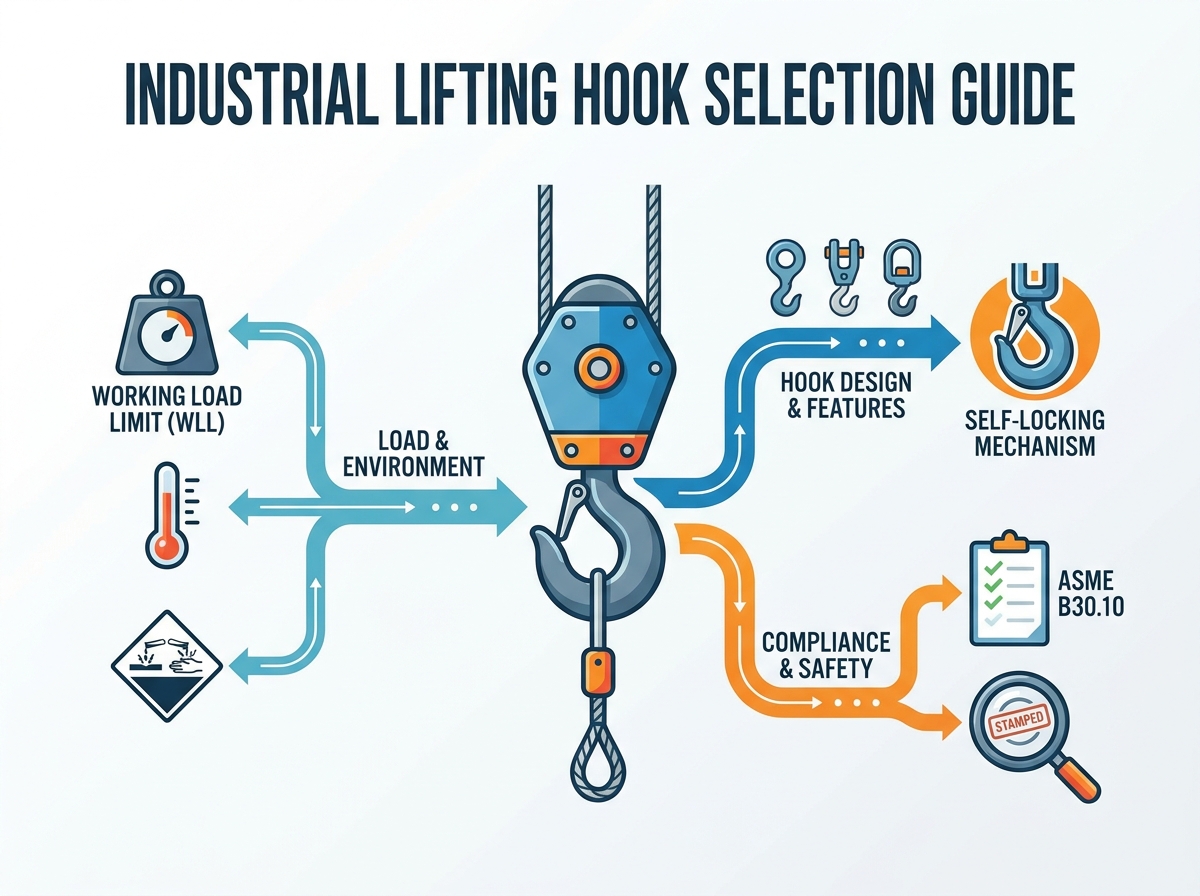
Key Structural Features of a Heavy Duty Hook
Analyzing the anatomy of a heavy duty hook reveals how different components manage stress. Understanding attachment points, locking mechanisms, and metallurgy ensures optimal performance.
Attachment Points (Eye vs. Clevis vs. Swivel)
The connection method dictates system flexibility. Choosing incorrectly places lateral stress on your rigging.
- Eye Hooks: These feature a closed, solid ring at the top. They work best for permanent or semi-permanent connections using shackles or couplers. They provide massive structural strength.
- Clevis Hooks: These feature a U-shaped attachment point and a load pin. They allow direct attachment to chain links without requiring an intermediate coupling link. This streamlines the assembly.
- Swivel Hooks: These prevent load spin and stop wire ropes from unlaying. You must differentiate between positioning swivels and bearing swivels. Positioning swivels allow you to orient the load prior to lifting, but they cannot rotate under tension. Bearing swivels contain internal ball bearings. They are explicitly designed to rotate smoothly under full WLL.
Locking Mechanisms
Load retention is non-negotiable for overhead lifting. Mechanism choice directly impacts site safety policies.
Standard spring latches offer basic load retention. A simple spring pushes a metal flap closed across the throat. While acceptable for basic lifts, they remain prone to damage. Careless operators often bend them, rendering them useless.
Self-locking hooks, also known as positive locking hooks, provide superior security. The latch mechanism closes automatically when loaded. More importantly, it cannot open while under tension. This eliminates accidental load release during dynamic movements. Safety managers heavily prefer self-locking designs for overhead lifting operations.
Material Grades
Steel chemistry dictates strength and weight. You must evaluate Grade 80, Grade 100, and Grade 120 alloys for your rigging hook.
Grade 80 serves as the baseline standard for overhead chain lifting. However, Grade 100 offers approximately 25% more strength per mass. Grade 120 pushes this further, offering nearly 50% more strength than Grade 80.
Higher grades allow manufacturers to produce physically smaller, lighter components. A lighter hook reduces worker fatigue during repetitive tasks. It improves overall ergonomics without sacrificing safety or WLL capacity.
Safety Standards, Compliance, and Risk Mitigation
Regulatory compliance protects both your workforce and your business liability. Navigating ASME standards ensures continuous operational safety.
ASME B30.10 Standards
The ASME B30.10 standard governs lifting hooks strictly. It mandates regular, documented inspections. Inspectors must check the throat opening expansion meticulously. Industry guidelines typically permit no more than a 5% increase in throat width, or 1/4 inch, whichever is less.
Twist tolerances are even stricter. ASME allows zero degrees of visible twist from the unbent plane of the hook. If you visually detect a twist, the metallurgical structure has yielded. You must remove it from service immediately.
Required Markings
Traceability ensures accountability. Compliant hardware must display permanent, legible markings forged or stamped directly into the metal.
You must locate the manufacturer's logo or identification mark. The Working Load Limit (WLL) must be clearly visible. The steel grade and a unique traceability code must also appear. If a hook arrives missing any of these four elements, consider it non-compliant and reject the shipment.
Implementation Risks
Human error introduces severe risks despite perfect hardware selection. Tip loading represents the most common operational failure.
Engineers design hooks to carry the load deep in the bowl (the saddle). Applying the load to the extreme tip shifts the stress vector. Tip loading leverages the weakest geometric point, drastically reducing the effective capacity. This misuse causes rapid deformation, stretches the throat opening, and ultimately triggers catastrophic snapping.
Common Mistake: Welding Repairs
Never attempt to repair a deformed hook using heat or welding. Applying intense heat alters the factory heat-treatment of the alloy steel. This compromises the temper and drastically lowers the WLL unpredictably. ASME standards demand immediate destruction and replacement of deformed hooks.
How to Shortlist Suppliers for Lifting Hardware
Your safety program relies entirely on the integrity of your supply chain. Shortlisting vendors for lifting hardware requires stringent vetting processes.
Documentation and Traceability
Reputable vendors operate with complete transparency. They must provide mill test certificates upon request. These certificates verify the chemical composition and heat treatment of the steel batch. Furthermore, suppliers should offer proof load testing documentation. This proves the specific component design survived rigorous factory testing before shipment.
Engineering Support
Complex lifts rarely use off-the-shelf solutions exclusively. Evaluate whether the supplier offers internal technical consultation. Strong vendors employ engineers who assist with custom Below-the-Hook devices. They analyze your specific center-of-gravity challenges and recommend tailored attachment methodologies.
Availability and Lead Times
Equipment downtime ruins project margins. Assess the vendor's inventory depth and distribution network. You need a partner capable of supplying standardized replacement components rapidly. Fast lead times keep your operations moving when unexpected damage requires immediate hardware replacement.
Conclusion
Specifying the correct lifting solutions requires balancing environmental realities, advanced latch security, and strict regulatory compliance. You cannot rely on weight capacity charts alone when protecting your workforce. Always prioritize ASME compliance and insist on comprehensive vendor traceability.
We recommend conducting a comprehensive rigging hardware audit immediately. Check all existing chains, hoist mechanisms, and attachment points for wear and non-compliance. Verify cross-compatibility before placing bulk procurement orders to guarantee seamless, safe integration across your entire fleet.
FAQ
Q: What is the difference between a grab hook and a slip hook?
A: Grab hooks feature a narrow throat designed specifically to "grab" and securely lock onto a chain link. This allows operators to shorten a chain sling. Slip hooks have a wider throat, allowing the chain to slide through freely for general connection purposes.
Q: When is a self-locking hook required over a standard latch hook?
A: While OSHA requires load-retaining latches for most overhead lifting, self-locking hooks are strongly recommended in dynamic environments. They are often mandated by site-specific safety policies to eliminate the risk of standard latches being crushed or forced open during complex lifts.
Q: Can a deformed heavy duty hook be repaired or welded?
A: No. According to ASME standards, applying heat or welding to repair a bent or elongated hook fundamentally alters the metallurgical properties. This compromises the WLL entirely. You must immediately destroy and replace any deformed lifting equipment.
Q: How often should industrial lifting hooks be inspected?
A: Operators must conduct a visual inspection before each shift begins. Additionally, a documented, comprehensive inspection by a qualified person is required at least annually. You must increase this frequency for equipment subjected to severe usage or extreme environmental conditions.

 English
 العربية
 Français
 Русский
 Español
 Português
 Deutsch
 italiano
 日本語
 한국어
 Nederlands
 Tiếng Việt
 ไทย
 Polski
 Türkçe
 አማርኛ
 ພາສາລາວ
 ភាសាខ្មែរ
 Bahasa Melayu
 ဗမာစာ
 தமிழ்
 Filipino
 Bahasa Indonesia
 magyar
 Română
 Čeština
 Монгол
 қазақ
 Српски
 हिन्दी
 Slovenčina
 Slovenščina
 Norsk
 Svenska
 українська
 Ελληνικά
 Suomi
 Հայերեն
 עברית
 Dansk
 اردو


