Turnbuckles endure massive stress in any rigging setup. Latent thread damage or subtle body deformation presents severe liability and safety risks. You cannot afford to ignore these critical connection points. Proper turnbuckle inspection operates as a vital operational protocol rather than a simple safety mandate. This proactive approach prevents catastrophic load drops, avoids hefty OSHA fines, and stops costly project downtime. We built this comprehensive guide to give you an evidence-based framework for evaluating hardware wear accurately. You will learn how to maintain strict compliance with ASME standards and establish defensible removal-from-service criteria. Equip your team with the right knowledge to identify hidden hazards before they escalate into fatal accidents. Strong oversight guarantees safer lifts every day and protects your operations fully.
Key Takeaways
- Regulatory Baseline: Standardized turnbuckle inspection must align with ASME B30.26 guidelines for rigging hardware.
- Dual-Phase Evaluation: Effective risk management requires both pre-shift visual checks and documented periodic inspections.
- Zero-Tolerance Deformation: Even minor bending, galling, or unauthorized modifications (like welding) dictate immediate removal from service.
- Traceability is Mandatory: Hardware lacking legible manufacturer identification or Working Load Limit (WLL) markings cannot be safely evaluated and must be discarded.
The Business Case for Standardized Rigging Inspection
Replacing a single damaged turnbuckle costs a fraction of your operating budget. In stark contrast, load drops trigger exponential financial devastation. We routinely see companies face catastrophic equipment damage, prolonged litigation, and devastating regulatory penalties following a single rigging failure. Insurance premiums skyrocket when investigators uncover negligence.
A successful risk management program sets clear, measurable success criteria. You want predictable equipment lifecycles. You demand zero on-site rigging failures. You require audit-ready compliance documentation available on demand. Hitting these targets transforms your safety culture into a distinct competitive advantage. Clients inherently trust contractors who prioritize secure lifting operations over rushed timelines.
Industry expectations place heavy liability directly on operational leadership. Site supervisors and procurement teams share the burden if non-compliant hardware remains in active circulation. Ignorance does not provide any legal cover during an OSHA investigation. Implementing a highly standardized rigging inspection protocol acts as your strongest organizational defense. This proactive mindset heavily shields your vulnerable workforce while simultaneously protecting corporate profit margins.
A common mistake teams make is treating rigging gear as an untracked consumable. They throw parts in a bin and pull them out as needed without verifying their history. This breaks the chain of traceability. A standardized program forces accountability. Every piece of hardware must earn its place on the hook every single day.
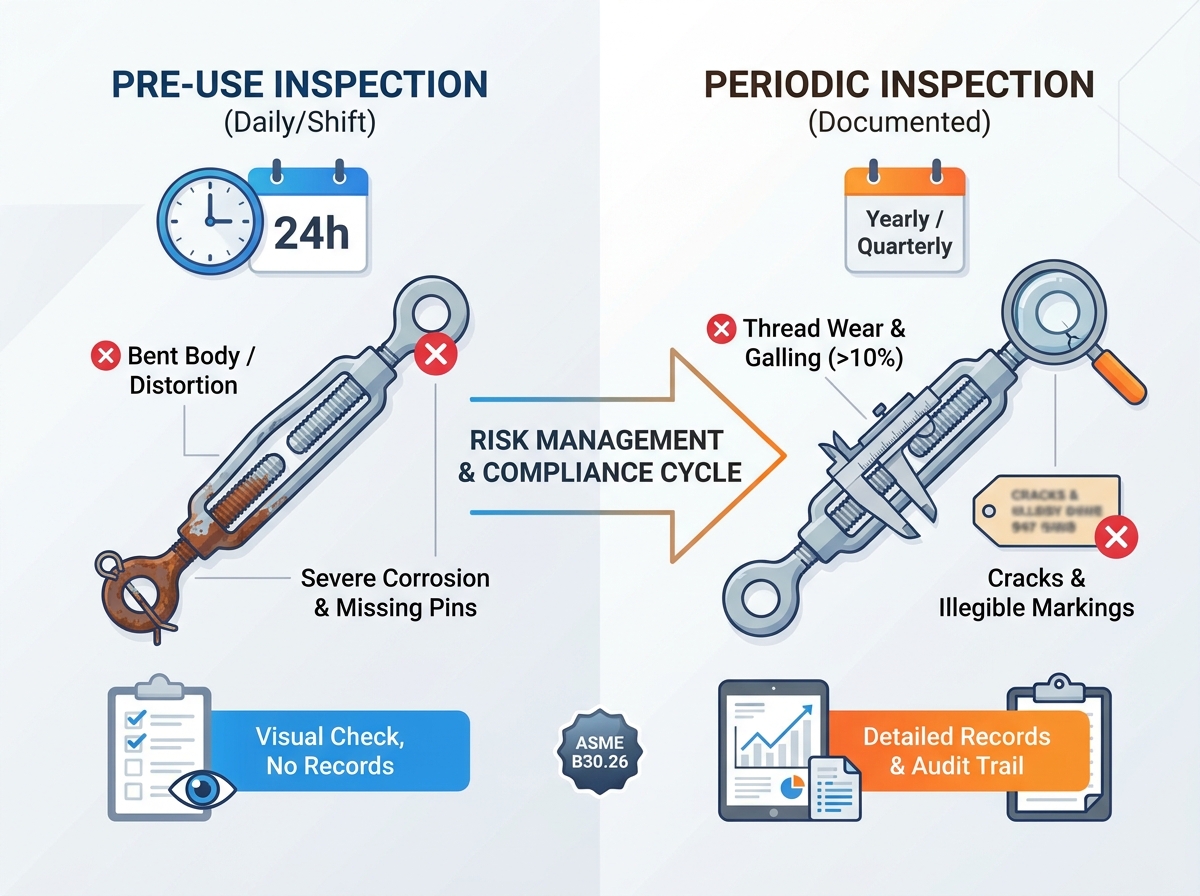
Pre-Use vs. Periodic Inspection: Structuring Your Protocol
Effective safety protocols separate checks into two highly distinct phases. You need daily operational vigilance combined with scheduled, heavily documented compliance audits.
Pre-Use (Daily/Shift) Inspections
The primary operator holds absolute responsibility for daily evaluations. They must visually assess specific points before conducting any lift. A fast but meticulous tensioner inspection catches obvious hazards before heavy tension applies. Operators should actively look for severe corrosion, missing cotter pins, or visibly bent bodies.
Consider these essential daily checks for your operators:
- Verify the presence and security of all required locking nuts or safety wires.
- Check the entire body frame for visible twists, deep scratches, or cracks.
- Examine the threaded ends for dirt buildup, metal shavings, or minor galling.
- Ensure all moving parts rotate smoothly without excessive binding or grinding.
If an operator spots any irregularity, they must halt the lift immediately. Never leave these critical evaluations to chance or assume someone else checked the gear yesterday.
Periodic (Documented) Inspections
This secondary phase requires a much deeper dive by a certified, qualified person. This individual must possess specific training in rigging safety standards. Inspection frequency depends entirely on the severity of your specific service environment. ASME guidelines suggest the following structured schedule:
- Normal Service: Conduct a comprehensive inspection yearly. This applies to standard warehouse environments or light industrial use where loads rarely reach maximum capacity.
- Severe Service: Inspect monthly or quarterly. Offshore oil platforms, busy maritime ports, and heavy construction sites fall squarely into this high-risk category.
- Special Service: Inspect as directly recommended by a qualified person. Extreme temperature environments or chemically corrosive areas often dictate custom, highly frequent timelines.
You must maintain detailed written or digital records for these periodic checks. These historical logs prove your ongoing compliance during unexpected safety audits. They also help managers track the realistic lifespan of gear over time, highlighting when specific brands fail prematurely.
Core Evaluation Dimensions for Turnbuckle Wear
Evaluating turnbuckle wear demands exact precision. You must scrutinize multiple individual components thoroughly to ensure safe, reliable operations.
Thread Integrity and Engagement
Thread health directly dictates the overall load-bearing capacity of the unit. You must thoroughly check the internal and external threads for galling, stripping, or cross-threading. Galling occurs when extreme friction physically transfers material between sliding metallic surfaces. This destructive process ruins the threading completely, often causing the unit to seize up. Clean the threads with a stiff wire brush and non-corrosive solvent before evaluating them. Dirt and heavy grease easily hide microscopic fractures or flattened thread peaks.
Assess thread engagement very carefully during the setup phase. All threads must sit fully engaged within the turnbuckle body to achieve the rated Working Load Limit (WLL). If you see threads exposed beyond the body's designated safety marks or inspection holes, the entire setup fails the standard. Proper engagement ensures heavy forces distribute evenly across the hardware. A best practice is to physically count the exposed threads and verify them against the manufacturer's specific guidelines.
Body and End-Fitting Assessment
Turnbuckle bodies occasionally stretch under extreme, sustained loads. You must physically measure for elongation or distortion across the open frame. Even a slight visible twist indicates the hardware experienced forces well beyond its designed capacity.
Next, inspect the end fittings closely. Eyes, hooks, and jaws or clevises endure massive, concentrated stress during a lift. Look carefully for nicks, deep cracks, and heavy gouges. Hooks, in particular, are prone to stretching open if overloaded. Measure the throat opening of the hook and compare it to the original specifications.
Industry standards enforce strict tolerance limits for all these components. Reject any part showing wear exceeding 10% of its original manufactured dimension. Use precise digital calipers to verify these crucial measurements accurately. Do not rely on visual estimation for dimensional wear. A fraction of an inch can determine the difference between a successful, safe lift and a fatal load drop.
Identification and Hardware Modifications
Traceability separates safe, reliable gear from dangerous, counterfeit scrap metal. Missing, illegible, or heavily painted-over WLL markings automatically invalidate the component. You must read the specific manufacturer identification clearly stamped on the metal. If rust, wear, or thick industrial paint obscures the stamped capacity, you cannot legally use the item.
Any unauthorized modifications compromise the metallurgical integrity of the forged steel. Do not weld, heat, or bend these components under any circumstances. Such extreme heat alterations destroy the original temper of the metal, creating brittle stress points. You must discard modified hardware immediately upon discovery. Unapproved field repairs present a massive, indefensible liability to your entire operation. If a worker welds a handle onto the body for easier turning, they have instantly ruined the certification of that device.
Rejection Criteria: When to Remove Turnbuckles from Service
You must establish firm, unyielding boundaries for removing compromised rigging hardware. Guesswork routinely leads to fatal errors on the busy job site.
Definitive Removal Triggers
We heavily recommend using a rigid, no-exceptions list for rejection criteria. Train your teams to remove gear instantly if they find bent bodies, missing lock nuts, or missing cotter pins. Excessive pitting from chemical exposure or saltwater corrosion also mandates immediate removal. If the clevis jaws show any sign of spreading apart, the unit is entirely unsafe. Once a trigger is met, debate stops, and the hardware leaves the active fleet.
Quarantine Procedures
Rejection means permanent, undeniable destruction. You must actively prevent accidental reuse by other well-meaning crews. Throwing a damaged part in a corner bin invites disaster, as someone will inevitably grab it when they run short on gear. Instead, aggressively cut the eyes or hooks off rejected turnbuckles using a grinder. Torch directly through the main body if necessary. A red paper tag alone does not guarantee safety in a chaotic laydown yard. Create a dedicated, locked quarantine box for condemned gear until your safety team can physically destroy it.
Risk Mitigation
Strict adherence to these exact removal criteria protects your entire company from ruin. If an accident happens elsewhere on the site, your pristine, up-to-date inspection logs prove legal due diligence. Defensible records act as your strongest possible shield against post-accident liability claims. They show regulatory bodies and insurance adjusters that you take safety seriously and enforce standards rigorously.
Modernizing Your Wire Rope Hardware Management
Scaling a corporate safety program requires integrating modern digital tools. Managing heavy wire rope hardware on fragile, easily lost paper checklists creates highly risky blind spots.
Process Scalability
Transition your team to modern digital inspection management software. Mobile applications give safety supervisors real-time fleet visibility across multiple distant job sites. Cloud-based safety logs completely prevent lost or damaged records. Technicians can snap high-resolution photos of damaged threads and upload them instantly for managerial review. Some advanced programs utilize RFID tags or stamped QR codes to track the exact lifecycle of individual components, entirely removing manual data entry errors.
Procurement Strategy
Tracking exact wear rates heavily informs much better future purchasing decisions. If certain turnbuckle brands fail early or show rapid thread galling, your digital data highlights the negative trend immediately. You can adjust your buying habits accordingly to save money over the long term. Data-driven procurement prevents you from buying substandard, cheap gear repeatedly.
Vendor Selection
Shortlist your replacement hardware suppliers very carefully based on stringent criteria. Prioritize vendors providing fully certified, easily traceable equipment. Their gear must meet strict domestic and international compliance standards, including ASME and OSHA requirements. Ask for mill test reports before signing large purchase orders. Quality vendors stand behind their metallurgical data.
Common Turnbuckle Defects and Required Actions
| Defect Category | Visual Indicator | Required Action |
| Thread Damage | Galling, stripping, or cross-threading | Remove from service immediately |
| Deformation | Bent body, elongated eyes, widened jaws | Destroy hardware to prevent reuse |
| Material Wear | Nicks, gouges, or wear exceeding 10% | Measure with calipers; discard if over limit |
| Traceability | Missing WLL or manufacturer markings | Quarantine and remove from active fleet |
Conclusion
Rigorous turnbuckle safety relies heavily on strict, objective criteria. You must remove operator guesswork completely from the equation. Clear, unyielding rules prevent catastrophic structural failures and keep your workforce alive. Start your modernization process today. Audit your current inspection logs for any glaring gaps. Destroy all non-compliant hardware immediately to protect your crew from accidental use. Finally, partner with certified rigging suppliers to standardize your entire inventory for the future. Proactive maintenance saves lives and thoroughly protects your business reputation.
FAQ
Q: How often should turnbuckles be inspected?
A: Operators must conduct a visual pre-use inspection before every single shift. For documented periodic inspections, the frequency depends entirely on service severity. Normal service requires yearly checks. Severe service demands monthly or quarterly evaluations. A qualified person dictates the exact schedule for special service applications based on environmental hazards.
Q: Can you repair a bent turnbuckle?
A: No. You can never safely repair a bent turnbuckle. Heating, welding, or bending destroys the metallurgical integrity and load capacity of the forged hardware. Unauthorized modifications directly violate ASME B30.26 standards. You must permanently destroy and discard any bent or deformed components to ensure job site safety.
Q: What is the maximum allowable wear for turnbuckle threads?
A: Industry standards mandate rejecting a turnbuckle if material wear exceeds 10% of the original manufactured dimension. Furthermore, any visible sign of thread stripping, galling, or cross-threading demands immediate removal. Threads must remain perfectly intact to safely sustain the hardware's rated Working Load Limit during a heavy lift.
Q: Why do turnbuckles need safety wire or lock nuts?
A: Turnbuckles frequently experience intense vibration and dynamic loads during rigging operations. These physical forces can easily cause the threaded ends to unscrew over time. Safety wire or lock nuts securely lock the threads in place. Verifying these mechanisms is a strictly mandatory step during any pre-lift evaluation.

 English
 العربية
 Français
 Русский
 Español
 Português
 Deutsch
 italiano
 日本語
 한국어
 Nederlands
 Tiếng Việt
 ไทย
 Polski
 Türkçe
 አማርኛ
 ພາສາລາວ
 ភាសាខ្មែរ
 Bahasa Melayu
 ဗမာစာ
 தமிழ்
 Filipino
 Bahasa Indonesia
 magyar
 Română
 Čeština
 Монгол
 қазақ
 Српски
 हिन्दी
 Slovenčina
 Slovenščina
 Norsk
 Svenska
 українська
 Ελληνικά
 Suomi
 Հայերեն
 עברית
 Dansk
 اردو


