Specifying the correct tensioning components holds an entire project together. Load-bearing stability relies heavily on seemingly small connection points. A single hardware failure compromises structural integrity and jeopardizes job site safety. Poor component specification leads to disastrous, expensive consequences. Premature hardware failure and strict compliance violations put crews at risk every day. Catastrophic load drops often trace back to undersized or improperly matched gear used under extreme stress. We will explore how to specify the right construction turnbuckle for any scenario. This guide provides structural engineers and procurement teams an evidence-based framework. You will learn how to evaluate, select, and source these critical devices for specific project demands.
Key Takeaways
- End-Fitting Alignment: Selecting between jaw, eye, and hook configurations depends entirely on the connection point's permanence and the required articulation.
- Material Durability dictates ROI: Hot-dip galvanized (HDG) steel offers superior cost-to-lifespan ratios for general construction, while stainless steel is non-negotiable for highly corrosive environments.
- WLL over Breaking Strength: Procurement must base decisions strictly on the Working Load Limit (WLL) with appropriate safety factors, not ultimate breaking strength.
- Installation Risks: Over-tensioning and thread galling are the leading causes of structural turnbuckle failure during implementation.
Evaluating the Role of a Construction Turnbuckle in Structural Rigging
Engineers must define clear success criteria for tension hardware before procurement begins. Suitable commercial construction components require predictable load management. They also demand verifiable metallurgy and high environmental resistance. Standard commercial-grade hardware often fails these tests. It lacks the heat treatment and material density required for heavy industrial use. You must source forged, load-rated components to ensure maximum safety.
These robust devices serve several core applications across demanding job sites. They handle guy wire tensioning for communication towers and structural supports. They also manage architectural cable bracing and complex suspension systems. Furthermore, crews rely on them heavily for heavy-duty lifting and material positioning.
Adopting a strict evaluation mindset prevents dangerous operational compromises. Off-the-shelf hardware lacks the certified strength required for overhead loads. Forged bodies provide the necessary grain structure to resist sudden deformation. You cannot substitute light-duty hardware when human lives and expensive assets hang in the balance.
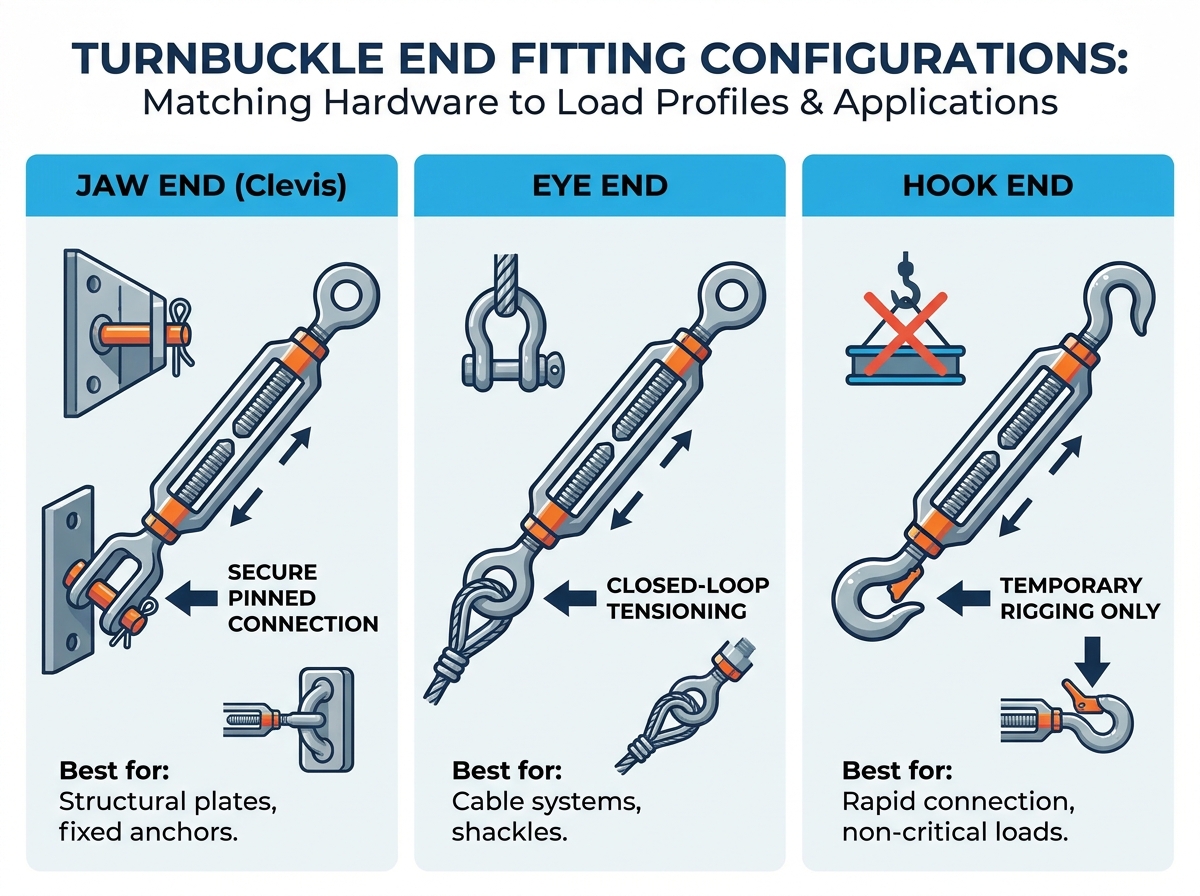
End Fitting Configurations: Matching Hardware to Load Profiles
Selecting the correct end fitting ensures your assembly performs safely under immense stress. Each available configuration serves a distinct mechanical purpose.
Jaw (Clevis) Ends
Jaw ends work best for connecting to pad eyes or thick structural plates. They also attach easily to closed-loop connection points. The primary advantage lies in their highly secure, pinned connection. A jaw fitting cannot slip off under slack line conditions. You simply remove the pin, position the jaw over the anchor, and secure it.
Eye Ends
Eye ends pair perfectly alongside shackles or wire rope thimbles. They function as an exceptionally reliable cable tensioner. This highly secure, closed-loop design eliminates the risk of unintentional disconnection. Once rigged, the eye remains permanently captured by its mating hardware.
Hook Ends
Hook ends suit temporary setups where rapid connection and quick release are required. However, they carry severe operational limitations. You should never use hooks for permanent or overhead lifting applications. They risk disengagement under variable line tension. If the line goes slack suddenly, the hook can easily fall out of its anchor.
Hybrid Configurations
Many complex projects require hybrid configurations, such as a localized jaw and eye combination. These match asymmetrical connection points within a single integrated rigging assembly. You might attach the rigid jaw to a fixed structural plate. Meanwhile, the eye securely connects to a flexible wire rope sling. This engineered flexibility solves complex routing challenges efficiently.
Material and Coating Specifications: Galvanized vs. Stainless Steel
Environmental exposure strictly dictates your material alloy choice. Selecting the wrong alloy invariably leads to rapid corrosion and ultimate structural failure.
Hot-Dip Galvanized (HDG)
A galvanized turnbuckle features drop-forged steel dipped in molten zinc. This thermal process creates a rugged, sacrificial barrier against oxidation and rust. It offers high tensile strength alongside excellent corrosion resistance. HDG hardware serves as the undisputed industry standard for general outdoor construction. It excels flawlessly in guy wire applications and heavy structural framing.
Stainless Steel (SS 304 / SS 316)
Stainless steel delivers vastly superior corrosion resistance over carbon steel. However, it possesses slightly lower yield strength and carries a substantially higher upfront cost. It remains highly susceptible to dangerous thread galling if not properly lubricated. You should specify stainless steel exclusively for harsh marine environments. It also suits architectural rigging requiring specific aesthetics and heavy chemical exposure zones.
Coated and Specialized Finishes
Some unique projects demand powder-coated or painted variations over the base material. High-visibility construction zones often require bright safety colors to prevent accidental vehicle impacts. Architectural projects might need custom color matching to blend seamlessly into the surrounding structure. These specialized coatings provide an essential extra layer of protection.
Material Performance Comparison Matrix
| Material Alloy | Corrosion Resistance | Tensile Strength Rank | Ideal Operational Environment |
| Hot-Dip Galvanized (HDG) | High | Very High | Standard outdoor, heavy industrial, framing |
| Stainless Steel (304) | Very High | Moderate | Mild marine, architectural displays |
| Stainless Steel (316) | Superior | Moderate to High | Saltwater marine, heavy chemical facilities |
Working Load Limits (WLL) and Structural Compliance
Deeply understanding load ratings prevents catastrophic job site accidents. You must specify a structural turnbuckle based solely on the manufacturer's certified Working Load Limit (WLL). Never base serious procurement decisions on ultimate breaking strength figures. The WLL incorporates a rigorous, standard safety design factor. For standard rigging tasks, this critical factor typically sits at 5:1. This generous margin accounts safely for dynamic forces and unexpected shock loads.
These specialized devices are engineered exclusively for straight, in-line tension loads. Side loading drastically reduces their safe holding capacity. It causes catastrophic internal bending across the threaded body. You must ensure the engineered load path remains perfectly straight in practice. Any angular pull severely compromises the entire assembly.
Hardware compliance and third-party certifications validate hardware quality. Always review detailed manufacturer documentation before executing a purchase. Look for strict adherence to recognized industry standards. ASTM F1145 compliance guarantees the hardware meets rigorous, repeatable testing protocols. Specific traceability codes stamped deeply into the metal provide an invaluable layer of accountability.
Implementation Risks and Installation Best Practices
Even the finest hardware fails quickly if installed incorrectly. Proper field implementation requires strict adherence to established mechanical best practices.
Mitigating harmful thread galling stands as a top field priority. Galling occurs when intense friction micro-welds the threads together during active adjustment. You must apply premium anti-seize compounds during the initial tensioning phase. This proactive step proves particularly crucial for raw stainless steel assemblies. A seized rigging turnbuckle becomes utterly impossible to adjust or remove safely.
Securing the threaded setup successfully prevents dangerous accidental loosening. Structural vibration and shifting wind loads cause threaded bodies to back off. You must install heavy-duty lock nuts tightly against the main body frame. Alternatively, run braided safety lock wire through the frame and both end fittings. This robust mechanical barrier stops unwanted rotation completely.
Strict field inspection protocols catch hidden damage early. Conduct thorough pre-use and periodic structural inspections. Check carefully for bent bodies or microscopic thread deformation. Look extremely closely for elongated eyes or spread jaw fittings. Remove any deformed hardware from active service immediately. Do not attempt to repair or physically straighten bent components.
Procurement Checklist: How to Shortlist and Specify Tension Hardware
Sourcing reliable construction rigging requires a highly systematic approach. Follow this sequential checklist to ensure you acquire the correct structural components.
- Audit the Load: Calculate the maximum static and dynamic loads accurately. This engineering calculation determines your baseline WLL requirements. Always account for worst-case weather conditions and impact forces during operation.
- Define the Environment: Map the expected exposure to moisture, salt, or harsh chemicals. This specific data helps you select intelligently between galvanized steel or stainless alloys. Coastal projects always demand superior atmospheric corrosion resistance.
- Specify the End Fittings: Match your required jaw, eye, or hook to the existing structural attachment points. Ensure the pin sizes and jaw inside widths align perfectly with your anchor fabricated plates.
- Verify Supplier Credentials: Ensure your chosen vendor provides full lot traceability. Request recent load testing certificates and accurate hardware dimensional tolerances. Reliable suppliers gladly provide extensive testing documentation for seamless field integration.
Conclusion
Successful structural rigging relies directly on aligning WLL, environmental materials, and highly secure end-fittings. Careful component evaluation efficiently prevents costly delays and serious liability issues. Prioritizing engineered, load-rated hardware over low-cost market alternatives mitigates long-term operational risks. It actively ensures your projects remain remarkably safe, compliant, and durable.
Review your active procurement standards immediately. Audit your current job sites for improper side-loading or unrated light-duty hardware. Encourage procurement managers and field engineers to consult closely with specialized rigging experts. Always request highly detailed quotes based strictly on specific load demands and precise environmental requirements.
FAQ
Q: What is the difference between a standard turnbuckle and a rigging turnbuckle?
A: Rigging variations are drop-forged, strictly load-rated, and designed for heavy lifting and structural support. Standard or commercial-grade options are typically cast or bent. They completely lack certified WLLs, making them suitable only for light-duty applications like light fencing. Never substitute commercial grades for critical lifting tasks.
Q: Can you use a construction turnbuckle for overhead lifting?
A: You can only use it safely if it is drop-forged and explicitly rated for overhead lifting by the official manufacturer. It must also utilize highly secure closed end fittings. You must use a jaw or eye configuration exclusively. Never use open hooks for overhead lifting applications.
Q: How do I prevent a structural turnbuckle from loosening over time?
A: Secure the final assembly using specialized jam nuts. Thread them tightly against the main body to freeze the threads. Alternatively, run a stainless safety seizing wire through the body and the end fittings. This safety wire mechanically prevents the barrel from rotating under heavy vibration.
Q: Should I choose a jaw-and-jaw or eye-and-eye cable tensioner?
A: Use a jaw-and-jaw setup if you are attaching directly to a fixed anchor plate or a solid structural pad eye. Use an eye-and-eye configuration if you are connecting via an intermediate shackle. Eyes also work best when routing a wire rope directly through the fitting using a protective metal thimble.

 English
 العربية
 Français
 Русский
 Español
 Português
 Deutsch
 italiano
 日本語
 한국어
 Nederlands
 Tiếng Việt
 ไทย
 Polski
 Türkçe
 አማርኛ
 ພາສາລາວ
 ភាសាខ្មែរ
 Bahasa Melayu
 ဗမာစာ
 தமிழ்
 Filipino
 Bahasa Indonesia
 magyar
 Română
 Čeština
 Монгол
 қазақ
 Српски
 हिन्दी
 Slovenčina
 Slovenščina
 Norsk
 Svenska
 українська
 Ελληνικά
 Suomi
 Հայերեն
 עברית
 Dansk
 اردو


