Industrial rigging leaves absolutely no room for error. When suspending tons of steel, load-bearing hardware becomes your operational lifeline. Structural failures cause catastrophic safety incidents and severe project downtime.
Turnbuckles serve as critical tensioning components in these rigorous environments. Unfortunately, supply chain volatility makes bulk procurement highly risky. Varying global manufacturing standards constantly complicate the sourcing process. Procurement teams must continuously balance landed logistics costs against uncompromising quality assurance requirements.
We will guide you through a systematic framework for evaluating potential manufacturing partners. You will learn how to mitigate quality risks effectively and verify critical safety documentation. This approach helps you structure bulk orders safely for demanding industrial applications.
Key Takeaways
- Matching technical specifications (WLL, end fittings, material) to project environments is the mandatory first step before issuing an RFQ.
- Vetting a turnbuckle manufacturer requires verifying traceability, specifically through Mill Test Reports (MTRs) and proof load testing certifications.
- Total landed cost—factoring in lead times, defect rates, and compliance—matters more than raw unit price when buying wholesale turnbuckles.
- Sourcing overseas (e.g., a China turnbuckle supplier) requires strict third-party QA protocols and sample validation prior to full-scale production.
Defining Your Technical Baseline Before Issuing an RFQ
Procurement teams frequently face frustrating quoting delays. These delays often stem from vague initial requests. Mismatched products can completely ruin project timelines. You must prevent these issues by establishing rigorous, non-negotiable specifications upfront. Clear technical baselines allow vendors to quote accurately and deliver suitable hardware.
Material and Environmental Matching
Selecting the correct material directly determines hardware longevity. Environmental factors dictate this choice entirely.
- Heavy-Duty Outdoor Construction: Specify a galvanized turnbuckle for these applications. You must insist on hot-dip galvanization. Electro-galvanized coatings wear away too quickly in harsh weather.
- Marine Environments: Specify 316 stainless steel for highly corrosive marine settings. This alloy contains molybdenum, providing superior resistance against saltwater degradation.
Load and Standard Compliance
Safety relies entirely on accurate load ratings. You must explicitly define the required Working Load Limit (WLL) in your RFQ. Industrial operations typically demand a safety factor of 5:1. This means the breaking strength must be five times higher than the stated WLL. Furthermore, specify adherence to recognized federal or international standards. Referencing ASTM F1145 ensures the hardware meets strict dimensional and performance criteria.
End Fitting Configurations
You must clarify exact configuration requirements based on mating hardware. Failing to specify these ends results in unusable components. Buyers typically choose between Jaw/Jaw, Eye/Eye, Hook/Hook, or custom setups.
Common Configuration Applications
| Style | Primary Application | Mating Compatibility |
| Jaw / Jaw | Connecting to fixed anchor points. | Easily connects to wire rope slings and fixed pad eyes. |
| Eye / Eye | Straight-line tensioning scenarios. | Best suited for shackles and wire rope thimbles. |
| Hook / Hook | Temporary rigging setups. | Quick connections for non-critical, temporary loads. |
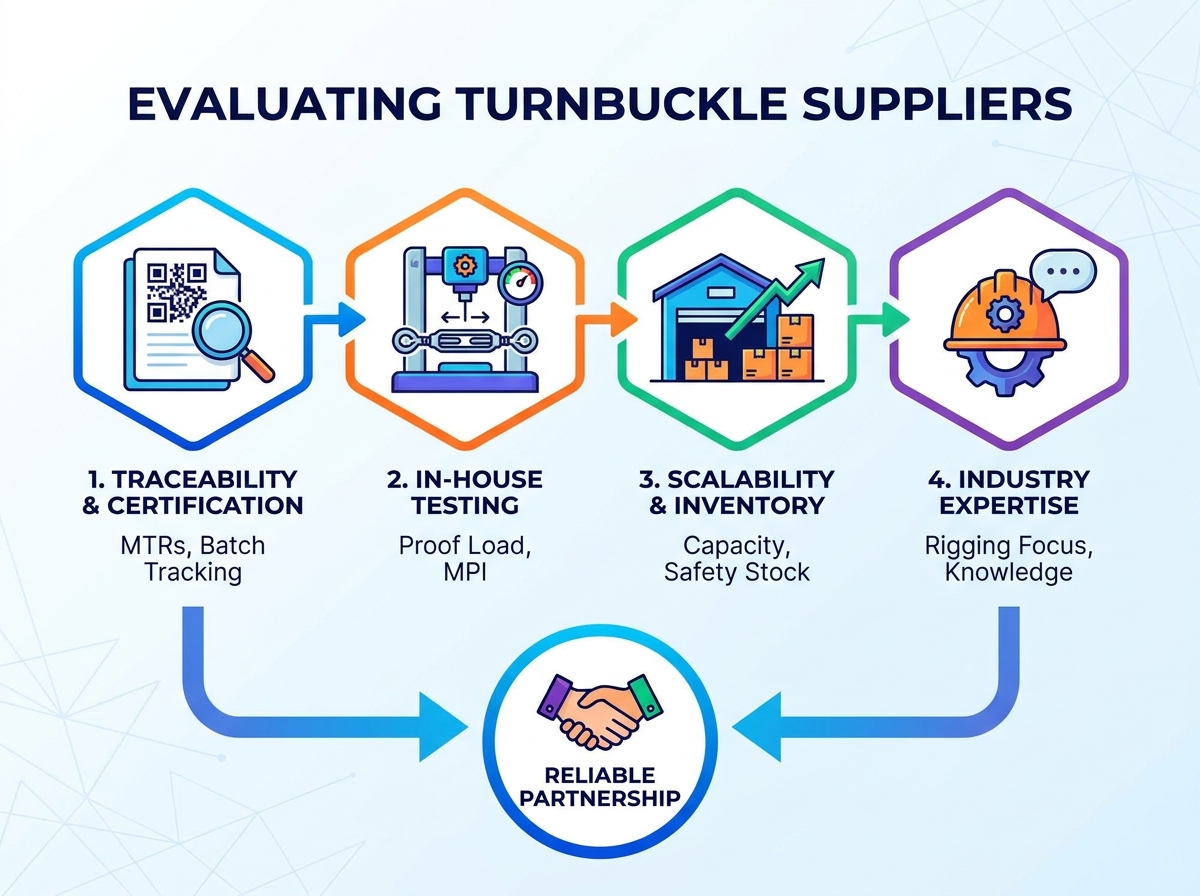
4 Key Criteria for Evaluating a Turnbuckle Supplier
Buyers must move beyond polished marketing claims. You need to evaluate operational capability and quality control maturity deeply. A reputable turnbuckle supplier will willingly demonstrate their technical competence. The following criteria help you separate legitimate manufacturers from basic trading companies.
Traceability and Certification
Industrial safety mandates complete transparency. The vendor must provide full batch traceability upon request. Demand Mill Test Reports (MTRs) showing chemical composition and physical properties. If a vendor cannot produce proper documentation, disqualify them immediately. Traceability ensures you can isolate defective batches during a recall.
In-House Testing Capabilities
Quality control should never be outsourced entirely. Look for partners performing in-house proof load testing. Elite manufacturers also utilize Magnetic Particle Inspection (MPI) or ultrasonic testing. These advanced non-destructive methods reveal internal micro-fractures invisible to the naked eye. Robust internal testing signifies a mature manufacturing operation.
Scalability and Inventory Management
Assess their overall manufacturing capacity carefully. Ask how they handle sudden volume spikes. Large projects often experience unexpected scope changes requiring rapid hardware deployment. Determine whether they hold raw material or finished goods inventory. This safety stock acts as a crucial buffer against unpredictable supply chain shocks.
Deep Industry Expertise
Rigging operations involve complex physics. A dedicated rigging hardware supplier understands load dynamics intimately. Generalist metal-stamping brokers lack this specialized engineering knowledge. Specialized partners offer valuable advice regarding specific threading types and fatigue resistance.
Navigating Global Sourcing and the "China Turnbuckle" Market
Procurement teams need an objective, risk-adjusted view of global sourcing. Buying domestic provides shorter lead times but often carries premium pricing. Offshore sourcing offers distinct advantages if managed correctly.
The Cost vs. Risk Calculus
Overseas manufacturers often provide significant cost advantages for bulk orders. However, these savings introduce specific risks. You must account for extended transit times and potential communication barriers. Quality assurance consistency also fluctuates across different regions. You must build robust oversight mechanisms to protect your investment.
Strict Verification Protocols
You can safely source overseas by implementing strict verification rules. Many buyers successfully utilize a China turnbuckle manufacturer by demanding total transparency. Follow these essential protocols:
- Demand ISO Certification: Require current ISO 9001 certification to ensure standardized management practices.
- Mandate Third-Party Inspections: Schedule pre-shipment inspections using independent auditors like SGS or TÜV.
- Verify Facility Equipment: Request live video tours showcasing drop-forging machinery and testing labs.
Landed Cost Reality
Never make decisions based solely on the factory unit price. You must calculate the true landed cost accurately. Factor in international tariffs, ocean freight expenses, and customs clearance fees. Additionally, calculate the financial impact of holding safety stock. You will need extra inventory to compensate for longer international lead times.
Red Flags to Watch for When Buying Wholesale Turnbuckles
Industrial hardware procurement contains numerous hidden pitfalls. Deceptive practices compromise safety and drain budgets. You must recognize these common warning signs early in the negotiation process.
Unrealistic Pricing Structures
If a bid comes in 30% below the market average, proceed cautiously. Unrealistic pricing usually indicates inferior steel grades. It might also mean the factory skipped essential hot-dip galvanization processes. Cheap hardware inevitably fails under maximum stress. You should view aggressive undercutting as a major quality risk.
Vague Load Ratings
Be extremely skeptical of marketing materials using terms like "heavy duty" or "super strong." These phrases mean absolutely nothing in industrial engineering. Legitimate vendors publishing wholesale turnbuckles catalogs provide precise, tested WLL charts. They detail breaking strengths and safety factors for every single size offered.
Inconsistent Threading and Machining
Poor thread engagement represents a frequent defect in low-tier manufacturing. If the threads bind or feel loose, structural integrity is compromised. The body and end fittings must thread together smoothly under load. Rough machining indicates degraded tooling equipment and lax quality control standards.
Refusal to Provide Samples
A credible manufacturer eagerly accommodates sample requests. They gladly run a paid sample batch before locking in high-volume contracts. If a vendor demands a massive upfront commitment without allowing physical inspection, walk away. You must hold and test the hardware before wiring large deposits.
The Shortlisting Process: Securing Your Rigging Hardware Supplier
Transitioning from initial evaluation to a finalized partnership requires actionable steps. A structured shortlisting process eliminates emotional decision-making. Follow this proven four-step methodology to secure a reliable turnbuckle manufacturer.
- Execute a Blind RFQ: Send identical Request For Quotation documents to your top shortlisted vendors. Compare their response times. Evaluate the depth of their technical clarification questions. Assess their overall pricing transparency. Fast, highly detailed responses indicate excellent customer service.
- Conduct Sample Destructive Testing: Order initial samples immediately. Send these samples to an independent laboratory for destructive testing. You must verify actual breaking strengths. The test results must perfectly align with their stated WLL and safety factor charts.
- Process a Small Trial Order: Never jump straight into an annual contract. Execute a smaller trial run first. This allows you to evaluate packaging quality comprehensively. You can also assess their logistics efficiency and invoice accuracy during this phase.
- Negotiate the Final Contract: Once satisfied, begin formal negotiations. Lock in clear Service Level Agreements (SLAs). Define precise defect resolution procedures. Establish guaranteed lead times. Aim to secure price stability over a 6 to 12-month horizon to protect your budget.
Conclusion
Sourcing an industrial turnbuckle at scale represents a highly critical engineering and procurement exercise. Your operational success relies heavily on demanding total transparency. You must diligently verify technical documentation and relentlessly test physical samples.
We advise you to audit your current supply chain immediately. Download a comprehensive RFQ template to standardize your requirements. Reach out to certified hardware manufacturers today to benchmark your current pricing and quality levels.
FAQ
Q: What is the minimum order quantity (MOQ) for wholesale turnbuckles?
A: MOQ varies heavily by manufacturer and chosen material. Custom production runs typically demand 500 to 5,000 units. Standard sizes held in inventory require significantly smaller minimums. You should always confirm minimums early during the RFQ phase to align expectations.
Q: How do I verify the WLL of a turnbuckle from a new supplier?
A: You must demand official Mill Test Reports (MTRs) before purchasing. Furthermore, require independent laboratory proof-test certificates. A reliable partner will gladly supply these documents. You should also conduct independent destructive testing on initial sample batches to validate their published charts.
Q: What is the difference between drop-forged and cast turnbuckles?
A: Drop-forged hardware possesses a superior, continuous grain structure. This makes it mandatory for critical lifting and tensioning operations. Cast hardware is significantly weaker and brittle. You must restrict cast components strictly to light-duty, non-critical applications where safety is never a factor.
Q: How long are typical lead times for bulk rigging hardware orders?
A: Sourcing from domestic inventory usually takes 2 to 4 weeks. Overseas production paired with ocean freight typically requires 6 to 12 weeks. You must plan procurement schedules carefully. Always hold adequate safety stock to absorb transit delays and customs holds.

 English
 العربية
 Français
 Русский
 Español
 Português
 Deutsch
 italiano
 日本語
 한국어
 Nederlands
 Tiếng Việt
 ไทย
 Polski
 Türkçe
 አማርኛ
 ພາສາລາວ
 ភាសាខ្មែរ
 Bahasa Melayu
 ဗမာစာ
 தமிழ்
 Filipino
 Bahasa Indonesia
 magyar
 Română
 Čeština
 Монгол
 қазақ
 Српски
 हिन्दी
 Slovenčina
 Slovenščina
 Norsk
 Svenska
 українська
 Ελληνικά
 Suomi
 Հայերեն
 עברית
 Dansk
 اردو


