Specifying wire rope is not merely a commodity purchase. It represents a critical operational risk management decision for any industrial facility. Making the wrong choice exposes your entire operation to catastrophic equipment failure. It also introduces severe safety hazards to your workforce. Both mining and construction sectors move massive payloads daily. However, they face drastically different mechanical stressors, failure modes, and regulatory environments. A solution engineered for a crane might fail rapidly in an underground shaft. This article provides engineers and procurement teams with a clear, evidence-based framework. You will learn how to evaluate these components effectively. We will help you shortlist the right gear based on specific operational demands. You will understand how to ensure strict compliance requirements are met safely.
Key Takeaways
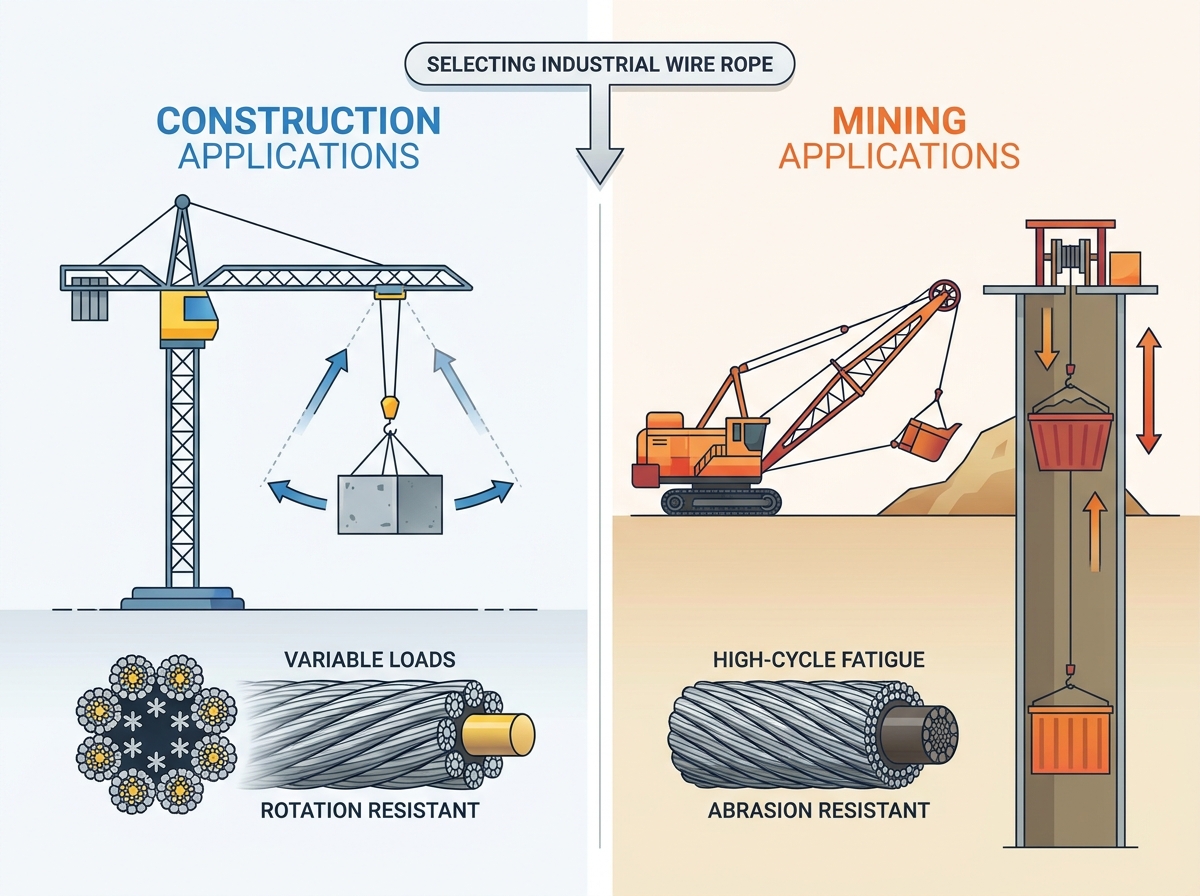
- Stress Profiles Differ: Construction applications typically demand rotation resistance and flexibility for variable lifting, while mining environments require extreme abrasion and fatigue resistance for continuous, high-cycle operations.
- Core Configuration Matters: Independent Wire Rope Core (IWRC) and specialized compacted strands are critical for heavy-duty mining, whereas specific lay types dictate lifting stability in construction.
- Compliance & TCO: Selection must align with distinct regulatory bodies (OSHA for construction, MSHA for mining) to avoid costly downtime and liability.
- Terminology: Distinguishing between standard steel cable and specialized industrial wire rope prevents critical procurement and safety errors.
1. The Business Impact of Specifying Industrial Wire Rope
Under-specifying your lifting equipment creates immense hidden costs across your organization. It leads directly to premature wear and unscheduled downtime. Catastrophic failures halt production entirely and ruin project timelines. They also trigger intense regulatory scrutiny and massive fines. Conversely, over-specifying wastes valuable capital budget needlessly. It often creates severe equipment mismatches. For example, installing an excessively stiff rope might destroy a small sheave rapidly.
You must define clear success criteria for your procurement strategy. Your primary goal is maximizing service life safely without compromising performance. You also need predictable degradation patterns. Predictable wear allows maintenance teams to schedule safe, routine replacements. Strict regulatory compliance remains non-negotiable for any heavy industry operation.
We recommend shifting your entire evaluation baseline immediately. Upfront purchase price is secondary to actual operational performance. You should measure the cost per ton lifted instead. Cost per operating hour provides a much more accurate efficiency metric. This approach reveals the true long-term value of a high-quality industrial wire rope. Focusing solely on cheap upfront costs often multiplies maintenance expenses later. True operational efficiency requires matching the exact specification to your unique site demands.
2. Construction Wire Rope: Variable Loads and Operational Flexibility
Construction sites operate in a highly dynamic, unpredictable environment. Tower cranes, mobile cranes, and hoists move constantly throughout the shift. Operators handle varied load weights every single hour. Sudden shock loading occurs frequently during complex lifts. Lifting angles change constantly as materials move across the busy site.
You must evaluate products against three critical dimensions:
- Rotation Resistance: Free-hanging loads tend to spin dangerously. Multi-strand, rotation-resistant ropes are mandatory here. Inner and outer strands lay in opposite directions. This specific design actively counteracts dangerous rotational torque.
- Crush Resistance: Multi-layer crane drums create extreme spooling pressures. The rope must resist intense deformation under heavy loads. A crushed outer layer ruins structural integrity quickly and forces early replacement.
- Flexibility: Construction equipment utilizes complex sheave and block systems. Ropes must navigate tight bending radii smoothly. High flexibility prevents early structural fatigue and broken outer wires.
These demanding conditions require highly specialized products. You need precise technical criteria for construction wire rope before placing an order. Crane operations depend heavily on stable, anti-rotational lifting wire rope. Ground crews also require highly durable rigging wire rope. They use these extensively for slings, manual hoists, and heavy tie-downs. Using the wrong configuration in a dynamic lift compromises the entire site. Always prioritize load stability and flexibility for these variable conditions.
3. Mining Wire Rope: High-Cycle Fatigue and Abrasive Environments
Mining operations are continuous and brutally repetitive. Friction winders, massive draglines, and shaft sinking equipment run non-stop. These heavy systems endure constant cyclical bending. They also face severe abrasive particulate exposure daily from rock and ore dust.
Evaluate products for underground and surface mining across these dimensions:
- Fatigue Life: Compacted strands increase the exterior surface contact area. This reduces localized pressure points on sheaves. Specialized internal lubrication is absolutely essential. It withstands continuous high-tension bending cycles safely.
- Abrasion & Corrosion Resistance: Abrasive rock dust acts exactly like sandpaper. It aggressively grinds away standard steel wires. Highly corrosive mine water accelerates internal rust and degradation. You must utilize robust protective coatings or heavily galvanized finishes.
- High Tensile Strength: Deep-shaft lifting demands incredible sustained power. Elevators often drop thousands of feet underground. The rope must support its own massive dead weight. It must simultaneously carry the heavy payload without stretching dangerously.
Target applications vary significantly across different sites. Surface extraction involves massive draglines and electric shovels. These machines require extreme outer abrasion resistance. Underground shaft applications require specialized heavy duty wire rope. High tensile strength prevents snapping under immense vertical strain. Specifying the correct mining wire rope prevents disastrous operational failures. Never treat surface and underground requirements interchangeably. Each unique environment attacks the metal differently.
4. Steel Cable vs. Industrial Wire Rope: Clarifying Procurement Terminology
Using generic terminology creates massive procurement risks for your company. Many buyers use the term steel cable loosely. They use it interchangeably with proper industrial terms. This leads directly to critical specification errors. Vendor miscommunication often follows, resulting in dangerous equipment mismatches on site.
You must understand the technical distinctions clearly to purchase safely.
Standard cables typically feature a much smaller overall diameter. They utilize a simpler, less robust construction method. Engineers use them for light bracing, guiding, or basic securing. Architectural applications also rely heavily on standard cables.
Proper industrial grades feature highly complex engineered structures. They utilize specific, calculated arrangements of wires, strands, and internal cores. Manufacturers design them specifically for heavy dynamic lifting. They handle extreme tension, shock loads, and heavy power transmission safely.
You need actionable advice for writing Request for Quotes (RFQs). Stop using generic terms immediately. Require vendors to specify the exact strand count. Detail the required core type precisely (like IWRC). State the required lay direction clearly. This clarity eliminates vendor guesswork and ensures ultimate safety.
Comparison Chart: Steel Cable vs. Industrial Wire Rope
| Feature | Standard Steel Cable | Industrial Wire Rope |
| Primary Application | Light bracing, architectural, guiding | Heavy lifting, dynamic tension, mining |
| Construction Complexity | Simple (fewer wires and strands) | Complex (engineered core, multi-strand) |
| Dynamic Load Capacity | Low to Moderate | Extremely High |
| Core Material | Usually lacks a dedicated heavy core | IWRC (Steel) or FC (Fiber) |
| Fatigue Resistance | Low | High (designed for cyclical bending) |
5. Decision Framework: Evaluating and Shortlisting Suppliers
You must evaluate and shortlist suppliers carefully. Map specific product features directly to your desired operational outcomes. This ensures you purchase capabilities, not just metal.
Core type dictates foundational performance characteristics. A Fiber Core (FC) provides excellent flexibility and elasticity. It also holds internal lubricants extremely well. An Independent Wire Rope Core (IWRC) provides superior crush resistance. It adds crucial overall breaking strength for heavy lifts.
Coating and lubrication impact longevity directly. Galvanized finishes resist rust effectively in damp environments. Bright finishes work well in dry, controlled conditions. Continuous mine use requires factory-impregnated core lubricants. These specialized lubricants prevent internal friction during brutal repetitive cycles.
Strand compaction alters the exterior profile significantly. Compaction creates a very smooth outer surface area. This significantly reduces sheave wear in high-use applications. It also increases the metallic cross-sectional area, boosting overall strength.
Compliance and traceability are absolutely mandatory. Verify your supplier documentation rigorously before purchasing. They must provide official mill test certificates. You must request proof-loading documentation before installation. Ensure strict adherence to OSHA, MSHA, API, or ISO industry standards.
Evaluate vendor capabilities beyond just basic manufacturing. Can they provide non-destructive testing (NDT) support? Do they offer reliable field inspection services? Look for custom cutting and certified socketing capabilities. A strong supplier acts as a true technical partner. They help you maintain safety long after the initial purchase.
6. Implementation Risks and Rollout Considerations
Implementation risks can ruin your investment immediately. Installation hazards require strict attention from your maintenance team. Improper unwinding causes permanent, dangerous kinks. A kink destroys the structural integrity instantly. Incorrect socketing compromises the rated breaking strength completely. These avoidable errors ruin the asset before it even enters service.
Always respect break-in periods. New ropes require a careful break-in phase. You must operate them at significantly reduced loads initially. Run them through several cycles slowly and smoothly. This allows the individual wires and strands to seat properly against the core. Skipping this crucial step causes uneven load distribution and early failure.
Modernize your site inspection protocols today. Shift away from purely reactive replacement strategies. Implement predictive maintenance programs immediately. Use electromagnetic testing equipment regularly. Nondestructive Evaluation (NDE) detects dangerous internal broken wires. Visual inspections alone cannot find hidden core damage. NDE prevents sudden, catastrophic failures effectively. Train your maintenance crews to track wear patterns accurately over time. Proactive monitoring saves immense money and protects human lives.
Conclusion
Construction applications prioritize load stability and flexibility under highly variable conditions. Complex lifts demand proper rotation resistance and drum crush resistance. Mining demands extreme durability against abrasive dust and cyclical fatigue. Continuous extraction cycles require compacted strands and superior internal lubrication to survive.
We strongly advise procurement and engineering teams to collaborate closely. Conduct a comprehensive site audit together. Always consult with a certified rigging engineer prior to finalizing any specifications. Expert input prevents costly purchasing mistakes and enhances safety.
Take immediate action to protect your operation. Review your current replacement intervals today. Assess whether your current specifications truly match your actual site demands. Request a technical consultation or quote from a certified manufacturer. Securing the exact right equipment ensures maximum safety and ongoing operational efficiency.
FAQ
Q: Can construction wire rope be used in mining applications?
A: Generally, no. Construction ropes often prioritize rotation resistance over extreme abrasion and fatigue resistance. Mining cycles are continuous and brutal. Using construction-grade options in mines severely reduces lifespan. It also poses significant safety risks due to rapid degradation.
Q: What is the average lifespan of heavy duty wire rope in industrial applications?
A: Lifespan is measured in operational cycles or ton-miles, not calendar days. It depends entirely on the operating environment. Sheave alignment, usage intensity, and maintenance schedules dictate longevity. Proper lubrication directly extends operational life significantly.
Q: How often should mining wire rope and lifting wire rope be inspected?
A: Regulatory baselines dictate minimums. OSHA requires daily visual inspections for cranes. MSHA enforces strict periodic non-destructive testing (NDT) requirements for mine hoists. High-cycle environments require continuous monitoring. Never skip daily visual checks before operating heavy loads.
Q: What is the difference between IWRC and FC in industrial wire rope?
A: IWRC stands for Independent Wire Rope Core. It provides higher strength and resistance to drum crushing. FC stands for Fiber Core. It offers greater flexibility and excellent internal lubricant retention. However, FC is unsuitable for extreme heavy-duty lifting.

 English
 العربية
 Français
 Русский
 Español
 Português
 Deutsch
 italiano
 日本語
 한국어
 Nederlands
 Tiếng Việt
 ไทย
 Polski
 Türkçe
 አማርኛ
 ພາສາລາວ
 ភាសាខ្មែរ
 Bahasa Melayu
 ဗမာစာ
 தமிழ்
 Filipino
 Bahasa Indonesia
 magyar
 Română
 Čeština
 Монгол
 қазақ
 Српски
 हिन्दी
 Slovenčina
 Slovenščina
 Norsk
 Svenska
 українська
 Ελληνικά
 Suomi
 Հայերեն
 עברית
 Dansk
 اردو


