In industrial procurement, the stakes are undeniably high. Purchasing substandard rigging components routinely leads to catastrophic safety failures, extended equipment downtime, and massive liability risks. While pricing often drives initial conversations, decision-stage buyers must look beyond the invoice. Traceability, technical capability, and supply chain reliability matter just as much as the bottom line. You cannot afford to rely on vague assurances when workforce safety hangs in the balance. This article provides a skeptical, evidence-based questioning framework. It helps procurement teams evaluate a potential wire rope supplier rigorously. By asking the right technical and operational questions, you will separate true manufacturing partners from unreliable middlemen. You will learn exactly what proof to demand before signing any purchase order.
Key Takeaways
- Demand Proof, Not Promises: Always request Mill Test Certificates (MTCs) and third-party audit reports before finalizing an order.
- Align Specs with Application: Specific use cases like overhead lifting or heavy marine environments require distinct construction, core types, and compliance standards.
- Evaluate Supply Chain Resilience: Assess production capacity, lead times, and risk mitigation strategies, especially when sourcing global or wholesale wire rope.
- Test Post-Sale Accountability: A supplier’s warranty policies, claim-handling processes, and technical support reveal their true reliability.
Understanding the Stakes: Why Vetting Your Wire Rope Supplier is Critical
Premature rope failure impacts your business directly. When rigging components fail on a job site, the financial and operational fallout is immediate. Crane downtime halts entire construction schedules. Delayed project timelines trigger severe penalty clauses. More importantly, sudden structural failures put human lives at risk. Assessing your vendors thoroughly prevents these catastrophic scenarios.
You must understand the operational differences between a direct wire rope manufacturer and a distributor. Manufacturers own the production lines. They control raw material sourcing, wire drawing, stranding, and closing processes. They offer deep customization and direct quality control. Distributors, conversely, purchase finished goods in bulk and manage local inventory. Use a direct factory partner for large-scale projects, custom engineering, or heavy ongoing demand. Choose a distributor when you need rapid, small-batch local deliveries.
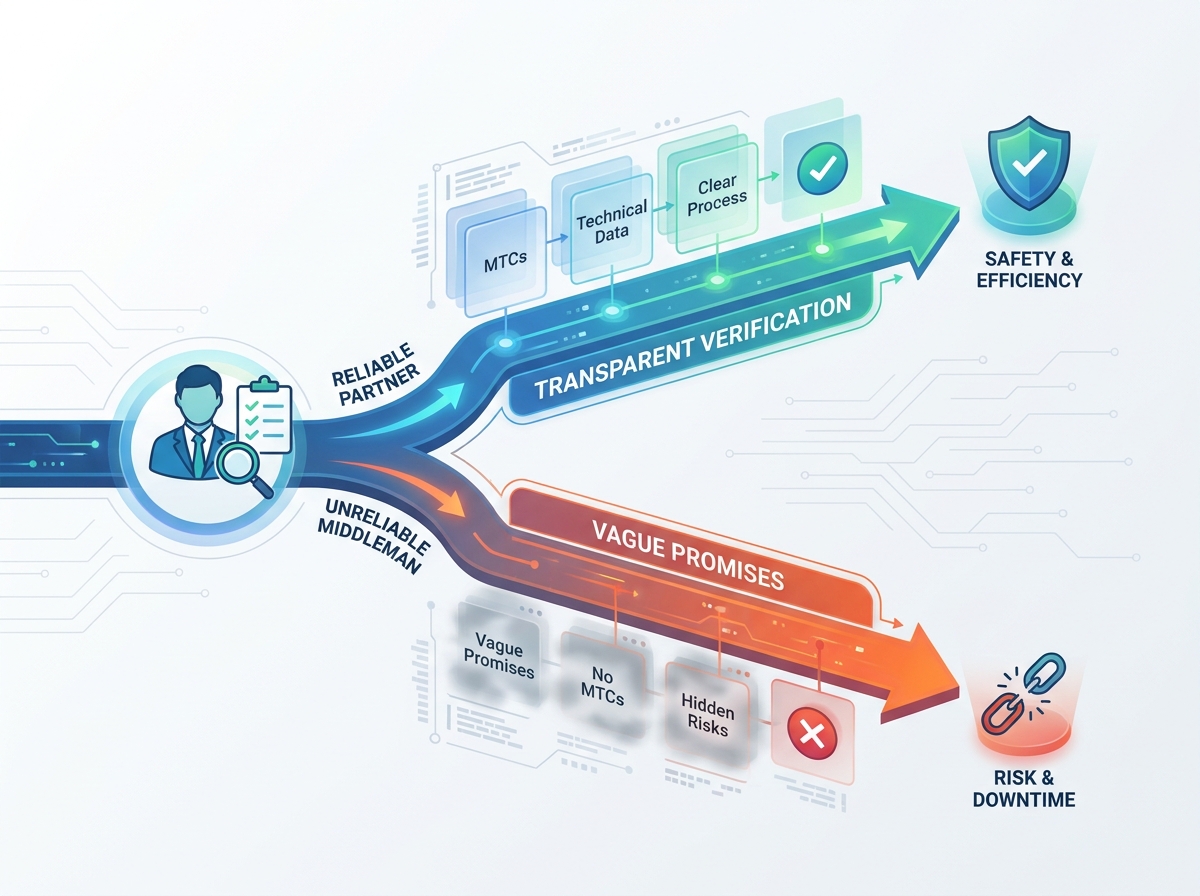
Treat the initial vetting phase as a "Professionalism Test." The questions you ask do more than gather basic data. They test how transparently the vendor communicates. If they answer technical questions with vague sales pitches rather than hard data, you should walk away. A credible vendor supplies engineering charts, metallurgical data, and compliance documents without hesitation.
Technical & Application-Specific Questions
You must match the product precisely to its intended application. Ask the vendor directly: "Do you have specific engineering data for lifting wire rope versus general-purpose rigging?" General-purpose products fail quickly under heavy cyclic bending. Detail the necessity of matching rope construction to the exact machinery. For example, a 6x36 construction offers flexibility, while an 8x19 construction provides different load characteristics. You must also specify the core type. An Independent Wire Rope Core (IWRC) resists crushing better than a Fiber Core (FC). Lay direction matters equally for spooling stability.
When evaluating crane wire rope, demand specific performance metrics. Ask them: "What fatigue-resistance and anti-rotation characteristics do your products offer?" Tower cranes and mobile cranes require specialized anti-rotation designs to prevent load spinning. Emphasize the need for verified Minimum Breaking Load (MBL) data. Request operational lifespan estimates based on specific bending cycles. Do not accept generic answers. They must provide charts linking diameter, construction, and MBL.
Corrosive environments require specialized protection. Ask the vendor: "How do you verify the galvanization or lubrication standards?" Marine or chemical environments destroy unprotected steel rapidly. They should specify the zinc coating mass per square meter. They must also detail the lubrication application method during the stranding process. Core lubrication ensures internal friction does not destroy the strands from the inside out.
Quality Assurance and Compliance Standards
Traceability guarantees safety. Demand transparency by asking: "Can you provide a sample Mill Test Certificate (MTC) EN 10204 3.1 for your products?" Buyers must demand heat numbers on every certificate. Heat numbers trace the final product back to the exact batch of raw steel. The MTC must show tensile strength verification and a full chemical composition breakdown. This document proves they used high-carbon steel rather than inferior alloys.
Evaluate their testing infrastructure thoroughly. Ask them: "What destructive and non-destructive testing (NDT) capabilities exist in your facility?" In-house testing proves serious manufacturing capability. Look for mentions of torsion testing machines, massive tensile test beds, and dedicated fatigue test machines. If they outsource all testing, they lose immediate quality control over daily production batches.
Certifications validate baseline competence. Verify their adherence to global safety standards. Do they hold active ISO 9001 certifications? Can they produce API (American Petroleum Institute) monograms for offshore applications? Verify CE marks for European markets and compliance with EN 12385 standards. Do not just look at the logos on their website. Ask for certificate numbers and verify them independently.
Common Testing Capabilities to Verify
| Testing Method | Primary Purpose | What to Look For |
| Tensile Testing | Verifies Minimum Breaking Load (MBL) | Test beds capable of pulling up to the maximum load rating of the rope. |
| Torsion Testing | Checks ductility of individual steel wires | Data showing the wire can twist repeatedly without snapping prematurely. |
| Fatigue Testing | Simulates cyclic bending over sheaves | Machines estimating operational lifespan under continuous load. |
| Non-Destructive Testing (NDT) | Detects internal flaws without breaking the rope | Electromagnetic testing (MRT) verifying internal core integrity. |
Supply Chain Resilience and Scalability
Supply chain disruptions cripple project timelines. You must assess capacity and lead times meticulously. Ask them: "What is your actual production capacity, and how do you handle peak season delays?" This question is essential for buyers ordering wholesale wire rope. High-volume buyers cannot afford sudden inventory gaps. A robust partner will share monthly tonnage limits and detail their raw material safety stock.
Evaluating global sourcing requires a sharp focus on logistics. If they operate as a China wire rope supplier, probe their export processes. Ask: "What are your exact logistics workflows, customs clearance support, and FOB/CIF terms?" Address the legitimate concerns of global sourcing, such as shipping volatility and communication gaps. Top-tier international suppliers mitigate these risks. They maintain dedicated export teams, partner with reliable freight forwarders, and provide transparent tracking documentation.
Clarify Minimum Order Quantities (MOQ) early in the negotiation. Standard stock items usually have flexible MOQs. However, custom engineering runs require specific setup times. Ask about MOQ flexibility for specialized constructions or unique coatings. A cooperative partner will often negotiate trial batch sizes before demanding massive bulk commitments.
Accountability and Post-Sale Support
A supplier’s true character emerges when things go wrong. Start by evaluating their claim handling procedures. Ask: "Walk me through your exact process if a batch fails a pre-installation inspection." Look for a documented, transparent Non-Conformance Report (NCR) process. Vague promises like "we will replace it immediately" offer no systemic protection. An NCR process shows they investigate the root cause, document the failure, and implement corrective actions.
Technical support differentiates true partners from mere transaction points. Ask them: "Do you provide installation guidance, maintenance manuals, or retirement criteria?" Proper installation prevents immediate damage. They should supply detailed spooling instructions. Furthermore, they must outline clear retirement criteria based on ISO 4309, helping your maintenance teams know exactly when to pull a rope from service.
Establish baseline expectations for warranty terms. You need absolute clarity regarding manufacturing defects versus operational wear-and-tear. A solid warranty covers metallurgical failures, improper stranding, and defective cores. It will not cover damage from abrasive environments, shock loading, or poor lubrication on your end. Get these distinctions documented in writing before ordering.
The Shortlisting Framework: Next Steps for Procurement
Procurement teams need a structural approach to grade potential vendors. Create a quick mental scoring matrix for grading a steel wire rope supplier based on their responses. Heavily weight technical transparency, MTC readiness, and communication speed. Lowest unit price should carry the lowest weight in your matrix. A cheap product with no traceability presents an unacceptable corporate risk.
Watch out for critical red flags during your communications. If you spot these warning signs, remove the vendor from your shortlist immediately:
- Reluctance to share current facility photos or live video feeds.
- Vague answers regarding the origin of their high-carbon steel rods.
- Lack of an established Quality Management System (QMS) like ISO 9001.
- Inability to produce a sample 3.1 MTC upon request.
- Defensive reactions when questioned about destructive testing methods.
Once you filter out the high-risk vendors, move to actionable next steps. Do not jump straight to a massive bulk order.
- Request a live video audit of their manufacturing facility and testing labs.
- Order a small trial batch to inspect the physical packaging, lubrication quality, and spooling neatness.
- Send the trial sample to an independent third-party lab for independent tensile verification.
- Finalize the master supply agreement only after the trial passes all internal criteria.
Conclusion
Asking hard, technical questions protects your bottom line and your workforce safety. Industrial lifting and rigging leave no margin for error. By systematically evaluating traceability, manufacturing capabilities, and post-sale support, you filter out unreliable vendors efficiently. Remember, a credible partner will always welcome rigorous vetting. They view your technical questions as an opportunity to demonstrate their expertise and engineering strength. Take control of your procurement process today. Download a comprehensive evaluation checklist or contact the vendor's engineering team directly to discuss your specific project requirements.
FAQ
Q: What is the difference between a wire rope supplier and a manufacturer?
A: Manufacturers own the production lines and control raw material sourcing. They draw the wire and strand the final product. Suppliers or distributors buy from these manufacturers and hold local inventory for faster, smaller-scale distribution.
Q: What documents should a steel wire rope supplier provide with my order?
A: At a minimum, expect a Mill Test Certificate (MTC) EN 10204 3.1, a packing list, and a commercial invoice. For specialized applications, ask for third-party inspection reports from agencies like SGS or Lloyd's Register.
Q: How do I verify the quality of a China wire rope manufacturer?
A: Request live video tours of their testing labs. Ask for their ISO or API certification numbers and verify them independently through official databases. Finally, check references from their existing international clients.
Q: Why is the Minimum Breaking Load (MBL) so important?
A: MBL is the critical safety metric indicating the absolute maximum force the rope can withstand before failing. It dictates the Safe Working Load (SWL) and ensures safety for all heavy lifting operations.

 English
 العربية
 Français
 Русский
 Español
 Português
 Deutsch
 italiano
 日本語
 한국어
 Nederlands
 Tiếng Việt
 ไทย
 Polski
 Türkçe
 አማርኛ
 ພາສາລາວ
 ភាសាខ្មែរ
 Bahasa Melayu
 ဗမာစာ
 தமிழ்
 Filipino
 Bahasa Indonesia
 magyar
 Română
 Čeština
 Монгол
 қазақ
 Српски
 हिन्दी
 Slovenčina
 Slovenščina
 Norsk
 Svenska
 українська
 Ελληνικά
 Suomi
 Հայերեն
 עברית
 Dansk
 اردو


