Effective wire rope storage serves as a critical risk management and asset preservation function. You must never treat it as a basic warehousing task. When environmental degradation causes premature equipment retirement, operations suffer massive financial and operational impacts. We see facilities lose thousands of dollars because they neglect proper staging protocols. Compliance begins the exact moment you remove a rope from active service or receive it into your inventory. Following manufacturer guidelines and strict industry standards, such as ASME or ISO, ensures workplace safety and product longevity. In this guide, you will learn how to protect your high-value assets correctly. We explore the hidden costs of poor storage, specific environmental criteria, and vital maintenance protocols. You will also discover how to upgrade your facility infrastructure to keep your lifting equipment in peak condition year-round.
Key Takeaways
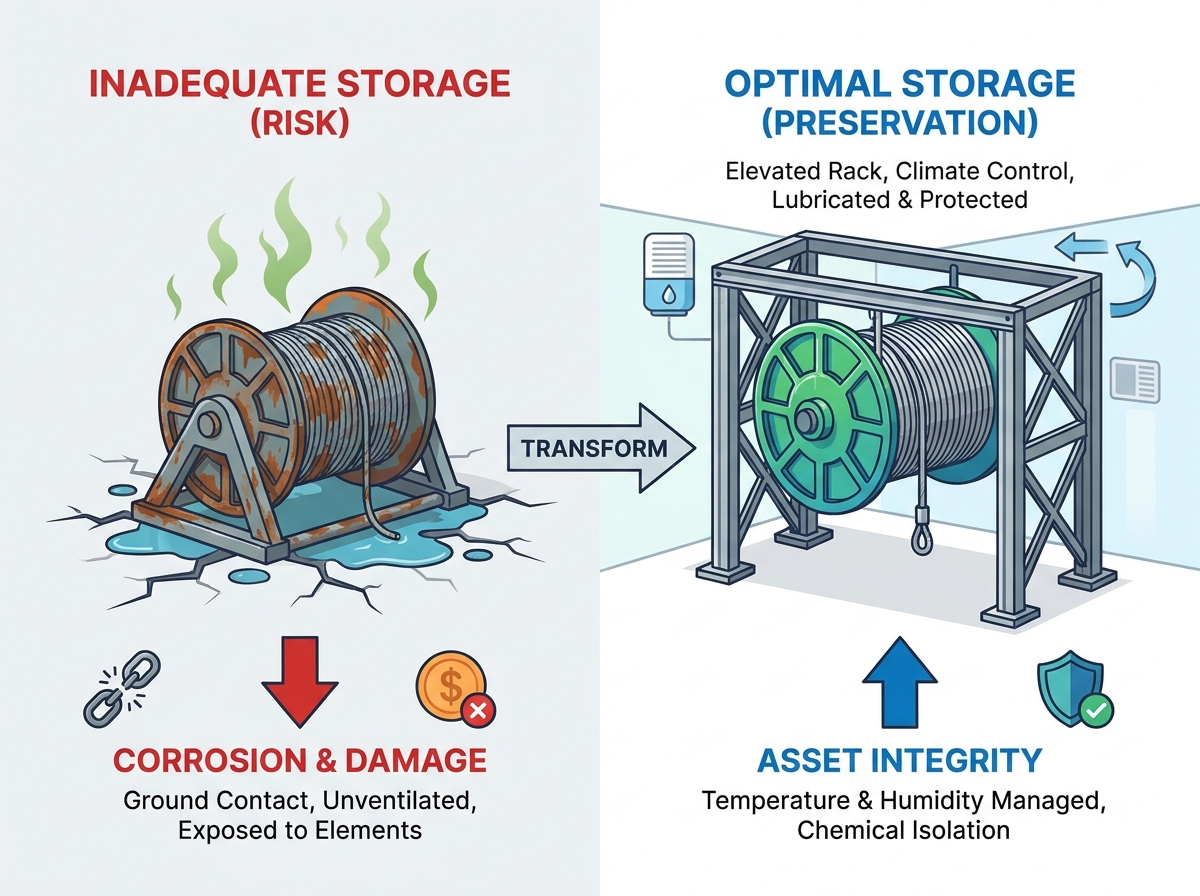
- Storing wire rope directly on the ground or in unventilated areas accelerates internal and external corrosion, leading to sudden failure risks.
- Proper pre-storage preparation—including cleaning and relubrication—is non-negotiable for preserving core integrity.
- Environmental controls (temperature, humidity, and chemical isolation) dictate the true shelf life of spare ropes.
- Upgrading to purpose-built storage racks minimizes mechanical damage to reels and prevents localized rope distortion.
The True Cost of Inadequate Wire Rope Storage
Operational Downtime & Replacement Costs
Hidden wire rope corrosion acquired during improper storage frequently causes failed pre-use inspections. When inspectors discover internal rust, you face expensive, unscheduled equipment replacements. This translates directly to severe operational downtime. Crane crews cannot work without certified, reliable lines. We often see facilities drain their maintenance budgets on new inventory simply because they stored their spares incorrectly. Proper preventative care stops these sudden financial shocks. Taking proactive steps ensures your replacement spools are always ready for immediate deployment.
Furthermore, the logistics of rushing a replacement order compound your financial losses. Expedited shipping for heavy steel components costs a premium. You lose revenue for every hour your machinery sits idle waiting for parts. Protecting your existing inventory eliminates these emergency logistics entirely. It keeps your daily operations running smoothly and predictably.
Safety and Compliance Liabilities
Deploying compromised equipment introduces severe safety implications to your worksite. If a degraded line snaps under a heavy load, the consequences are disastrous. Dropped loads endanger lives and destroy valuable site materials. Auditors and safety inspectors routinely trace accident failure points back to poor facility storage conditions. They rigorously check your warehousing practices against strict regulatory guidelines.
If your team ignores these standard operating procedures, you invite major compliance liabilities. Regulatory bodies issue heavy fines for negligent inventory management. Facility managers must view storage as an active compliance duty. Documenting your storage conditions proves your commitment to safety. It also provides a clear paper trail during annual safety audits.
The "Harsh Environment" Fallacy
Many operators falsely believe indoor storage automatically protects their assets from harm. This dangerous assumption costs companies heavily. Even enclosed indoor environments act as harsh environments under specific conditions. Industrial fumes, thick airborne dust, and high relative humidity destroy bare steel rapidly. You must evaluate your indoor climate very carefully.
If your warehouse lacks active ventilation, condensation builds up quickly. This moisture ruins your inventory silently over time. Facilities near marine environments or chemical processing plants face even higher indoor risks. Salt air permeates poorly sealed warehouses easily. You must actively defend your spares against these invisible indoor threats.
Core Environmental Criteria for Wire Rope Storage
Climate Control
You must maintain acceptable temperature and humidity thresholds inside your storage facility. Industry experts strongly recommend keeping relative humidity below 50%. Lower humidity prevents the formation of condensation on metal surfaces. Condensation causes rapid surface rust and aggressively degrades the original factory lubrication. When warehouse temperatures fluctuate wildly between day and night, steel actively sweats.
We advise installing dedicated climate control systems in your staging rooms. Using industrial dehumidifiers extends shelf life dramatically. Managers should place hygrometers near the storage racks to monitor moisture levels daily. Consistent climate monitoring prevents the slow, invisible degradation of the inner core.
Chemical and Contaminant Isolation
Keep your storage areas completely isolated from chemical hazards. Acid fumes and heavy exhaust gases attack metal surfaces continuously. Corrosive airborne particulates from nearby manufacturing processes settle into the structural strands. Over time, they eat right through protective chemical barriers. You should always isolate spare inventory in clean, dedicated zones.
Never store your spares near forklift battery charging stations. These stations emit corrosive hydrogen gases. Avoid placing reels near chemical vats, bleach storage, or ammonia lines. Segregating your inventory prevents cross-contamination. It also ensures the steel retains its structural integrity until deployment.
UV and Weather Protection
Both bare ropes and synthetic-covered variants require absolute shielding from direct sunlight. Ultraviolet rays degrade synthetic cores and protective outer jackets exceptionally fast. Prolonged UV exposure makes plastics brittle and prone to cracking under tension. Precipitation proves equally destructive to bare steel. Rainwater washes away vital protective oils.
Even during temporary outdoor staging, you must provide heavy-duty weather protection. Never leave equipment fully exposed to the outdoor elements. Use breathable, waterproof covers if you must stage materials outside temporarily. Proper shielding preserves the elasticity and strength of the internal components.
Ideal Storage Environment Benchmarks
| Environmental Factor | Acceptable Range | Risk of Non-Compliance |
| Relative Humidity | Below 50% | Rapid surface rust and core rot |
| Temperature | 50°F to 70°F (Stable) | Condensation from thermal shock |
| Chemical Contaminants | Zero exposure | Accelerated pitting and corrosion |
| Direct Sun Exposure | Zero UV exposure | Synthetic core and jacket degradation |
Pre-Storage Wire Rope Maintenance and Preparation
Inspection and Cleaning Protocols
Implementing rigorous wire rope maintenance starts before the spool ever hits the rack. You must outline clear steps for removing abrasive debris and moisture. If you store dirty equipment, it traps harmful contaminants directly against the steel. Use stiff nylon brushes and compressed air to clean the strands thoroughly. Never use highly acidic solvents for cleaning.
During the cleaning process, inspect the entire length for broken wires. Look closely for any mechanical damage or localized crushing. Document any anomalies in your maintenance log. Storing a damaged line wastes valuable warehouse space. It also creates a false sense of security regarding your backup inventory.
Application of Field Lubricants
After thorough cleaning, you must apply an approved anti-corrosive storage compound. Standard operating lubricants differ vastly from storage preservation coatings. Storage compounds create a thick, impenetrable barrier against moisture. Work this heavy lubricant deep into the valleys between the outer strands. This step protects the vulnerable inner core from hidden decay.
Always check manufacturer recommendations before selecting a chemical coating. Some synthetic cores react poorly to petroleum-based solvents. Using the wrong compound degrades the inner core chemically. Proper application requires patience, but it guarantees your spares remain pristine during long-term storage.
Reeling and Spooling Best Practices
You must tension the line properly during the rewinding process. Poor spooling leads directly to crushing, doglegs, or permanent structural distortion. We highly recommend using a motorized spooling machine. These machines maintain consistent tension across the entire drum. Consistent tension prevents the lower layers from flattening out.
Never allow the line to go slack and cross over itself. Crossed layers pinch and cut into one another under the weight of the spool. Neat, tight, and uniform layers prevent mechanical damage while resting in storage. Following strict spooling procedures preserves the exact shape of the strands.
Special Considerations for Lifting Rope and Rigging Equipment
Material-Specific Risks
Standard carbon steel differs fundamentally from stainless steel and galvanized variants. Carbon steel wire rope requires heavy, consistent lubrication to survive any storage period. It rusts rapidly upon exposure to baseline humidity. Conversely, stainless steel resists general rust effectively. However, it remains highly vulnerable to chloride pitting in marine or chemical environments.
Galvanized options offer moderate protection through a sacrificial zinc coating. Even so, this zinc layer depletes over time if exposed to acidic moisture. You must tailor your preservation strategy to the specific material grade. Applying a one-size-fits-all approach leaves specific alloys completely unprotected.
Sling and Assembly Storage
Terminated rigging equipment demands highly specialized handling. You should hang slings, heavy hooks, and shackles properly in dedicated areas. Hanging prevents kinking and stops mechanical damage to the spliced eyes or metal fittings. Never toss your assemblies into a tangled, disorganized pile on the floor.
Floor storage exposes fittings to dirt, moisture, and accidental forklift damage. We recommend using dedicated pegboards or robust A-frame racks. These keep individual assemblies separated, organized, and adequately ventilated. Proper organization speeds up deployment and simplifies your pre-use inspection routines.
Managing High-Performance Crane Ropes
High-performance rotation-resistant lines require incredibly strict storage tolerances. A specialized lifting rope is highly sensitive to improper handling. It suffers severely under uneven resting pressures. You must support these expensive spools evenly to prevent internal strand displacement. Uneven pressure forces the core out of alignment.
Handle compacted crane lines gently at all times. Any sudden structural shift permanently ruins their engineered rotation-resistant properties. Use specialized spreader bars when lifting these reels with a crane. Never drop them, even from a few inches off the ground. Treating them delicately preserves their complex internal geometry.
Evaluating Cable Storage Solutions: Racks, Reels, and Facilities
Elevated Storage Mandates
Reels must never touch concrete or dirt floors directly. Ground contact wicks moisture straight into wooden or steel flanges. This transfers dampness directly into your valuable equipment. Implementing proper cable storage absolutely requires elevated platforms. Elevation guarantees necessary airflow underneath the heavy spools.
You can use sturdy plastic pallets, custom A-frames, or heavy-duty cantilever racking systems. Wood pallets work temporarily, but they can harbor moisture and insects over time. Steel or high-density plastic racks offer superior long-term isolation from ground-level hazards. Always keep the lowest tier at least six inches above the floor.
Reel Orientation and Support
Reels should always rest securely on their sturdy flanges. You must never rest them on the spooled material itself. Resting heavy weight directly on the spooled layers causes localized crushing and severe flattening. This creates a permanent weak point in the line.
Inspect wooden reels periodically for any signs of rot or termite damage. If a wooden reel shows structural weakness, transfer the line to a steel drum immediately. Proper support maintains the structural integrity of your assets. Securing the spools prevents them from rolling and causing workplace injuries.
Inventory Rotation (FIFO)
A strict First-In, First-Out (FIFO) inventory system prevents long-term degradation. Factory lubrication eventually dries out and flakes off over multi-year storage cycles. By rotating stock diligently, you ensure older spares enter active service before they degrade on the shelf. This simple practice maximizes the return on your capital investment.
Tag every single spool with its exact receiving date and material grade. Use weather-resistant tags and clear barcodes for easy tracking. Train your warehouse staff to pull the oldest compliant stock first. This prevents new arrivals from burying older inventory in the back of the facility.
Vendor & Infrastructure Shortlisting
You must evaluate your current facility infrastructure honestly. Determine if you need upgraded HVAC systems to manage seasonal humidity swings. Look into specialized racking vendors to optimize your vertical warehouse space safely. Upgrading your racks prevents ground-level damage completely.
Consider integrating automated inventory tracking software to monitor shelf life closely. Software alerts you when a spool requires proactive relubrication. Proactive infrastructure upgrades prevent quiet asset degradation. They save your company significant money in the long run by eliminating preventable waste.
Conclusion
Effective storage acts as an active, vital extension of your predictive maintenance program. It requires daily commitment, strict procedures, and proper facility infrastructure. We challenge decision-makers to audit their current laydown yards and warehouses immediately. Compare your daily practices against the environmental criteria we outlined above.
To maximize your return on investment and ensure total safety, focus on these next steps:
- Standardize pre-storage cleaning and lubrication protocols across all your operating sites.
- Invest in elevated, heavy-duty racking systems to eliminate harmful ground contact.
- Implement a strict FIFO inventory system to rotate older stock into service efficiently.
- Install climate monitors in all dedicated indoor storage areas to prevent invisible condensation.
FAQ
Q: How long can steel wire rope be stored before it degrades?
A: Shelf life varies based on factory lubrication and environmental controls. Properly preserved indoor ropes can last for years in climate-controlled spaces. However, poorly stored ropes in high-humidity areas can degrade in just a few weeks. Regular inspection and relubrication extend this timeline significantly.
Q: Can wire rope be stored outdoors if it is covered with a tarp?
A: Outdoor storage under a tarp creates a dangerous greenhouse effect. Non-breathable tarps trap ground moisture, which accelerates condensation and rust. We recommend using breathable covers and elevated blocking if temporary outdoor staging is absolutely unavoidable.
Q: Does stainless steel wire rope need to be lubricated before storage?
A: Yes. While highly resistant, stainless steel is not immune to all forms of corrosion. It remains vulnerable to pitting from chlorides in industrial environments. Applying specific protective barriers depending on your storage climate offers essential secondary protection against chemical damage.

 English
 العربية
 Français
 Русский
 Español
 Português
 Deutsch
 italiano
 日本語
 한국어
 Nederlands
 Tiếng Việt
 ไทย
 Polski
 Türkçe
 አማርኛ
 ພາສາລາວ
 ភាសាខ្មែរ
 Bahasa Melayu
 ဗမာစာ
 தமிழ்
 Filipino
 Bahasa Indonesia
 magyar
 Română
 Čeština
 Монгол
 қазақ
 Српски
 हिन्दी
 Slovenčina
 Slovenščina
 Norsk
 Svenska
 українська
 Ελληνικά
 Suomi
 Հայերեն
 עברית
 Dansk
 اردو


