Specifying the wrong wire rope leads to premature catastrophic failure. It creates severe safety hazards. It also causes unscheduled downtime. Over-specifying results in wasted budget. Procurement teams face a critical choice here. They must select between galvanized and stainless steel options. Both materials offer distinct advantages for load-bearing tasks. They provide unique environmental resilience. However, they are not interchangeable. Using the wrong material in a harsh environment guarantees rapid degradation. We aim to provide a clear framework. This guide helps you evaluate cost, tensile strength, and corrosion resistance. You will learn exactly when to select galvanized cables. You will see when stainless steel becomes mandatory. We explore metallurgical differences and performance metrics. We also highlight hidden implementation risks like galvanic corrosion. This comprehensive guide ensures you make informed, safe, and economical rigging decisions.
Key Takeaways
- Galvanized wire rope typically offers higher breaking strength and a lower upfront cost, making it the standard for heavy lifting and dry indoor/outdoor rigging.
- Stainless steel wire rope (usually 304 or 316 alloy) provides superior, through-and-through corrosion resistance for marine and highly corrosive environments, though at a premium price and slightly lower tensile strength.
- Mixing metal types (e.g., stainless steel fittings with galvanized cable) accelerates galvanic corrosion—a critical implementation risk often overlooked in rigging design.
- Total Cost of Ownership (TCO) should dictate selection: the higher upfront cost of stainless often negates replacement and labor costs in harsh environments.
The Fundamental Differences: Metallurgy and Protection Mechanisms
Engineers must understand how each metal fights oxidation. The core metallurgy dictates long-term performance. We see distinct protection mechanisms in these two materials. Choosing the right metal prevents early structural failure.
Galvanized Wire Rope (Coated Protection)
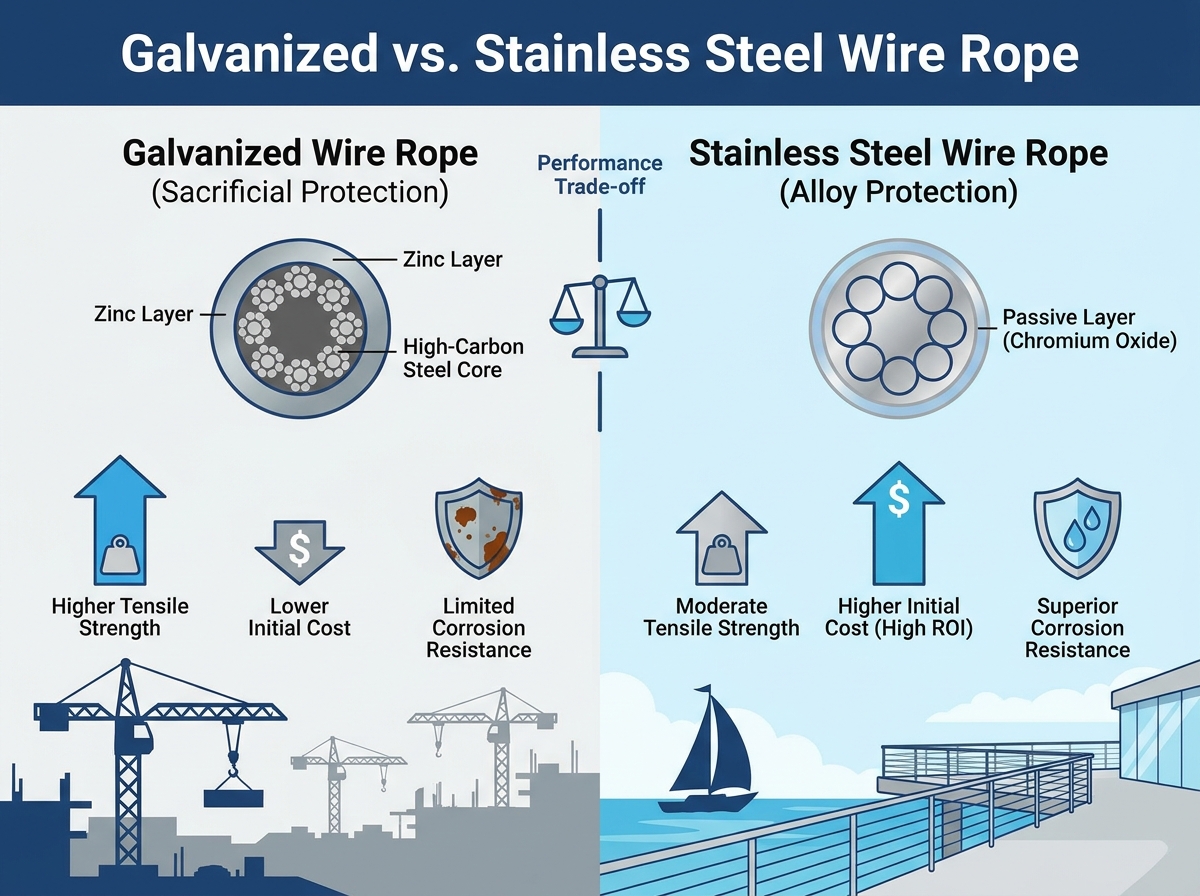
Manufacturers create this rope from high-carbon steel wire. They hot-dip or electroplate the raw strands. This process adds a protective outer layer of zinc. The zinc functions via sacrificial protection. It oxidizes first to protect the underlying steel core. This chemical sacrifice keeps the inner strands intact. It works exceptionally well in dry environments.
Limitation: The zinc layer is relatively soft. Physical abrasion easily compromises it. Severe chemical exposure strips the coating quickly. Once exposed, the core steel is highly vulnerable. It suffers from rapid oxidation and rust. We recommend regular inspection for coating damage. You must apply specialized lubricants. These lubricants help maintain the protective barrier.
Stainless Steel Wire Rope (Alloy Protection)
Manufacturers produce this using a specialized steel alloy. They mix iron, chromium, and sometimes nickel or molybdenum. Grade 316 includes molybdenum for extra resilience. This metal functions via a microscopic passive layer. The chromium oxide layer self-heals continuously. It requires ambient oxygen to maintain this barrier. The protection runs entirely through the metal strand.
Limitation: It has vulnerabilities in specific settings. It is susceptible to crevice corrosion. Tea staining occurs in oxygen-starved environments. High-chloride areas exacerbate this chemical issue. You must keep the surface clean. Allowing oxygen flow prevents localized pitting. Regular fresh-water washing stops salt accumulation.
Performance Evaluation: Strength, Lifespan, and Cost
Selecting the right material requires balancing three metrics. You must evaluate strength, longevity, and financial impact. Let us break down these specific performance categories. This evaluation prevents dangerous under-specification.
Tensile Strength and Work Load Limits (WLL)
Galvanized: High-carbon steel gives galvanized rope incredible strength. It generally possesses a 10% to 15% higher breaking strength. This compares to standard 300-series stainless of the same diameter. It is ideal for a heavy-duty lifting rope. Crane operators rely on this high yield point. It handles sudden dynamic loads safely. The rigid core resists crushing on winch drums.
Stainless: The addition of chromium creates a slightly softer alloy. This softer metal means a lower Work Load Limit (WLL). Engineers must often upsize the diameter. A thicker stainless cable matches the lifting capacity of a thinner galvanized equivalent. This size increase affects pulley and sheave compatibility. You must verify your hardware dimensions before upgrading.
Environmental Resilience and Lifespan
Galvanized: This material is excellent for general outdoor exposure. It handles construction sites and standard rigging perfectly. However, lifespan diminishes rapidly in salt-laden air. Acidic environments destroy the zinc coating. Continuous submersion causes premature failure. You must replace it frequently in coastal zones. Regular greasing extends its operational life significantly.
Stainless: This is the ultimate corrosion resistant wire rope. Grade 316 is imperative for continuous marine exposure. Food-grade applications require harsh chemical washdowns. Stainless handles these extremes effortlessly. It maintains structural integrity for decades in wet conditions. It resists degradation from UV exposure and industrial chemicals.
Cost vs. ROI
Galvanized: It features a low initial capital expenditure. It is highly cost-effective for many industrial applications. Operators treat the rope as a consumable item. They regularly replace it due to mechanical wear. They discard it before corrosion sets in. This makes it perfect for high-friction environments. The low replacement cost keeps maintenance budgets manageable.
Stainless: It carries a high initial price tag. It often costs twice or three times the price of galvanized alternatives. However, it yields a high return on investment. Permanent architectural installations benefit immensely. Marine rigging sees replacement labor far exceed material costs. Investing upfront saves massive future labor expenses. You avoid costly facility shutdowns for rope replacement.
Wire Rope Performance Comparison
| Performance Metric | Galvanized Steel | Stainless Steel (Grade 316) |
| Tensile Strength | Very High (High-carbon core) | Moderate (Softer alloy) |
| Corrosion Resistance | Moderate (Sacrificial zinc layer) | Excellent (Chromium oxide layer) |
| Initial Material Cost | Low | High (2x - 3x premium) |
| Magnetic Properties | Highly Magnetic | Non-magnetic / Weakly magnetic |
| Best Application | Heavy lifting, dry outdoor rigging | Marine, chemical, architectural |
Scenario-Based Decision Framework: When to Use Which
Field conditions dictate your material choice. We organized common applications into a clear decision framework. Follow these guidelines for optimal results. Using the correct material prevents catastrophic accidents.
- Heavy Lifting & Cranes: Select galvanized wire rope. Cranes require maximum tensile strength. They also receive regular maintenance lubrication. This combination makes galvanized the safest choice. It remains the most economical option for dynamic lifting. Tower cranes and mining hoists depend on it.
- Marine & Offshore Environments: Select stainless steel wire rope (specifically Type 316). As a dedicated marine wire rope, it withstands saltwater spray. It handles complete submersion without rapid degradation. Boat rigging depends entirely on this alloy. Offshore oil platforms use it for safety lifelines.
- Architectural Rigging & Fencing: Select stainless steel. Architects prefer it for aesthetic longevity. It provides clean, polished finishes. It resists environmental staining over decades. Public safety barriers rely on its consistent appearance. Balcony railings maintain their structural integrity and visual appeal.
- General Industrial & Agricultural: Select galvanized. It provides sufficient weather resistance. It handles standard outdoor tensioning well. You can use it for zip lines and structural bracing. It manages these tasks at a highly manageable cost. Farm enclosures and greenhouse supports utilize it extensively.
Hidden Implementation Risks: Galvanic Corrosion and Rigging Cable Hardware
Many engineers overlook the hardware connections. The rope is only one part of the system. Mixing metals creates severe structural hazards. You must evaluate the entire assembly.
The Mixed-Metal Trap
A common point of failure occurs during installation. Technicians pair a galvanized cable with incompatible fittings. They use stainless steel turnbuckles, thimbles, or clips. This mistake compromises the entire load-bearing system. The connection points become the weakest link. Visual inspections often miss this hidden danger until failure occurs.
Electrolytic Action
This pairing creates a dangerous chemical reaction. It requires an electrolyte like moisture or saltwater. The dissimilar metals trigger galvanic corrosion. This causes the zinc on the galvanized cable to corrode. It deteriorates at an incredibly accelerated rate. The core steel rusts and fails shortly after. The stainless steel hardware remains pristine while the cable snaps.
Best Practice
Always match your steel cable to your hardware. Use galvanized fittings on a galvanized rope. Use stainless hardware alongside a stainless rope. This uniform approach ensures structural integrity. It protects your rigging cable from invisible chemical decay. Train your installation crews to verify hardware compatibility. Never mix metals in damp or coastal environments.
Field Verification: How to Identify What You Have
Maintenance teams often encounter unmarked spools. They need quick ways to identify the metal. Use these three field verification methods. Accurate identification prevents dangerous misapplications.
- Visual Inspection: Galvanized rope typically has a duller finish. It presents a matte-gray appearance unless freshly electroplated. Conversely, stainless retains a brighter look. It has a more polished silver appearance. Dirt and grease can obscure these visual cues. Clean a small section before inspecting.
- Magnetic Testing: Most galvanized steel cable is highly magnetic. This happens due to the high-carbon core. Standard 304 and 316 stainless steel behaves differently. They are naturally non-magnetic. They become only weakly magnetic after heavy cold-working. A standard pocket magnet provides a quick field test.
- Wear Patterns: Observe the degradation over time. Look for white powdery residue on galvanized ropes. This powder is zinc oxide. Look for localized brown tea staining on stainless steel. You might also spot tiny pitting marks. These wear patterns confirm the underlying metallurgy.
Conclusion
The choice between these metals is not a universal debate. You are not simply picking a "better" option. You must engineer the solution for specific stress factors. Optimize for strength and cost using a galvanized option. Optimize for long-term survival in corrosive environments using stainless.
Here are your next steps:
- Evaluate your specific load requirements meticulously.
- Determine your environmental exposure class accurately.
- Consult a certified rigging specialist for complex lifts.
- Request a material sample.
- Test the sample against operational conditions before ordering bulk quantities.
FAQ
Q: Which is stronger: galvanized or stainless steel wire rope?
A: Galvanized wire rope is generally 10-15% stronger than standard stainless steel wire rope of the same diameter because it utilizes a high-carbon steel core. This makes it the preferred choice for heavy lifting applications where maximum tensile strength is required.
Q: How long does galvanized wire rope last outside?
A: Depending on the thickness of the zinc coating and environmental factors (humidity, pollution, salt), it can last anywhere from 5 to 20 years. Regular lubrication extends its lifespan significantly by protecting the zinc layer from premature oxidation.
Q: Can you use stainless steel hardware on galvanized wire rope?
A: It is highly discouraged. Mixing these metals in a damp environment causes galvanic corrosion, which rapidly strips the zinc coating off the galvanized cable, leading to premature rust and structural failure. Always match your hardware metal to your cable metal.
Q: Is stainless steel wire rope rust-proof?
A: No steel is entirely rust-proof. Stainless steel is highly corrosion-resistant, but inferior grades (like 304 in a marine environment) or lack of oxygen exposure can cause pitting and crevice corrosion over time. Grade 316 should be used for harsh environments.

 English
 العربية
 Français
 Русский
 Español
 Português
 Deutsch
 italiano
 日本語
 한국어
 Nederlands
 Tiếng Việt
 ไทย
 Polski
 Türkçe
 አማርኛ
 ພາສາລາວ
 ភាសាខ្មែរ
 Bahasa Melayu
 ဗမာစာ
 தமிழ்
 Filipino
 Bahasa Indonesia
 magyar
 Română
 Čeština
 Монгол
 қазақ
 Српски
 हिन्दी
 Slovenčina
 Slovenščina
 Norsk
 Svenska
 українська
 Ελληνικά
 Suomi
 Հայերեն
 עברית
 Dansk
 اردو


