Specifying the wrong industrial wire rope compromises site safety and accelerates equipment downtime. B2B buyers and engineers often face a tough choice between two dominant classifications in the market. You must understand how these ropes behave under load before finalizing a purchase.
While the 6x19 and 6x37 classes look virtually identical and often boast identical breaking strengths, their operational behavior differs significantly. Selecting the wrong profile can lead to catastrophic failure, severe drum crushing, or rapid bending fatigue. Engineers cannot simply swap them without consequence.
This guide deconstructs the mechanical trade-offs between 6x19 and 6x37 classes. We will explore how abrasion resistance and flexibility dictate your selection process. You will learn how to align your specific lifting or rigging requirements with the correct rope class.
Key Takeaways
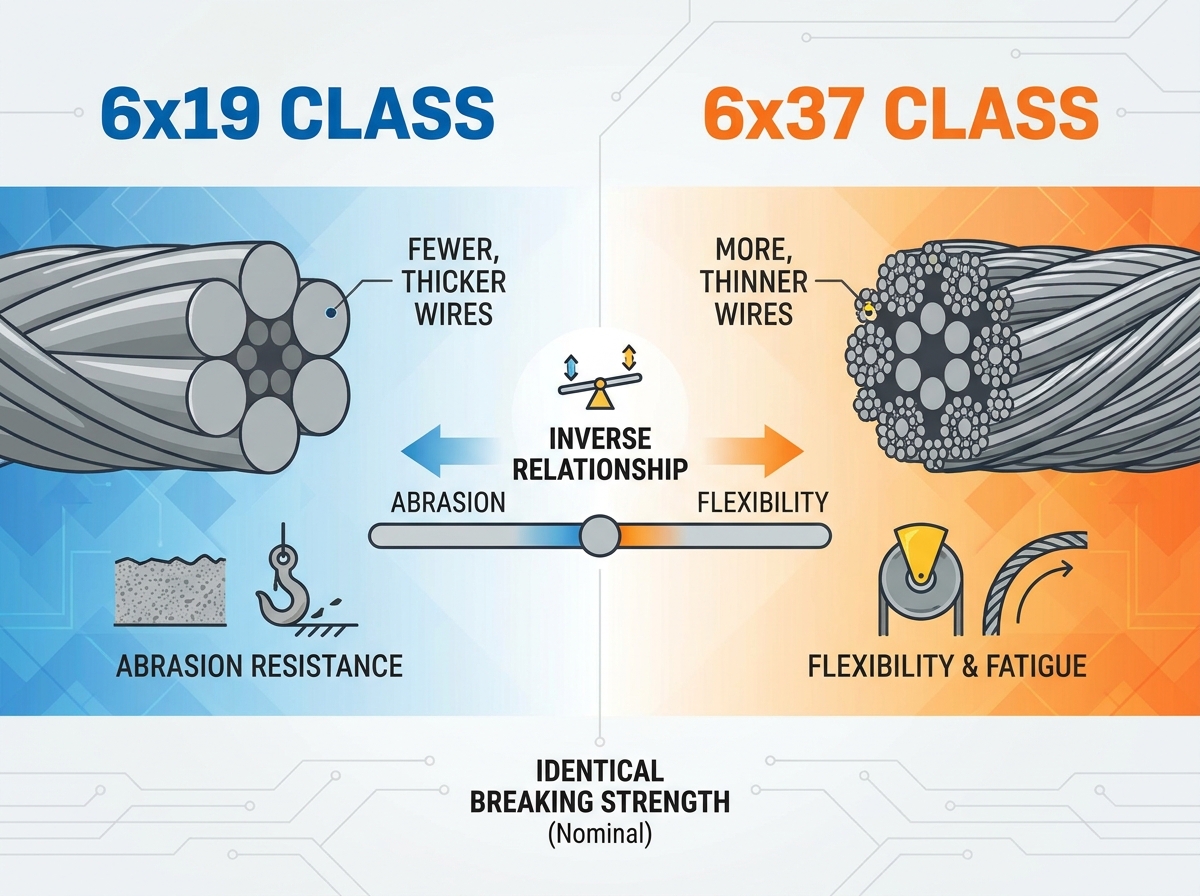
- The Golden Rule of Wire Rope: There is a direct, inverse relationship between abrasion resistance and flexibility.
- 6x19 Wire Rope: Features fewer, thicker outer wires. Excels in environments with high friction and abrasive wear, but suffers under tight bending radii.
- 6x37 Wire Rope: Features more, thinner outer wires. Excels in bending fatigue and flexibility (making it an ideal crane rope), but is highly susceptible to external abrasion.
- Strength Parity: Nominal breaking strengths for both classes are generally identical for a given diameter and steel grade; the decision hinges on application physics, not load capacity.
Understanding Wire Rope Construction: The 6x19 and 6x37 Classes
Many procurement professionals mistakenly believe the numbers in a rope designation represent an exact wire count. In reality, "6x19" and "6x37" designate broad classes rather than precise manufacturing blueprints. Understanding this distinction helps you evaluate wire rope construction accurately.
The first number always indicates the number of strands wrapped around the core. Both classes feature six outer strands. The second number represents the nominal range of wires contained within each of those six strands. Manufacturers arrange these wires in specific geometric patterns to achieve desired performance characteristics.
The 6x19 Class Breakdown
The 6x19 class includes ropes containing 6 strands, typically holding 15 to 26 wires per strand. Because the strand diameter remains constant for a given rope size, fitting fewer wires into the same space requires using thicker individual wires. Common configurations in this class include the 6x25 filler wire and the 6x19 Seale pattern. The Seale construction places larger wires on the outside layer of the strand, creating a robust shield against external damage.
The 6x37 Class Breakdown
The 6x37 class includes ropes containing 6 strands, typically holding 27 to 49 wires per strand. To fit this higher volume of wires into the same strand diameter, manufacturers must draw the steel into much thinner filaments. A popular configuration here is the 6x36 Warrington Seale. This complex pattern mixes different wire diameters within the strand to maximize metallic area while maintaining extreme pliability.
Core Types and Crush Resistance
Beyond the outer strands, you must also specify the core material. Both classes can be supplied with an Independent Wire Rope Core (IWRC) or a Fiber Core (FC). The core acts as the foundation, supporting the outer strands under heavy loads.
- Independent Wire Rope Core (IWRC): This core is essentially a smaller steel rope running down the center. It increases overall breaking strength and provides excellent resistance to drum crushing.
- Fiber Core (FC): Made from synthetic materials or natural sisal, this core increases flexibility and holds internal lubricants well. However, it offers poor crush resistance on multi-layer winch drums.
The Core Evaluation: Abrasion Resistance vs. Bending Fatigue
The fundamental engineering trade-off in rigging involves balancing wear resistance against flexibility. You cannot maximize both simultaneously. When you increase one attribute, you inherently decrease the other. This inverse relationship dictates whether you should select a 6x19 or 6x37 profile.
Abrasion Resistance (The 6x19 Advantage)
Abrasion occurs when the rope rubs against sheaves, winch drums, the ground, or the load itself. The 6x19 class dominates in abrasive environments. Because it utilizes fewer, thicker outer wires, it provides a highly robust wear surface.
Think of these thick outer wires as heavy armor plating. When dragged across concrete or spooled onto a rough, grooved drum, the thick steel takes much longer to wear down. Abrasive grit, sand, and dirt have a harder time penetrating the strand valleys. If your operation involves dragging loads, scraping surfaces, or working in gritty environments, the 6x19 class offers superior longevity. The thick wires simply sacrifice their outer layers slowly over time, keeping the inner wires protected.
Flexibility and Fatigue (The 6x37 Advantage)
Bending fatigue occurs when a rope repeatedly flexes around a sheave or drum. Every time the steel bends, the outer wires stretch while the inner wires compress. Over thousands of cycles, this stress causes the steel to harden, become brittle, and eventually snap.
The 6x37 class excels at combating bending fatigue. A higher number of individual, thinner wires allows the steel wire rope to bend much more easily without permanent deformation. Thinner wires act like the pages of a paperback book—they slide past one another smoothly when bent. This construction distributes bending stress across a larger number of wires, drastically extending fatigue life in repetitive lifting cycles. If your equipment requires the rope to navigate complex pulley systems continuously, the 6x37 class prevents premature wire snapping.
Performance Comparison Summary
The table below highlights the primary operational differences between the two classes.
| Performance Metric | 6x19 Class | 6x37 Class |
| Abrasion Resistance | Excellent (Thick outer wires) | Poor (Thin outer wires wear quickly) |
| Bending Flexibility | Moderate to Low | Excellent (Highly pliable) |
| Fatigue Life (Repetitive Bending) | Shorter on small sheaves | Significantly longer |
| Resistance to Drum Crushing | High (Maintains shape well) | Lower (Prone to flattening) |
Technical Evaluation Criteria: D/d Ratios and Equipment Compatibility
You cannot select a rope based solely on environmental conditions. The physical dimensions of your lifting equipment dictate strict boundaries for rope selection. The most critical metric engineers use to match a rope to a machine is the D/d ratio.
D/d Ratio Requirements (Sheave-to-Rope Diameter)
The D/d ratio expresses the relationship between the diameter of the sheave (D) and the diameter of the rope (d). A larger ratio means the rope bends around a gentler curve. A smaller ratio forces the rope into a tight, stressful bend.
Equipment manufacturers design sheaves and drums around specific rope classes. You must respect these engineering limits to ensure safe operation.
- 6x19 Ratio Requirements: A 6x19 wire rope generally requires a larger minimum D/d ratio, typically around 34:1. Because the wires are thick and stiff, forcing them around a small sheave generates immense bending stress. If you run a 6x19 rope on undersized sheaves, you will experience premature fatigue breaks. The outer wires will snap long before they wear down from abrasion.
- 6x37 Ratio Requirements: The 6x37 class can safely operate on much smaller sheaves, typically requiring a D/d ratio of around 23:1. The thinner wires easily navigate tight curves. This flexibility allows equipment designers to build more compact cranes and hoists, accommodating tighter equipment footprints without sacrificing lifting capacity.
Crush Resistance on Winch Drums
When spooling multiple layers of rope onto a winch drum, the bottom layers endure massive crushing forces from the layers wrapped above them. The rope must resist flattening to maintain its structural integrity.
The 6x19 class performs slightly better against drum crushing. Its larger outer wires provide a rigid, stable structure that resists deformation under heavy radial pressure. Conversely, the 6x37 class is more prone to flattening if spooled poorly under heavy load. The multitude of thin wires can shift and compress, causing the rope to lose its round profile. Once a rope flattens, it will not spool evenly, leading to severe mechanical damage during subsequent lifts.
Application Match: Categorizing Lifting Wire Rope Needs
Matching the rope class to the specific application prevents catastrophic failures and extends operational lifespans. You must analyze the primary tasks your equipment performs daily. We can categorize lifting wire rope needs based on the severity of the operating environment.
When to Specify 6x19 Wire Rope
You should specify the 6x19 class when the environment is harsh, abrasive, and unforgiving. It thrives in heavy industrial settings where handling abuse is high and bending radii are large.
- Earthmoving Equipment: Draglines, scrapers, and excavators constantly drag ropes through dirt, gravel, and rock. The thick outer wires of the 6x19 class withstand this relentless grinding action.
- Heavy-Duty Winching: Logging operations, marine towing, and off-road recovery winches subject ropes to severe abrasion and poor spooling conditions. The 6x19 class resists crushing and scraping better than any flexible alternative.
- General Purpose Rigging: For standard lifting slings used in construction yards, the 6x19 class offers excellent durability against sharp load edges and rough handling by ground crews.
When to Specify 6x37 Wire Rope
You should specify the 6x37 class when the application demands continuous, rapid bending over sheaves. It thrives in controlled environments where precision lifting takes precedence over brute-force dragging.
- Overhead Traveling Cranes: Factory and warehouse cranes perform hundreds of repetitive lifts daily. The 6x37 class serves as the ideal crane rope because it absorbs continuous bending fatigue without snapping.
- Complex Reeving Systems: Mobile cranes and hoists utilizing multiple sheave blocks force the rope to bend back and forth rapidly. The 6x37 class navigates these tight pulley systems smoothly.
- High-Speed Hoisting: Situations where the rope must bend rapidly and continuously under load require maximum flexibility to prevent heat buildup and internal wire fatigue.
Implementation and Inspection Realities
Even the most perfectly specified rope will eventually degrade. Understanding how these two classes fail allows your maintenance teams to implement effective inspection and lubrication protocols. You must train your inspectors to look for different warning signs depending on the rope class installed.
Differing Failure Modes
Because their constructions differ, 6x19 and 6x37 ropes exhibit distinct failure modes at the end of their service lives.
The 6x19 class generally fails via visible crown wear. As the rope rubs against sheaves and drums, the thick outer wires slowly grind down. You will notice a distinct flattening of the outer wires. This wear is highly visible and predictable, giving inspectors ample warning before the rope loses critical strength.
Conversely, a 6x37 wire rope often exhibits sudden crown wire breaks from abrasion. Because the outer wires are so thin, abrasive wear grinds through them very quickly. An inspector might find numerous snapped outer wires even though the core integrity remains intact. The failure mode looks jagged and sudden compared to the smooth wear of a 6x19 rope.
Inspection Protocols (ASME B30.30 / ISO 4309)
Industry standards strictly govern rope retirement criteria. Organizations like ASME (American Society of Mechanical Engineers) and ISO (International Organization for Standardization) mandate specific inspection protocols based on rope construction.
Retirement criteria for broken wires differ based on the rope class. Because the 6x37 class contains significantly more wires in total, it is allowed slightly more broken wires per lay length than a 6x19 rope before mandatory retirement. A lay length represents the distance it takes for one strand to make a complete spiral around the core. Inspectors must know exactly which class they are evaluating; applying 6x19 retirement criteria to a 6x37 rope will result in premature and unnecessary replacement.
Lubrication and Maintenance
All running ropes require regular lubrication to function safely. However, the 6x37 class requires exceptionally diligent internal lubrication. The higher number of internal moving wires generates significantly more internal friction during bending. If a 6x37 rope runs dry, the internal wires will grind against each other, causing the rope to destroy itself from the inside out.
Maintenance teams should use pressurized lubricators for 6x37 ropes to force grease deep into the core. For 6x19 ropes used in dirty environments, lighter, penetrating oils are often preferred so abrasive dirt does not stick to heavy grease on the outer wires.
Conclusion
Selecting between 6x19 and 6x37 wire ropes ultimately comes down to understanding the physical demands of your specific machinery. By recognizing the trade-offs between abrasion resistance and flexibility, you can dramatically improve safety and equipment uptime.
- Shortlisting Logic: Base your final decision on the primary mechanism of expected failure. If previous ropes failed due to wear and flattening on the outer strands, lean toward the 6x19 class. If they failed due to snapping and broken wires in the flex zones around sheaves, pivot to the 6x37 class.
- Verify Dimensions: Never swap classes without checking your equipment limits. Ensure your sheave diameters meet the minimum D/d ratio requirements for the new rope class.
- Next Steps: Recommend consulting with a rigging specialist to evaluate existing crane sheave dimensions and verifying the required Working Load Limit (WLL) before finalizing procurement. They can help you confirm core types and steel grades to match your operational environment perfectly.
FAQ
Q: Does 6x37 wire rope have a higher Working Load Limit (WLL) than 6x19?
A: No. Assuming the same diameter, core type, and steel grade, their breaking strength and WLL are practically identical. The difference lies strictly in flexibility and wear characteristics. The increased number of wires in the 6x37 class improves bending fatigue life, not load-bearing capacity.
Q: Can I substitute a 6x19 wire rope for a 6x37 crane rope?
A: Usually no. Substituting 6x19 on a crane designed for 6x37 will likely violate minimum D/d ratio requirements. The stiffer 6x19 rope will struggle to navigate the smaller sheaves, causing it to suffer rapid bending fatigue and fail prematurely. Always consult the crane manufacturer's specifications.
Q: What does IWRC mean when attached to these classifications?
A: IWRC stands for Independent Wire Rope Core. It indicates the center of the rope is made of steel rather than fiber. An IWRC increases overall strength by about 7.5% and significantly improves resistance to drum crushing for both 6x19 and 6x37 ropes, making it standard for heavy lifting.

 English
 العربية
 Français
 Русский
 Español
 Português
 Deutsch
 italiano
 日本語
 한국어
 Nederlands
 Tiếng Việt
 ไทย
 Polski
 Türkçe
 አማርኛ
 ພາສາລາວ
 ភាសាខ្មែរ
 Bahasa Melayu
 ဗမာစာ
 தமிழ்
 Filipino
 Bahasa Indonesia
 magyar
 Română
 Čeština
 Монгол
 қазақ
 Српски
 हिन्दी
 Slovenčina
 Slovenščina
 Norsk
 Svenska
 українська
 Ελληνικά
 Suomi
 Հայերեն
 עברית
 Dansk
 اردو


