When people ask “How long is a shackle?”, they usually mean one of two very different things:
The length of a shackle of anchor chain (a traditional nautical unit).
The physical size of the metal shackle used in lifting, rigging, or anchoring.
Confusing these two can lead to costly mistakes, unsafe anchors, or mismatched rigging gear. This guide explains both meanings in plain language, shows how a bow shackle differs from other types, and gives practical tips on measurement, selection, and safety.
What Is a Shackle?
A shackle is a U‑shaped metal connector closed by a pin or bolt. It is one of the most common pieces of hardware in lifting, rigging, and anchoring systems. You will see shackles:
Connecting anchor chain to an anchor.
Joining wire ropes, chains, and slings.
Securing loads on deck, on construction sites, or in industrial plants.
Typical materials include:
Two of the most important forms are the shackle as a metal fitting and the “shackle” as a chain‑length unit, plus a key related term: bow shackle. Understanding the differences is crucial for safe use and correct ordering.
The Nautical Meaning: How Long Is a Shackle of Chain?
Standard Nautical Shackle Length
In marine practice, a shackle of chain is a standard length of anchor chain, not a piece of hardware.
This unit is used worldwide on commercial ships, offshore vessels, and large yachts to describe how much anchor chain has been deployed.
Why This 90‑Foot Length Matters
Knowing that one shackle equals 90 feet helps you:
Estimate how much chain is overboard.
Calculate scope (ratio of chain length to water depth).
Plan total chain length per anchor when specifying equipment.
For example, if a vessel has 12 shackles per anchor, that is:
When the bridge orders “let go three shackles”, the deck crew knows they are putting approximately 270 ft (82 m) of chain in the water.
The Hardware Meaning: How Long Is a Shackle Fitting?
When riggers and engineers talk about a shackle as a piece of hardware, they are referring to the U‑shaped connector itself. This does not have a universal length.
The physical length of a shackle depends on:
Work Load Limit (WLL) or Safe Working Load.
Material and grade (carbon steel, alloy steel, stainless steel, etc.).
Shackle type (bow shackle vs D/chain shackle vs specialty shapes).
Manufacturer’s design and applicable standards.
Common sizes range from:
Small shackles just a few inches long, used on small boats or light gear.
Medium to large shackles over 12 inches long, used on ships, cranes, and heavy lifting operations.
Whenever you need the exact length, you must check the dimension table from the manufacturer or measure it accurately yourself.
Types of Shackles: Focus on the Bow Shackle
Bow Shackle (Anchor or Bow Shackle)
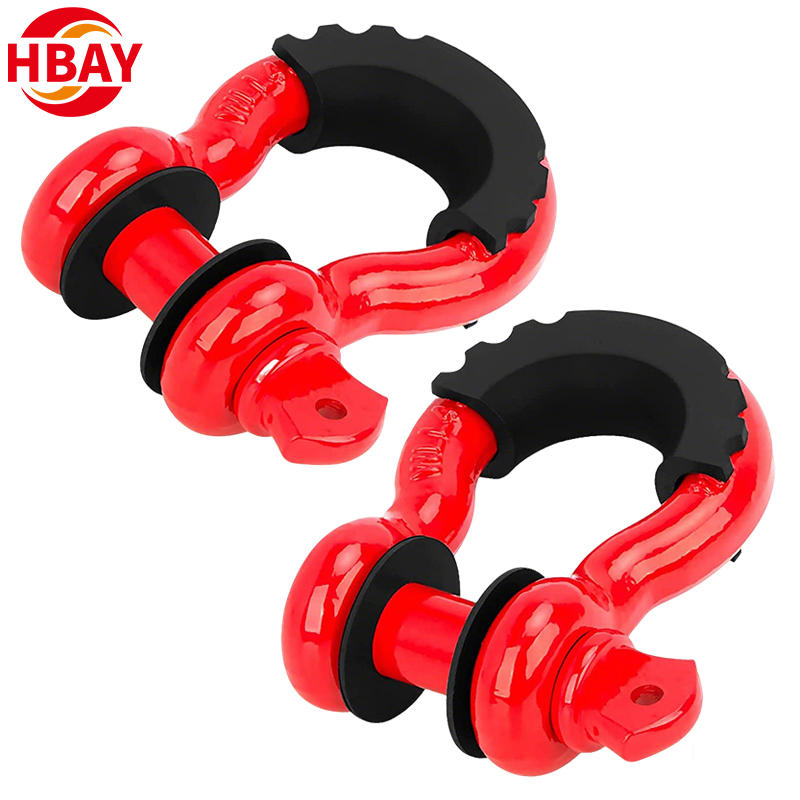
A bow shackle has a wide, rounded “O”‑shaped body. Key features:
A broad bow that allows multiple connections (for example, several sling legs into one shackle).
Better tolerance for multi‑directional loading and moderate side‑loads than a narrow D shackle.
Often used in lifting as an “anchor shackle”, especially when connecting multi‑leg slings to a single lifting point.
Typical uses of a bow shackle:
Connecting two or more slings to a crane hook.
Situations where load direction can change during operation.
Applications where extra internal space is required.
D Shackle (Dee / Chain Shackle)
A D shackle (also called a dee shackle or chain shackle) is narrower and shaped like a “D”.
Characteristics:
Optimized for straight‑line (in‑line) pulls.
Less tolerant of side‑loading compared with a bow shackle.
More compact, making it ideal where space is limited.
Typical uses of a D shackle:
Connecting chain to chain, or chain to a fixed pad eye.
Straight towing or pulling where the line of force is consistent.
Rigging setups where the load remains in a single direction.
Other Common Shackle Types
In addition to bow shackles and D shackles, you may encounter:
Wide‑body shackles – enlarged bow for improved sling angle performance.
Synthetic sling shackles – shaped and finished to protect webbing or synthetic rope.
Long‑reach or special‑purpose shackles – for unique offshore or structural applications.
Choosing the correct shackle style is as important as choosing the correct shackle length and WLL.
How to Measure a Shackle Correctly
Accurate measurement of a shackle ensures that it matches your chain, rope, or pad eye, and that it meets design and safety requirements.
Tools and Setup
You will need:
A caliper (digital or vernier) or a precise steel ruler.
A flat, level surface for consistency.
A clean shackle, free of heavy rust, dirt, or paint buildup.
Key Shackle Dimensions
When measuring a shackle (bow shackle or D shackle), focus on these dimensions:
Pin diameter – thickness of the pin; must match the chain or eye it passes through.
Body (bow) diameter – thickness of the shackle body.
Inside width – distance between the inner legs; controls what can fit inside.
Inside length – distance from inside of crown to inside bearing surface at the pin.
Outside width and overall length – needed for clearance and layout checks.
Step‑by‑Step Measurement Process
Identify the shackle type
Decide whether you are measuring a bow shackle or a D shackle. This affects how you interpret the inside dimensions.
Measure the pin diameter
Remove the pin where possible. Use a caliper at the widest point of the shank. Record in millimeters or inches.
Measure the inside width
Measure between the inner faces of the legs, at the narrowest point.
Measure the inside length
Measure from the inside of the crown (top) to the inside bearing surface where the pin seats.
Measure outside dimensions if needed
Measure overall length and width for clearance inside fairleads, pad eyes, or chain pockets.
Inspect while measuring
Check for deformation, cracks, heavy corrosion, excessive wear at the crown or pin holes, and thread damage.
Record and compare
Log the measurements and compare them with the manufacturer’s sizing chart or relevant standards (e.g., ASME or EN shackles).
Common Measurement Mistakes to Avoid
Using a flexible tape measure on round metal surfaces.
Measuring at an angle instead of perpendicular, causing false readings.
Ignoring wear that has reduced pin or body diameter.
Failing to document sizes, leading to mismatches when ordering replacements.
Shackle Length and Anchor Chain: Scope and Calculations
Converting Between Shackles, Fathoms, Feet, and Meters
To work confidently with anchor chain, remember:
If you know the total chain length and want to convert to shackles:
Determining How Many Shackles to Use (Scope)
Scope is the ratio between:
Typical recommendations:
5:1 to 7:1 scope for normal overnight anchoring in moderate conditions.
Larger scope in strong wind, swell, or poor holding ground.
Example (imperial):
Water depth at high tide: 30 ft
Bow roller above waterline: 5 ft
Effective depth: 35 ft
Desired scope: 6:1
Required rode: 35 × 6 = 210 ft ≈ 2.33 shackles of chain
In practice, you’d likely round up and deploy 2½ to 3 shackles.
Counting Shackles on Deck and in the Water
On larger vessels:
Each shackle of chain is joined by a special joining link or Kenter shackle, often color‑coded and marked.
Officers talk about “X shackles in the water” (the joining piece is below the surface) or “X shackles on deck” (the joining piece is between the windlass gypsy and the hawse pipe).
This terminology allows the bridge and foredeck teams to coordinate anchoring operations precisely without guessing distances.
How Different Sources Answer “How Long Is a Shackle?”
Below Deck / Yachting Media Perspective
Marine and yachting media often show captains on superyachts talking in terms of “shots” or “shackles” of chain when anchoring. In this context:
UU Lifting Perspective
A rigging and lifting supplier makes a clear distinction between:
A “shackle of chain” – a fixed unit of 90 ft / 27.43 m used in the maritime world for anchor chain.
A shackle fitting – the U‑shaped metal connector whose physical length varies with WLL, material, and type (bow shackle vs D shackle).
They emphasize choosing shackles via:
Correct Work Load Limit.
Suitable material for the environment.
Proper dimensions to match chains, hooks, and slings.
Yachting Forum Community Perspective
Experienced seafarers and yacht owners highlight that:
Modern merchant and yachting practice uses 15 fathoms / 90 ft as the standard shackle length of anchor chain.
Older naval references sometimes noted different lengths in specific periods, but for today’s practical purposes, 90 ft is treated as standard.
Crews commonly speak of “six shackles in the water” or similar when describing the deployed length.
JN Anchor Chain Manufacturer Perspective
An anchor chain manufacturer defines shackle length in anchoring as:
They connect this to:
Rules of thumb like 5–7 times water depth for calculating required chain length.
The effect of chain length on holding power, safety, and ease of handling.
QD Powerful Machinery Perspective
A rigging and lifting company explains:
A nautical shackle is 90 ft / 27.43 m, equivalent to 15 fathoms.
This standard is widely adopted in modern marine practice.
They also go into detail on shackle dimensions and proper measurement for compatibility with anchor chains and marine gear.
Answers Knowledge Platform Perspective
A Q&A platform summarizes:
It also covers related concepts such as:
Toolsli Measurement Guide Perspective
A tools‑focused guide concentrates on:
How to measure a shackle step‑by‑step.
Identifying the shackle type, measuring width, height, pin diameter, and overall length.
Inspecting for damage and comparing results with industry standards for safe use.
How to Choose the Right Shackle (Including Bow Shackles)
Choosing the right shackle is not just about “how long is a shackle?” but whether it is strong enough, appropriate for the load direction, and compatible with your equipment.
Start with Work Load Limit (WLL)
The WLL must be equal to or greater than the maximum load you expect, including dynamic effects.
Never use a shackle above its rated WLL.
Quality shackles usually have a safety factor of 4:1 to 6:1, meaning they are designed to withstand several times the WLL under test conditions.
Match Shackle Type to Load Direction
Consider Material and Environment
Carbon or high‑strength steel for general industrial use, protected with paint or galvanization.
Galvanized steel for regular marine environments.
Stainless steel (often grade 316) for high corrosion resistance in saltwater or chemicals, accepting a higher cost.
Verify Dimensions and Fit
Check that the pin diameter matches the chain link, pad eye, or fitting hole.
Ensure the inside width and length of the bow shackle or D shackle can accommodate slings and connectors without crowding or bending.
Confirm clearances where the shackle will sit, for example in an anchor roller or fairlead.
Minimize Side‑Loading and Misuse
Shackles are strongest in straight tension.
Side‑loading at 45° can reduce effective WLL by roughly 25–30%.
Side‑loading at 90° can reduce effective WLL to around 50% or less.
Never modify shackles by welding, grinding, or drilling; remove any shackle that has been altered.
Shackle Inspection, Maintenance, and Replacement
Proper care extends the life of your shackles and keeps lifting and anchoring operations safe.
Inspection Intervals
Before each significant use: quick visual check.
Monthly or more often in harsh or offshore conditions.
Immediately after any suspected overload, shock load, or incident.
What to Look For
Remove a shackle from service if you find:
Illegible or missing markings (size, grade, WLL).
Bent, twisted, or stretched body or pin.
Cracks, deep nicks, or gouges.
More than about 10% loss of original diameter due to wear or corrosion.
Heavy rust or pitting, especially around the pin holes and crown.
Damaged threads or pins that no longer seat properly.
Evidence of heat damage or unauthorized welding.
Storage and Corrosion Prevention
Rinse shackles used in saltwater with freshwater and let them dry.
Store in a dry, ventilated place, away from aggressive chemicals.
Consider light lubrication of pins and threads for carbon or alloy steel shackles.
For long‑term marine use, galvanized or stainless steel shackles often pay off in reduced maintenance.
FAQs About Shackle Length and Bow Shackles
How long is a shackle of anchor chain?
A shackle of anchor chain is traditionally 15 fathoms, which equals 90 feet or about 27.43 meters.
How long is a shackle as a piece of hardware?
There is no single standard length. A shackle fitting can range from a few inches to over a foot in overall length, depending on its WLL, material, and type (bow shackle, D shackle, etc.).
Is a bow shackle the same as an anchor shackle?
Many people use the terms interchangeably. Technically, a bow shackle has a wide, rounded bow designed for multi‑directional loads and multiple connections. In many catalogs and on boats, this is also described as an anchor shackle.
How do I know how many shackles of chain are in the water?
Divide the length of chain deployed by 90 feet (or 27.43 m). On larger vessels, crew members also count shackles as they see each marked joining link pass the windlass.
Can I use any shackle with my anchor chain?
No. You must:
Match the pin diameter to the chain link size.
Ensure the WLL of the shackle equals or exceeds the chain’s working strength.
Use a reputable, certified shackle suitable for marine use.
Understanding both meanings of “how long is a shackle” – the 90‑foot nautical unit and the variable length of the shackle fitting itself – is essential for safe anchoring, reliable lifting, and correct equipment selection. Whether you are choosing a bow shackle for a multi‑leg lift or calculating how many shackles of chain to pay out at anchor, precise knowledge leads to safer, more efficient operations.

 English
 العربية
 Français
 Русский
 Español
 Português
 Deutsch
 italiano
 日本語
日本語 한국어
한국어 Nederlands
 Tiếng Việt
 ไทย
ไทย Polski
 Türkçe
 አማርኛ
አማርኛ ພາສາລາວ
 ភាសាខ្មែរ
 Bahasa Melayu
 ဗမာစာ
ဗမာစာ தமிழ்
தமிழ் Filipino
 Bahasa Indonesia
 magyar
 Română
 Čeština
 Монгол
 қазақ
қазақ Српски
 हिन्दी
 فارسی
فارسی Kiswahili
 Slovenčina
 Slovenščina
 Norsk
Norsk Svenska
 українська
 Ελληνικά
 Suomi
Suomi Հայերեն
 עברית
עברית Latine
 Dansk
Dansk اردو
اردو Shqip
Shqip বাংলা
বাংলা Hrvatski
 Afrikaans
 Gaeilge
 नेपाली
 Oluganda


