
Hebei Anyue Metal Manufacturing Co., Ltd.
Professional hardware rigging manufacturing enterprise
- All
- Product Name
- Product Keyword
- Product Model
- Product Summary
- Product Description
- Multi Field Search
English
Views: 0 Author: Site Editor Publish Time: 2026-10-24 Origin: Site


The integrity of an overhead lift depends entirely on the weakest point in your load path. Even a tiny mismatch in your rigging hardware can cause catastrophic failure. Every day, procurement teams and safety managers debate between two primary attachment methods for their lifting operations. Choosing incorrectly does not just compromise operational efficiency on the job site. It introduces severe risks regarding load mismatches, accelerates equipment wear, and invites disastrous compliance failures. We need absolute certainty when specifying these critical components to ensure maximum safety. This article provides a technical, objective comparison between the two primary load-bearing designs. You will learn how to differentiate their structural mechanisms and operational benefits. Ultimately, we aim to help rigging professionals make compliance-aware, application-specific procurement decisions. Let us examine the mechanics, media compatibility, and inspection realities of these essential lifting tools.
Rigging professionals instantly recognize the unique U-shaped saddle at the top of a clevis hook. Engineers design this saddle, often called the clevis, to cradle a very specific size of chain link. The geometry must perfectly match the chain profile. This prevents unwanted lateral movement during a heavy lift.
The fastening mechanism relies on two crucial components. First, a heavy-duty load-bearing clevis pin slides horizontally through the saddle and the chain link. Second, a smaller cotter pin secures the load pin in place. This prevents the primary pin from backing out under severe vibration. The most significant structural advantage is the complete absence of intermediate hardware. You do not need an extra shackle. The chain connects directly into the hook base, keeping the load path short and efficient.
In contrast, an eye hook features a completely solid, enclosed top. Manufacturers forge or weld this top section into a circular or oval ring. We refer to this continuous metal ring simply as the eye. The solid construction distributes stress evenly across the entire top of the fixture.
Because the loop remains permanently closed, it introduces a necessary mechanical constraint. You cannot attach an eye design directly to a continuous length of welded chain. It physically cannot slide over a closed chain link. Therefore, riggers must introduce a connector. You always need a mechanical coupling link, a heavy-duty shackle, or a master link to join this hardware to your primary lifting media.
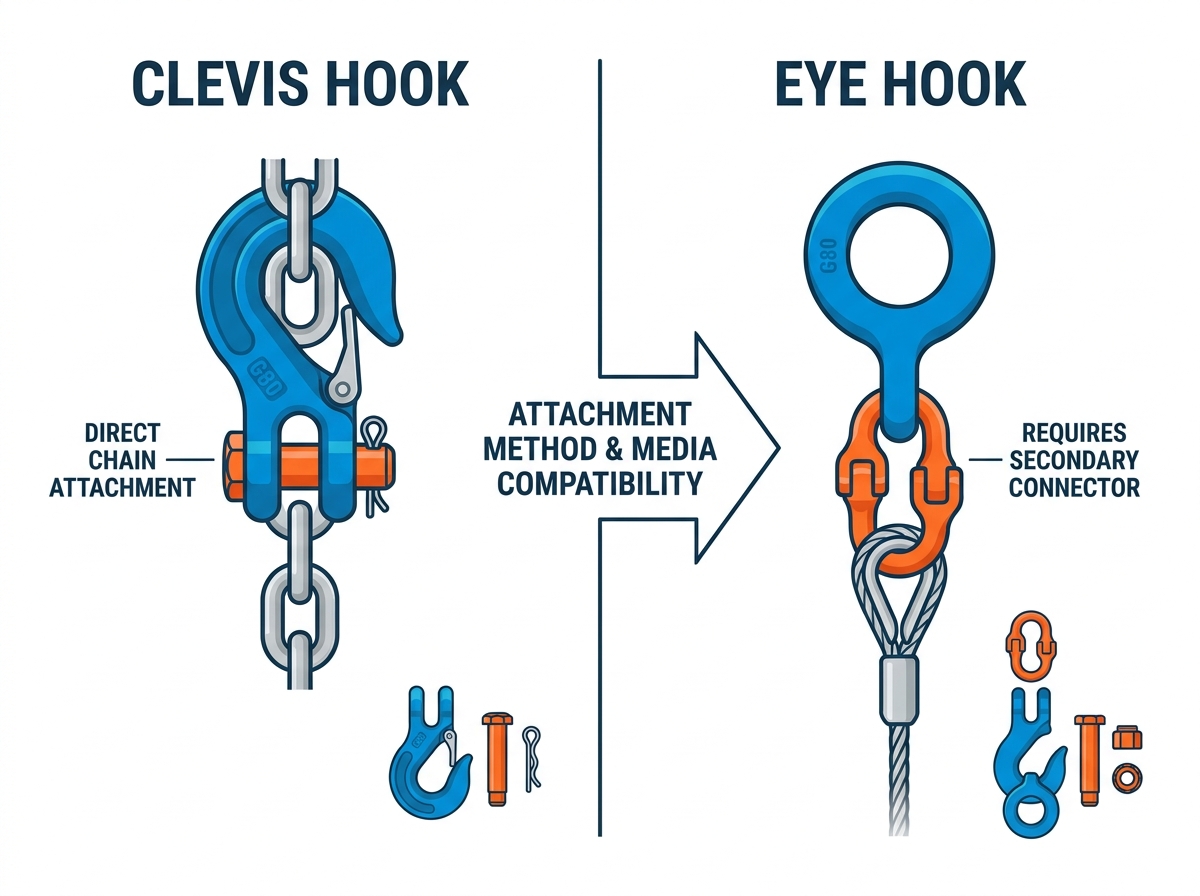
Because of its integrated saddle, the clevis design serves as the undisputed standard chain hook in the rigging industry. The internal geometry of the U-shape keeps the chain link perfectly aligned. It prevents the chain from twisting or binding under immense load tension. Preserving this structural integrity extends the lifespan of your alloy chains.
However, you must observe a strict implementation limitation. Clevis hardware remains entirely dimension-dependent. You cannot mix and match sizes. A 3/8-inch clevis saddle cannot safely accommodate a 1/2-inch chain. Forcing a larger link into a smaller saddle causes micro-fractures. Conversely, putting a small chain into a large saddle allows dangerous shifting during the lift.
The closed-loop design acts as the preferred sling hook across a much wider variety of lifting media. If you are not lifting exclusively with alloy chains, you almost certainly need an eye connection. It accommodates various materials seamlessly.
The smooth, rounded interior of the forged eye provides a critical safety factor for non-metal slings. It prevents chafing and cutting. A clevis pin would easily snag or crush soft materials under tension. The closed eye provides a wide, smooth bearing surface. This surface is highly compatible with the following common rigging media:
Table 1: Operational Differences Between Hardware Designs
| Operational Factor | Clevis Mechanism | Eye Mechanism |
|---|---|---|
| Field Maintenance | Extremely fast. Requires only basic hand tools to swap. | Slower. Often requires a hammer and punch for coupling links. |
| Tamper Resistance | Low. Cotter pins can be pulled easily by any worker. | High. Permanent integration deters unauthorized swaps. |
| Component Count | Low. Connects directly to the chain line. | Higher. Requires secondary mechanical couplings. |
| Vibration Vulnerability | Moderate. Cotter pins may loosen in high-vibration tasks. | Low. Solid forged loops have no loose fastening parts. |
Job sites demand operational efficiency. Equipment breaks. Cranes bump loads into steel beams. Latches crush. When hardware deforms, rigging crews must respond immediately. Here, we evaluate the distinct clevis advantage. If a spring latch breaks, riggers can swap the hardware on-site in mere minutes. They simply remove the cotter pin, slide out the load pin, and drop a new unit onto the chain. They only need standard pliers.
However, this speed introduces a specific risk factor. The removable pin setup creates localized wear points. Furthermore, high-vibration environments can compromise the cotter pin over time. If crews fail to inspect these pins regularly, the primary load pin could theoretically back out during a complex maneuver.
Many safety managers prioritize setup security over maintenance speed. We must evaluate the eye design advantage in these scenarios. When you assemble a closed-loop unit using mechanical coupling links, the resulting tool becomes virtually permanent. Driving the load pin into a coupling link typically requires a sturdy punch and a heavy hammer to seat it correctly.
This permanence provides an immense safety benefit. It prevents unauthorized field modifications. Untrained personnel cannot easily swap hardware or alter the sling legs on a whim. The engineered sling assembly remains entirely intact as originally certified by the manufacturer. Security often outweighs convenience in heavily regulated overhead lifts.
Selecting the right attachment style means nothing if you ignore the Working Load Limit. Every component in your load path must meet or exceed the heaviest intended lift. You must understand the critical requirement of grade matching. You can never mix low-grade steel with high-grade alloy components.
For example, installing a standard carbon steel fixture on a premium alloy chain degrades the entire system instantly. The system WLL drops to match the weakest component. To maintain compliance in overhead lifting, regulations demand high-strength materials. The industry relies heavily on the G80 hook (Grade 80) and Grade 100 variants. These specific alloys provide the necessary strength-to-weight ratio required for critical overhead operations.
Compliance requires rigorous, documented inspections. The American Society of Mechanical Engineers (ASME) outlines strict criteria in the B30.10 standard. Inspectors must look for entirely different wear patterns depending on your attachment architecture.
For clevis-specific wear points, inspectors must thoroughly check the internal load pin. They look for sheer wear, metal galling, and bending. They must also ensure the cotter pin is fully present, properly flared, and unmodified. A missing cotter pin warrants an immediate red tag.
For eye-specific wear points, inspectors focus on the top ring. They must evaluate the eye for elongation, which indicates the hardware suffered a severe overload. They also meticulously inspect the supplementary coupling link for hinge wear and proper pin seating.
Regardless of the specific design, general ASME criteria apply equally to any rigging hook or lifting hook in your facility. You must follow these mandatory inspection steps before every shift:
Making your final procurement choice requires analyzing your daily field operations. You should opt for this direct-pin style if your work meets specific criteria. Consider this your baseline logic for chain-heavy operations.
Conversely, the closed-loop style solves different operational challenges. You should default to this permanent style when working outside of dedicated chain applications. It provides superior safety for mixed-media rigging.
The choice between a clevis and eye hook is rarely about choosing the inherently "better" hardware. Instead, it is about selecting the correct attachment architecture for your specific lifting media and operational environment. Clevis designs offer unmatched speed for chain operations, while eye designs provide vital surface protection for synthetic slings and wire rope. Remember that safety always dictates your final selection. All components—including the chain, sling, mechanical connectors, and the hardware itself—must meet or exceed the Working Load Limit of your heaviest intended lift. Never compromise on grade matching. We strongly advise consulting with a certified rigger or referencing official manufacturer load charts before finalizing any procurement for overhead lifting operations.
A: No. The sharp angles of a chain link pocket and the relatively small diameter of a clevis pin will crush, kink, or drastically reduce the breaking strength of wire rope. Wire rope requires a thimble and an eye hook.
A: No. If both are forged to the same grade (e.g., Grade 80 or Grade 100) and the same size, their Working Load Limits are identical. Strength is determined by material grade and forging quality, not the attachment style.
A: No. The defining feature of a clevis hook is its integrated pin, which allows it to secure directly to a chain link, eliminating the need for an additional mechanical coupling link.


