
Hebei Anyue Metal Manufacturing Co., Ltd.
Professional hardware rigging manufacturing enterprise
- All
- Product Name
- Product Keyword
- Product Model
- Product Summary
- Product Description
- Multi Field Search
English
Views: 0 Author: Site Editor Publish Time: 2026-10-25 Origin: Site


Selecting the wrong hardware for a rigging or tie-down application doesn’t just cause costly operational delays. It introduces critical safety risks, potential load drops, and severe compliance violations. You risk failing rigorous OSHA and ASME regulations when incorrect gear enters the workspace. Hardware failure often leads to catastrophic accidents on the floor. While both component types secure heavy loads efficiently, their underlying mechanical designs dictate entirely different functions. One specific profile firmly locks a chain link in place under tension. The other profile lets the line slide smoothly to adjust dynamically around the load.
This guide provides an evidence-based framework for evaluating, comparing, and confidently selecting the right hardware. You will learn how to evaluate these options effectively for your specific jobs. We base this framework on throat size, connection type, load physics, and stringent industry safety standards.
You must understand how throat geometry fundamentally impacts load behavior. Manufacturers engineer every hardware component for a highly specific physical interaction. We analyze these structural differences to ensure workplace safety.
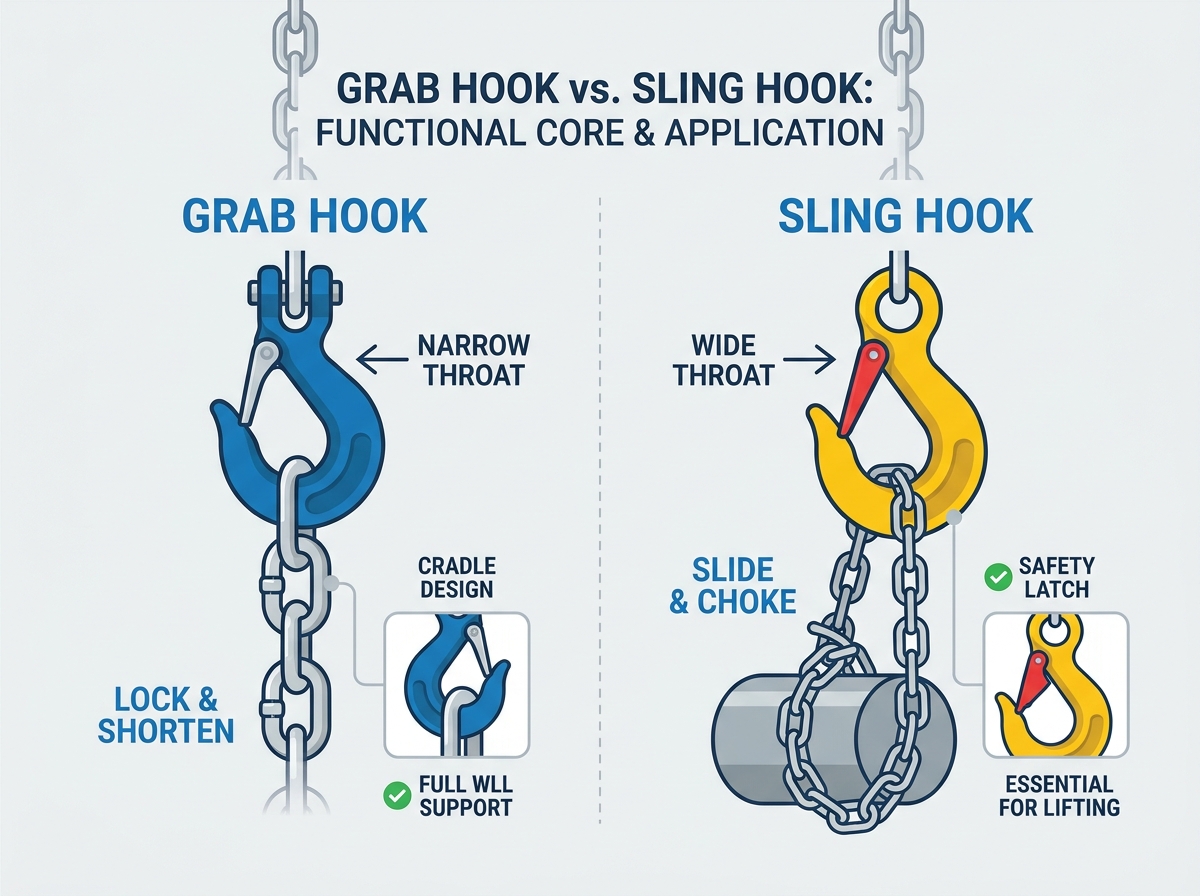
Engineers design this hardware utilizing a narrow, parallel throat. The primary function focuses entirely on movement control. It literally grabs a single link of a chain hook assembly. This precise narrow channel stops the entire line from sliding further. You lock the load firmly at an exact, predetermined length.
You must consider specific variations in the profile. We categorize them primarily as standard or cradle profiles. Cradle designs feature a contoured, curved saddle. They provide full support to the engaged link. This underlying structural support prevents unwanted deformation under heavy stress. Using a cradle profile helps you maintain 100% of the Working Load Limit. Standard profiles lack this saddle completely. They often induce sharp stress points on the engaged link.
This design contrasts sharply by utilizing a wide, rounded throat. The core function actively promotes line movement. It allows the chain or wire rope to pass through the opening freely. You rely on this sliding motion to cinch irregular loads tightly.
One crucial feature stands out for this sliding design. It almost universally requires a heavy-duty safety latch. You depend on this latch to keep the load seated securely. It keeps the sling trapped inside the bowl during slack conditions. If tension drops momentarily during a crane operation, the latch prevents accidental disconnects. We constantly emphasize checking these latches before every shift.
Evaluating your gear requires analyzing performance outcomes alongside rigid safety protocols. We cannot afford guesswork during the selection phase.
Your end goal heavily dictates your specific hardware selection. If your goal requires chain length adjustment, you need the narrow throat option. If you require rigid point-to-point tension, choose a grab hook. It isolates tension highly efficiently.
Alternatively, your goal might involve cinching an asymmetrical load. This requires forming a choker hitch. You might also need to accommodate thick synthetic straps or bulky wire slings. In these situations, you must deploy a sling hook. The broader throat accommodates thicker materials effortlessly without pinching or cutting them.
Application Performance Chart
| Application Goal | Preferred Hardware Profile | Line Movement Allowed |
|---|---|---|
| Adjusting multi-leg sling length | Narrow Throat / Locking | None |
| Point-to-point rigid towing | Narrow Throat / Locking | None |
| Choking cylindrical pipes | Wide Throat / Sliding | High |
| Lifting bundled lumber | Wide Throat / Sliding | High |
Rigging hardware constantly faces strict regulatory scrutiny. ASME B30.10 standards dictate proper usage limits universally. Using a standard, non-cradle design in a choker configuration creates extreme risk. It can reduce the chain’s overall Working Load Limit by up to 20%. This reduction occurs due to severe point-loading on the individual link. You compromise the structural integrity immediately.
Standard safety protocols also govern sliding configurations rigorously. You must never use overhead lifting hardware without a fully operational latch. The component must possess a self-closing latch to meet fundamental ASME safety protocols. Removing a damaged latch instantly violates compliance rules.
Evaluating the alloy grade remains an absolute non-negotiable step. You cannot mix metallurgical grades arbitrarily across your assemblies. A G80 hook must pair exclusively with Grade 80 components. Grade 100 hardware operates under identical matching rules. You must use these specific, high-strength grades for any overhead lifting tasks. They offer the necessary elongation properties needed to absorb sudden dynamic forces.
Grade 70 transport chains serve entirely different purposes. They are strictly designed for ground tie-downs and flatbed towing. You must never use Grade 70 hardware for overhead suspension. It lacks the elastic stretch required for overhead lifting. Mixing an overhead grade with a transport grade creates a dangerous weak link.
Beyond the throat design, you must select the correct base attachment. This specific base dictates how the component connects physically to your broader assembly.
A clevis base features a distinct U-shaped opening at the bottom. It utilizes a removable load pin for fast, secure attachment.
The pros of this design focus entirely on speed and simplicity. A clevis grab hook attaches directly to the chain. You do not need a separate mechanical coupling link. You simply pull the cotter pin, remove the load pin, seat the chain link, and re-secure it. This direct attachment allows you to install or replace parts quickly out in the field.
The cons revolve around strict size limitations. These attachments remain extremely size-specific. A 3/8-inch clevis base will only accept a 3/8-inch chain. You cannot force a mismatched line into the U-shaped bracket safely.
An eye base features a closed, seamlessly welded loop at the top. It forms a solid, unbroken ring of high-strength metal.
The pros focus heavily on articulation and versatility. This base requires a mechanical coupling link (often called a hammerlock) to attach. However, it offers superior articulation and flexibility under varied tension. You can use it alongside wire rope thimbles or flat synthetic slings. This extreme flexibility allows it to function as a highly versatile lifting hook in diverse environments.
The cons center entirely on assembly complexity. You require additional rigging hardware like couplers or specialized shackles. This extra hardware increases the overall weight and complexity of your lifting assembly.
Table: Hardware Connection Typology Comparison
| Attachment Type | Primary Advantage | Primary Disadvantage | Best Use Case |
|---|---|---|---|
| Clevis Base | Direct, fast attachment | Extremely size-specific | Field repairs, standard chain slings |
| Eye Base | High multi-material versatility | Requires additional couplers | Wire rope, synthetic sling assemblies |
Theoretical knowledge must translate safely into daily real-world applications. Operators face distinct physical scenarios and critical implementation risks on every shift.
You see these heavily utilized in specific, high-tension scenarios requiring absolute stability.
They dominate transport tie-downs on heavy flatbeds. You will find them constantly in heavy-duty towing assemblies. They also appear frequently in multi-leg chain slings. Operators use them here to meticulously adjust the length of individual legs. This crucial adjustment helps balance an asymmetrical load safely before the crane begins lifting.
The biggest implementation risk involves mismatching the chain size to the throat width. Forcing a larger chain into a smaller throat creates severe micro-fractures in the metal. Conversely, using a smaller chain in a larger throat causes dangerous slippage. It often results in sudden shock-loading. This violent shock can easily snap the entire assembly.
These models excel strictly where lines must move and adapt to changing shapes.
You deploy them for complex overhead lifting operations. They shine brightly when the rigging requires a choker hitch. Operators wrap the line around pipes, heavy lumber, or irregular cylindrical loads. The line slips efficiently through the throat to bite down hard on the material as tension increases.
The most prevalent implementation danger remains latch failure. Heavy swinging loads can accidentally crush or bend the safety mechanism. If the latch becomes bent, broken, or completely removed, you face a severe compliance violation. The rigging hook must be immediately removed from active service. There are zero regulatory exceptions for damaged latches.
Selecting the right component requires a highly systematic approach. Follow this standardized decision matrix to ensure safety and compliance.
Your specific daily application environment governs your hardware choices entirely.
A: Yes, provided it is explicitly rated for overhead lifting. It must be forged from Grade 80 or Grade 100 alloy. You must also use it strictly for chain length adjustment. You should never use it for choking the load directly.
A: A standard profile can reduce the chain assembly's WLL by roughly 20%. This reduction happens due to extreme shear stress applied directly to the engaged link. Using a cradle-style design generally preserves 100% of the assembly's WLL.
A: The industry largely uses these terms synonymously. Both feature a wide throat designed to let the chain slip through. However, the term "sling hook" usually implies an overhead-rated component equipped with a safety latch. "Slip hook" is more commonly used in ground-based tie-down or towing contexts.


